Clear Sky Science · en
Experimental study and evaluation analysis on the plugging mechanism of sand control screen in argillaceous Fine-Silt gas hydrate reservoirs
Why tiny grains matter for future energy
Natural gas hydrates—often called “combustible ice”—could become a major future energy source, especially in deep oceans like the South China Sea. But producing gas from these icy deposits can wash huge amounts of fine sand and clay into wells, clogging the filters that keep wells safe. This study explains why that clogging happens in especially troublesome clay‑rich sediments, and how a new life‑size laboratory device helps engineers design better well screens and operating practices.
Wells that choke on their own sand
In many oil and gas fields, loose sand is held in place with metal screens that let fluids through but block grains. In hydrate reservoirs made of very fine silt and a lot of clay, this job becomes far harder. The grains are only about one hundredth the width of a grain of table salt, and clay can make up a quarter of the rock. When hydrates melt during production, the solid “ice” that once glued the grains together disappears. Gas and water rush through, dragging fine particles toward the well. If too much sand enters, it erodes equipment; if the screen plugs, production collapses. Until now, most tests of sand control equipment were small, vertical lab setups that could not mimic long, tilted or horizontal wells, nor the complex behavior of clay swelling and moving with flowing water.
A full‑scale window into the wellbore
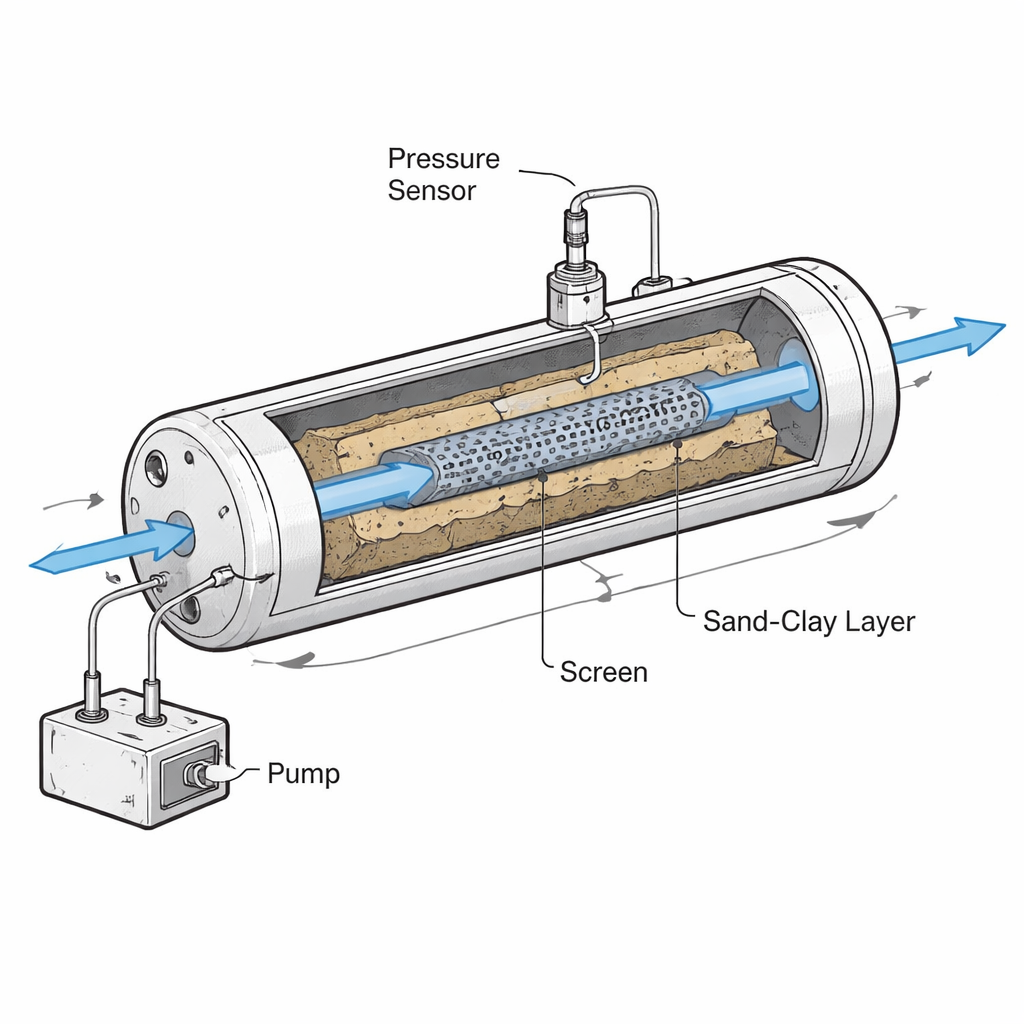
To bridge this gap, the authors built a full‑scale testing device that closely imitates conditions around a real hydrate well. A long, high‑pressure vessel holds a commercial sand control screen surrounded by layers of artificial sediment made from sand and clay. Pumps push water and suspended particles radially through this “mini reservoir” into the screen, while sensors track flow rates and pressures at several points. Crucially, the entire vessel can be tilted from vertical to fully horizontal, so the same screen can be tested under different well angles. After each test, the researchers open the vessel to see exactly where and how the screen has plugged, and they calculate how its permeability—its ability to pass fluid—changes over time.
How clay turns from helper to saboteur
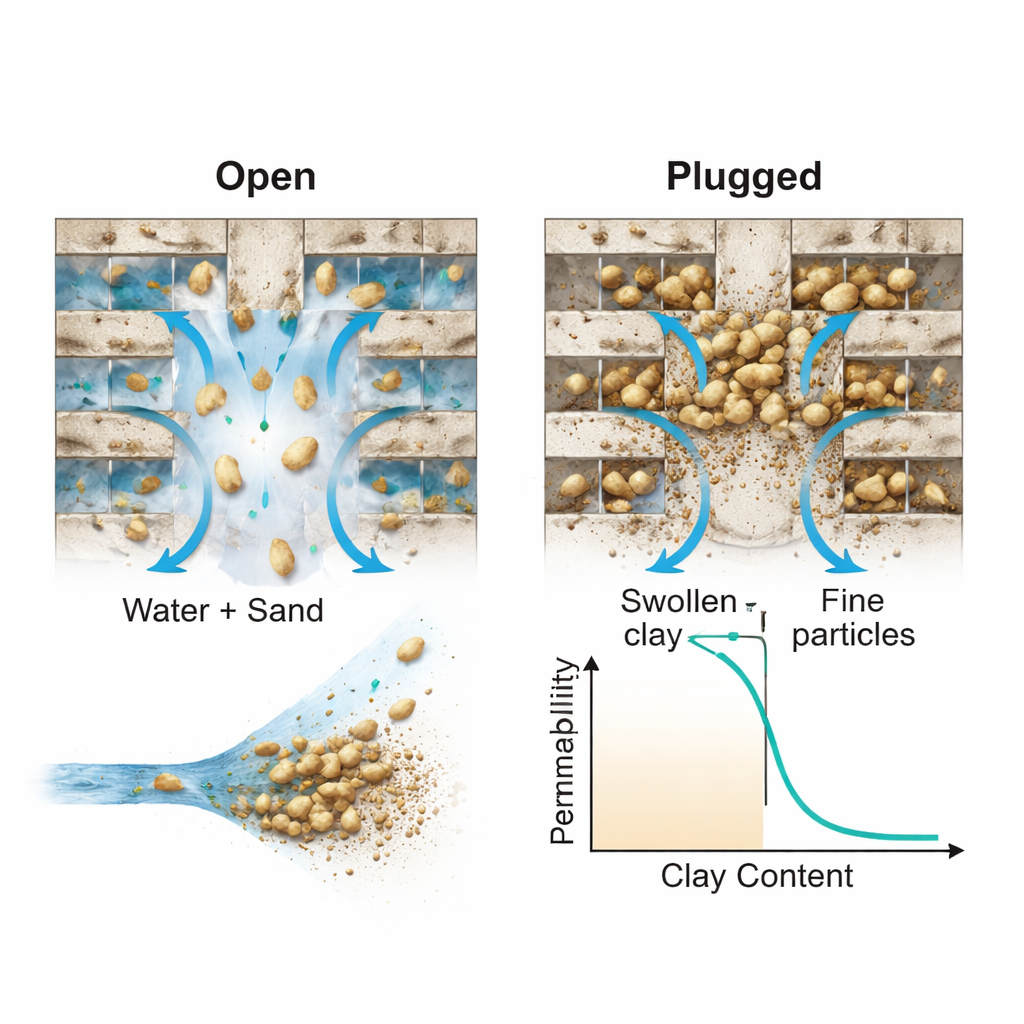
By comparing pure sand fillings with mixed sand‑and‑mud layers, the team showed that clay‑rich zones are far more damaging. In mixed layers, water causes clay to hydrate and swell, squeezing pore spaces and driving very fine particles deep into the screen’s filtering layer. Because this layer has irregular, tortuous pores, the particles are easy to trap and hard to flush out. Pressures near the well and across the screen climbed much higher than in pure sand tests, and parts of the screen mesh even deformed under the buildup. Systematic experiments varying “argillaceous” (clay‑rich) content revealed a sharp threshold: once the clay fraction reached about 55 percent, screen permeability dropped suddenly. At 80 percent clay, the screen was almost completely blocked, with pressures surging and virtually no flow through the metal fabric.
Angles, minerals and flow rates: what really matters
The study also teased apart several other influences. Changing the mineral makeup of the clay, especially the share of the strongly swelling mineral montmorillonite, modified how the surrounding formation behaved but had only modest direct impact on how badly the screen itself plugged. Tilting the well from vertical to horizontal did reduce screen permeability—from about 426 to 300 millidarcies—but this effect was relatively gentle compared with the role of total clay content. Production rate, in contrast, played a strong and subtle role. At low to moderate flow rates, plugging built up rapidly, cutting permeability. As rates increased, the faster fluid could partly scour away deposits, causing permeability to fluctuate and then level off. In clay‑rich layers, the upper part of the screen became a natural “plugging hot spot,” where gravity and low local flow allowed fine particles to settle and stick.
Finding the sweet spot for safe, steady production
For non‑specialists, the main message is that producing gas from fine, muddy hydrate sediments requires walking a tightrope. If operators push wells too hard, they stir up more particles and risk rapid clogging; if they are too gentle, the well may never reach useful output. The new full‑scale device shows that overall clay content and production rate are the two levers that matter most, while well angle and specific clay minerals are secondary. The authors recommend designing screens and gravel packs specifically for these sticky sediments, carefully tuning production pressure and rate, and paying special attention to the upper portions of horizontal screens where plugging tends to start. With these insights, engineers can better keep wells flowing—and bring hydrate resources online—without having them strangled by their own sand and clay.
Citation: Wang, Ec., Liao, H. & Zhang, He. Experimental study and evaluation analysis on the plugging mechanism of sand control screen in argillaceous Fine-Silt gas hydrate reservoirs. Sci Rep 16, 6227 (2026). https://doi.org/10.1038/s41598-026-37333-0
Keywords: gas hydrate reservoirs, sand control screens, clay plugging, well productivity, experimental simulation