Clear Sky Science · en
Accuracy of DentalMonitoring’s artificial intelligence in detecting common orthodontic braces treatment related emergencies
Why smarter braces matter
Anyone who has worn braces—or has a child in braces—knows that things can go wrong between checkups: a bracket pops off, a tiny wire tie breaks, or a clip opens and starts poking the cheek. These problems are often uncomfortable, can slow down treatment, and are not always noticed right away. This study looks at whether an artificial intelligence (AI) system, used with a smartphone at home, can reliably spot these small but important issues so that orthodontists can step in sooner.
Bringing the orthodontic visit to your phone
The researchers evaluated a system called DentalMonitoring, which combines a patient smartphone app, a cloud-based AI program, and an online dashboard for orthodontists. Patients place a simple camera aid in their mouth and record short scan sessions at home, guided by the app. The images are uploaded to secure servers, where AI software automatically inspects each tooth and bracket for a range of potential problems, then sends alerts and visual summaries to the orthodontist’s dashboard. 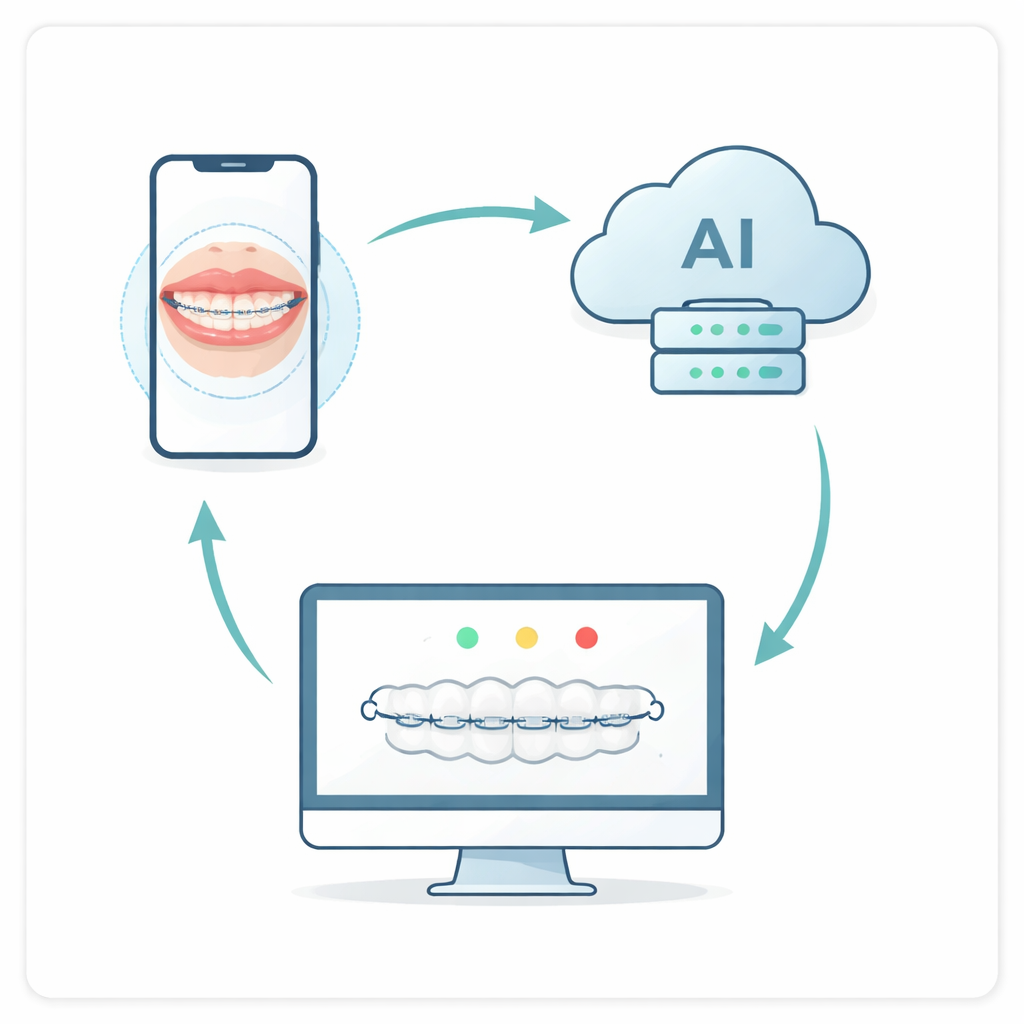
What kinds of problems were tested
This study focused on three very common issues with fixed braces. First was bracket debonding—a bracket that has come loose or fallen off the tooth. Second was an open self-ligating clip, a small metal door on some modern brackets that can spring open and stop holding the wire correctly. Third was tie loss, when the tiny elastic or wire tie that secures the archwire to a traditional bracket goes missing. These events may not always hurt, but they can quietly stall tooth movement or even lead to swallowing of loose parts, especially in children and teenagers.
How the study was carried out
The team analyzed scans from 1,014 real patients using braces in multiple orthodontic offices across the United States. All patients were at least 13 years old and wore either traditional metal, ceramic, or self-ligating brackets. For each scan, the AI produced its assessment for every tooth, while three independent orthodontic experts carefully reviewed the same images. Their combined judgment, resolved by discussion and, when needed, a fourth outside expert, was treated as the “ground truth.” The researchers then compared the AI’s answers with this expert standard to see how often the system correctly identified problems and how often it gave false alarms or missed an issue.
How accurate was the artificial intelligence
The AI proved to be highly accurate across all three types of incidents. For loose or missing brackets, it correctly caught about 98 out of 100 cases and almost never raised a false alarm. For missing ties, it correctly flagged about 93 out of 100 real problems, with a similarly strong ability to recognize when everything was normal. Open clips on self-ligating brackets were a bit more challenging, but the system still correctly identified roughly 9 out of 10 real issues. 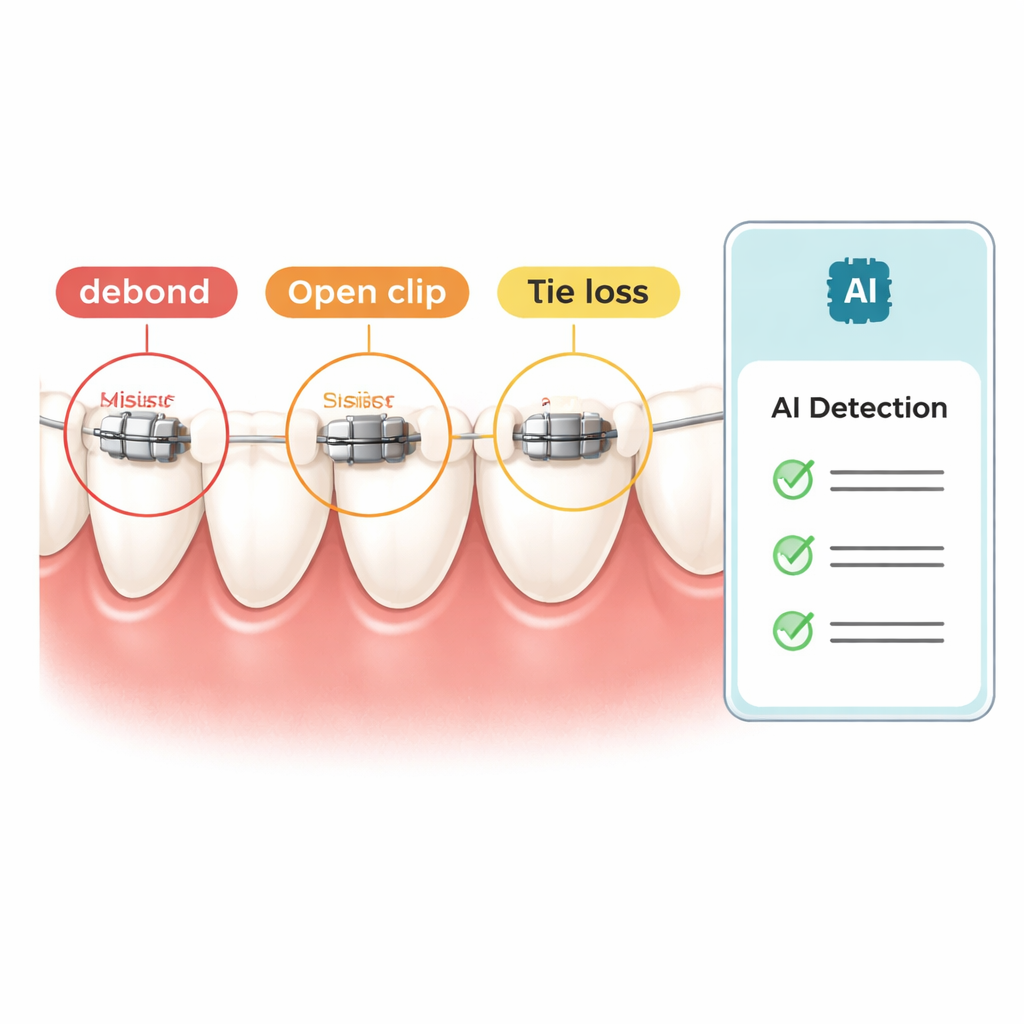
What this means for patients and dentists
The findings suggest that AI-assisted remote monitoring can serve as an extra safety net for people in braces. By reliably detecting loose brackets, missing ties, and open clips between office visits, systems like DentalMonitoring can alert orthodontists to contact patients sooner—sometimes before the patient realizes anything is wrong. This can reduce the number of undetected emergencies, limit treatment delays, and potentially shorten the overall time in braces, all while cutting down on unnecessary trips to the office. In plain terms, the study shows that carefully designed AI tools can help make orthodontic care more convenient, responsive, and secure for patients without replacing the expertise of the orthodontist.
Citation: McCray, J.F., Smith, L., Handlin, D. et al. Accuracy of DentalMonitoring’s artificial intelligence in detecting common orthodontic braces treatment related emergencies. Sci Rep 16, 6627 (2026). https://doi.org/10.1038/s41598-026-37329-w
Keywords: orthodontic emergencies, artificial intelligence, remote dental monitoring, braces problems, teledentistry