Clear Sky Science · en
Flexural strengthening of RC beams using basalt textile reinforced mortar: experimental and analytical investigation
Stronger bridges and buildings with a thin new jacket
Many aging bridges, parking garages, and buildings rely on reinforced concrete beams that were never designed for today’s heavier traffic and longer lifespans. Fully replacing these beams is disruptive and expensive, so engineers are searching for clever ways to upgrade existing structures from the outside. This study examines one such method: wrapping beams with a thin, cement-based jacket that contains basalt fibers arranged like fabric, aiming to boost strength and safety without major demolition.
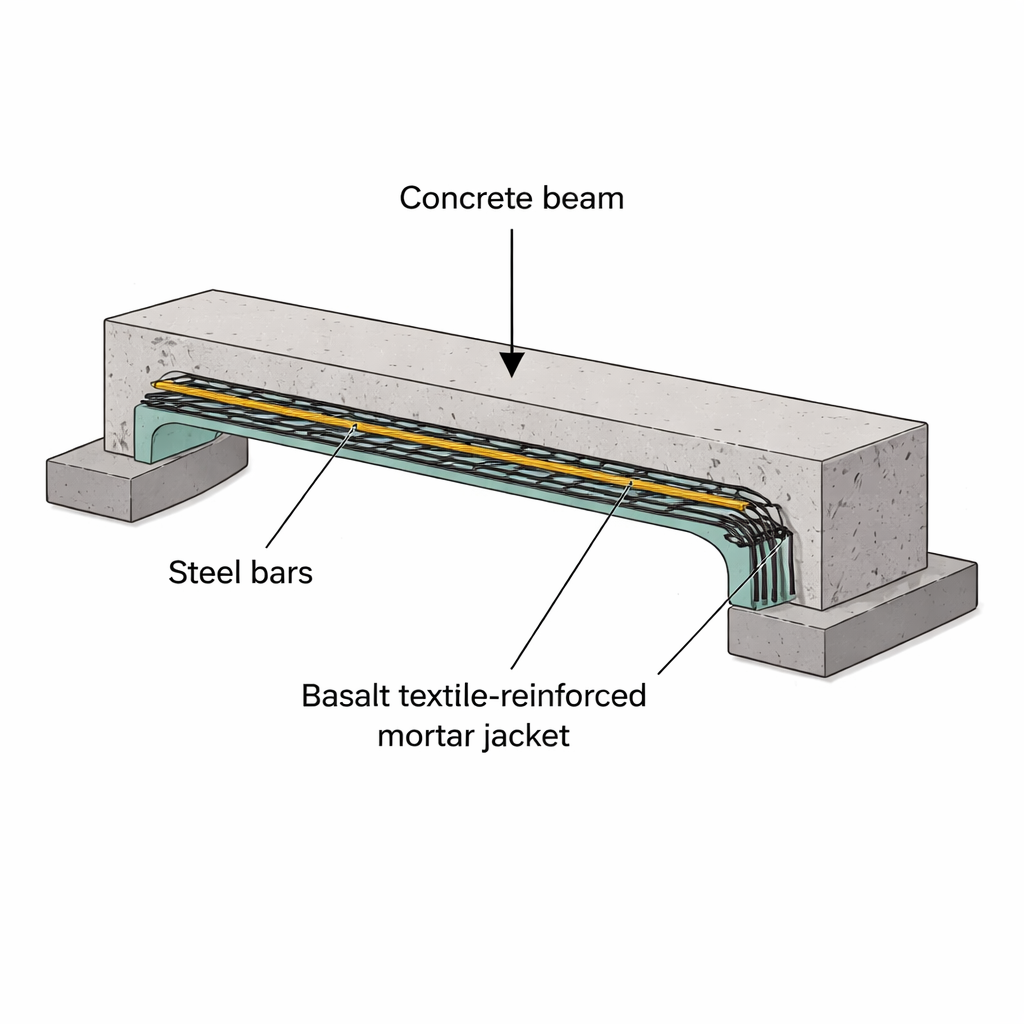
Wrapping tired concrete in a fiber-rich skin
The researchers focused on reinforced concrete beams, the workhorses that carry floors and bridge decks. Over time, steel inside these beams can corrode and concrete can weaken, cutting into the safety margin. A promising repair technique is Textile Reinforced Mortar (TRM), in which a fine fiber mesh is embedded in a thin mortar layer that is bonded to the outside of the beam. Unlike conventional fiber-reinforced polymers that use epoxy resins and can lose strength in heat or on damp surfaces, TRM uses a cement-based mortar that tolerates moisture and high temperatures better.
Why basalt textiles are an attractive option
This study zooms in on a particular kind of TRM made with basalt fibers, called Basalt Textile Reinforced Mortar (BTRM). Basalt fibers are drawn from volcanic rock and offer high strength, good corrosion resistance, and potentially lower cost than carbon fibers. The team wanted to know how different design choices—such as the number of textile layers, the size of the mesh openings, adding slender basalt bars inside the jacket, and using mechanical anchors—affect how much stronger and tougher reinforced concrete beams become when they are wrapped with BTRM.
Putting real-size beams to the test
To answer these questions, the researchers cast six full-scale concrete beams, each 2.3 meters long and reinforced inside with steel bars just like in real structures. One beam served as an unstrengthened reference, while the other five were wrapped with various BTRM jackets applied in a U-shape around the bottom and lower sides. Some beams received three layers of basalt textile, others five or even eight layers; some used a fine 5-millimeter textile mesh and others a coarser 34-millimeter mesh; one version included extra basalt bars within the jacket; and another used steel anchors glued into the concrete to help hold the jacket in place. All beams were loaded in a testing machine until they failed while instruments recorded how much load they carried and how far they bent.
Modest strength gains, but a stubborn weak link
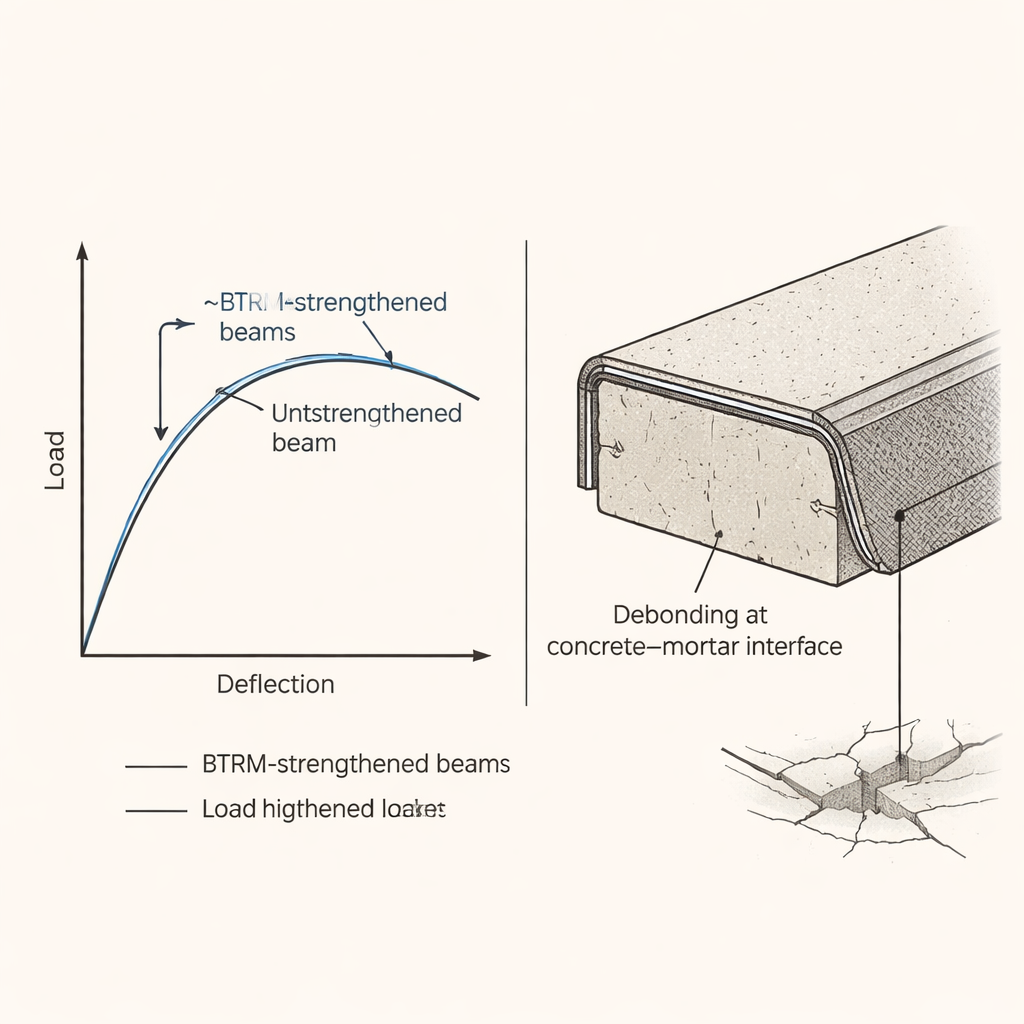
The strengthened beams carried between 11 and 18 percent more load than the unwrapped control beam before failing, confirming that BTRM can give an immediate boost in capacity. However, adding more textile layers did not continually increase strength; beams with three and five layers reached almost the same ultimate load, showing that benefits plateau once the bond between the jacket and the concrete becomes the governing weakness. The size of the mesh openings (5 versus 34 millimeters) made little difference to overall strength, and the added basalt bars improved performance only slightly, mainly by making the post-cracking behavior smoother and more energy-absorbing. Mechanical anchors helped the beams bend further before failure, but they did not raise the maximum load much because failure still occurred when the entire jacket peeled away from the concrete surface. In almost every strengthened beam, the mortar-and-textile layers stayed intact and separated cleanly from the concrete, revealing that the main problem lies at the concrete–mortar interface.
Sharper design tools for safer retrofits
Beyond the laboratory tests, the authors checked how well existing calculation methods predict the strength of such strengthened beams. Common design formulas tended to underestimate the actual capacity when they used very conservative strain limits for the textile, or to overestimate the gain when they assumed perfect bonding between jacket and concrete. By carefully comparing predictions with test data, the researchers proposed a refined, easy-to-use equation that better reflects real behavior when bonding is imperfect, and suggested safely increasing the allowable textile strain used in design. This modified formula closely matched their own test results and published data from other laboratories.
What this means for real-world structures
For non-specialists, the main message is that wrapping existing concrete beams with a thin basalt textile and mortar jacket is a practical way to gain roughly 10 to 20 percent extra strength and improve how gently beams fail, which can buy valuable safety and service life. However, the full potential of basalt textiles is currently held back not by the fibers themselves but by how well the jacket grips the old concrete. Improving surface preparation, bonding materials, and anchorage details will be crucial next steps to make this technique a more powerful and predictable tool for strengthening the world’s aging concrete infrastructure.
Citation: Shamseldein, A., ELgabbas, F., Kohail, M. et al. Flexural strengthening of RC beams using basalt textile reinforced mortar: experimental and analytical investigation. Sci Rep 16, 7382 (2026). https://doi.org/10.1038/s41598-026-37322-3
Keywords: reinforced concrete strengthening, basalt textile reinforced mortar, textile reinforced mortar, flexural behavior of beams, structural retrofitting