Clear Sky Science · en
Coating evaluation methodology for low-temperature thermographic application
Seeing Heat More Clearly
Infrared cameras let us “see” heat without touching what we measure, whether it is a building wall, an aircraft part, or human skin. But there is a catch: shiny or poorly known surfaces can fool the camera and lead to temperature errors of several degrees. This paper explains how to design and test special black coatings, sprayed onto a surface, so that infrared cameras can read temperature more accurately and reliably in everyday low-temperature situations.
Why Surface Coatings Matter
Infrared cameras do not measure temperature directly; they detect invisible thermal radiation leaving a surface. How strongly a surface emits this radiation is called its emissivity. Bright metals, for example, emit poorly and reflect a lot of surrounding radiation, so an infrared camera can confuse reflections with true surface heat. The authors show that one practical solution is to cover such tricky surfaces with a well-behaved reference coating. This coating should act like a stable, almost perfectly black skin that dominates what the camera sees, regardless of what lies underneath.
The Four Jobs of an Ideal Coating
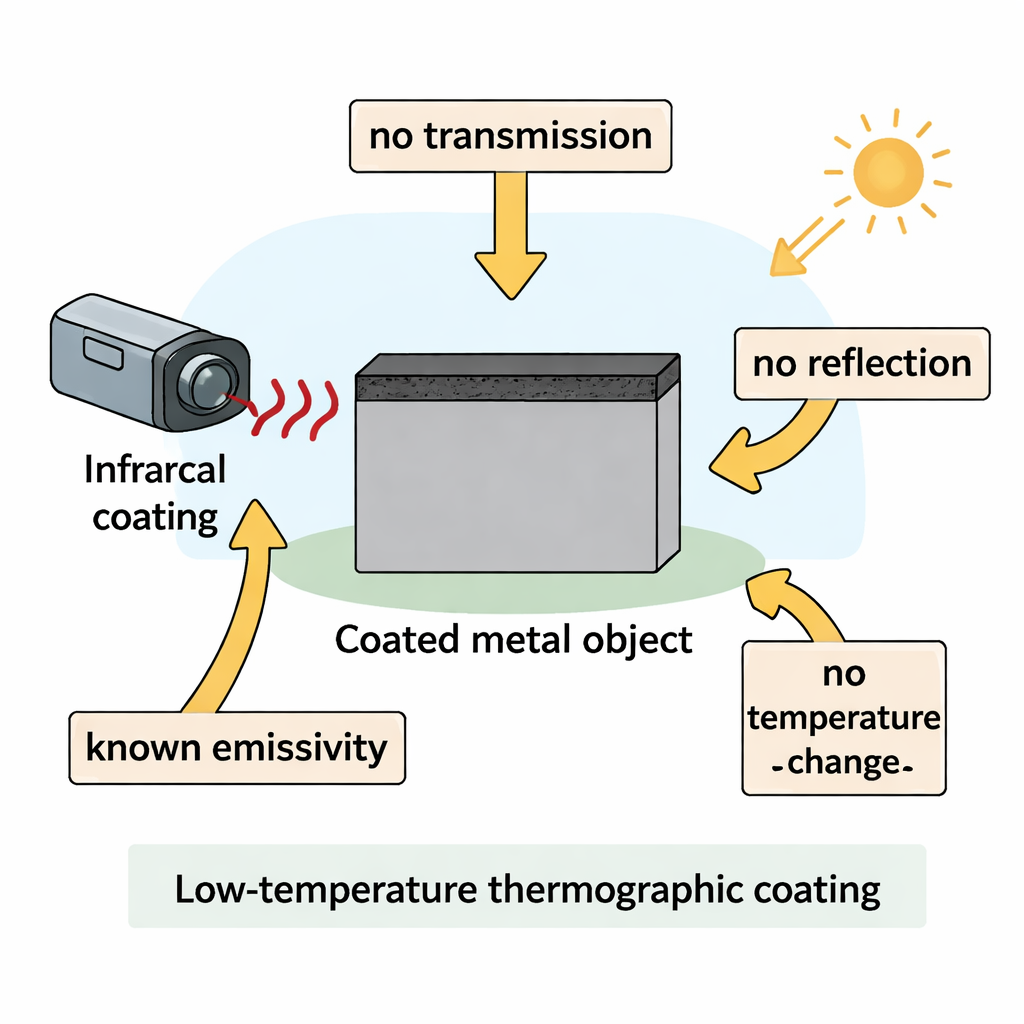
According to the study, a good thermographic coating must do four things at once. First, it should block radiation coming from the underlying material, rather than letting it shine through. Second, it should absorb almost all incoming radiation instead of reflecting the surroundings into the camera. Third, it must not act like thermal insulation that significantly cools or heats the surface just by being there, which means it should be thin and reasonably conductive to heat. Fourth, its effective emissivity for a given camera and viewing angle must be known and stable, so users can enter a reliable number into their software instead of guessing. The coating also needs to be easy to spray on, uniform over large areas, and mechanically and thermally stable up to the intended operating temperature.
Three-Step Testing Roadmap
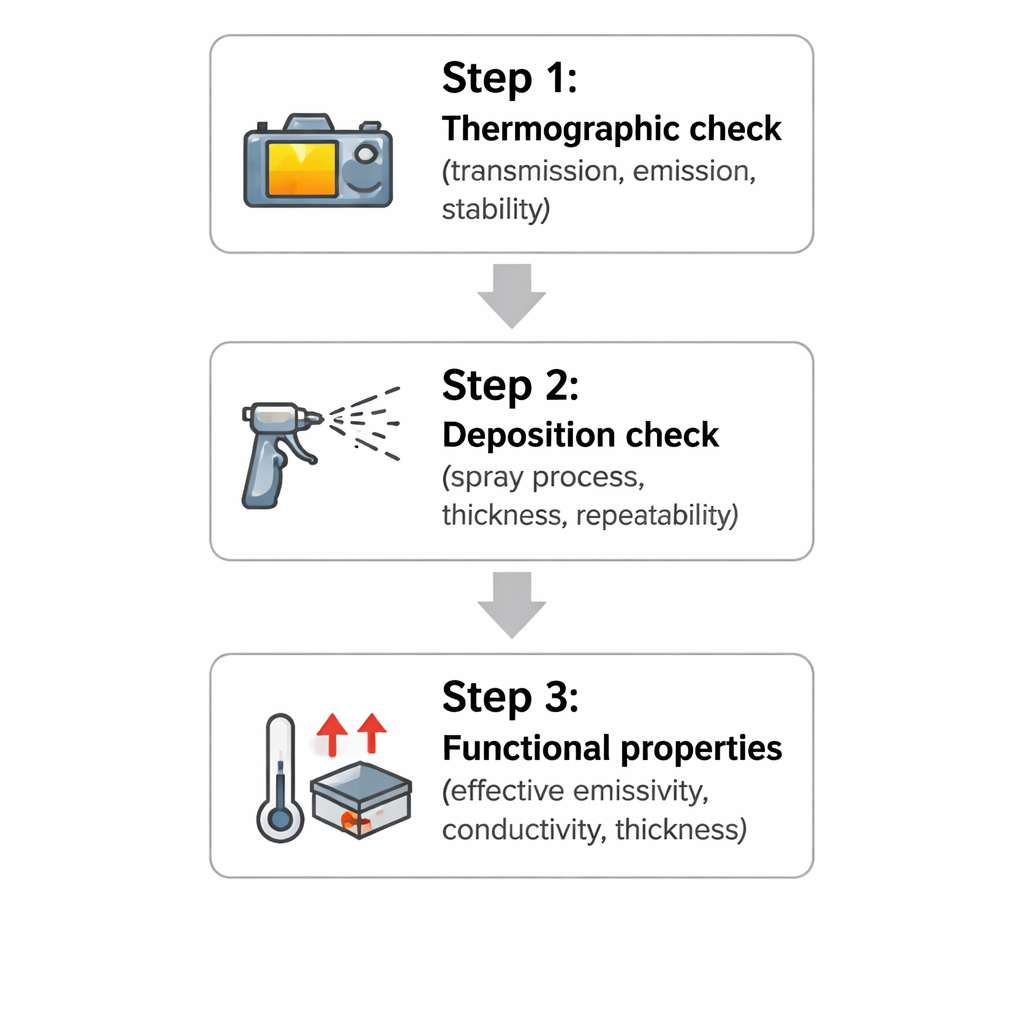
The authors present a structured, three-step methodology for checking whether a commercial spray paint can serve as such a reference coating. In Step 1, they perform a “thermographic check” using infrared-sensitive spectrometers to measure how much radiation the coating transmits and emits over the same wavelength range as a typical camera (7.5–13 micrometers). They then heat coated samples once to 120 °C and repeat the measurements at room temperature to see whether the properties changed. Strict cut-off values are used: transmission must be at or below 1%, emissivity at or above 0.7, and changes after heating must stay within 1 percentage point, with no visible cracking or peeling.
From Spray Can to Reliable Layer
Step 2 tackles something more down-to-earth: how to spray the coating so that anyone can reproduce it. The team tests a specific aerosol product (LabIR HERP-LT) by having several operators spray multiple samples using a defined distance, speed, and number of passes. They check how layer thickness, transmission, and emissivity vary from sample to sample. For the chosen spray paint, eight slow passes from 30 cm created a layer about 45–50 micrometers thick with transmission below 1% and emissivity near 0.95, and these values were highly repeatable. They also estimate how much coating is needed to cover one square meter, an important practical detail for real-world users.
Pinning Down Performance Numbers
In Step 3, the authors determine the key numbers engineers actually need. Using heated plates and infrared cameras, they measure the effective emissivity of the coating as seen by a real camera at different viewing angles. For the tested coating, emissivity is about 0.96 when the camera looks almost straight on, but it decreases as the angle becomes more grazing, especially above about 50 degrees. They also monitor emissivity over 40 minutes at 100 °C and find it remains very stable. Finally, they measure thermal conductivity and confirm that, although the coating is relatively poor at conducting heat, its effect is accounted for by defining emissivity with respect to the temperature at the interface between coating and base material.
What This Means in Practice
For non-specialists, the message is that simply using a “black paint” is not enough to guarantee accurate infrared temperature readings. The coating must be checked and characterized in a systematic way, as described in this three-step roadmap. When a coating passes all the criteria, as the tested spray did for temperatures up to 120 °C, it becomes a trustworthy tool: users can spray it on troublesome surfaces and confidently convert camera images into real temperatures, improving diagnostics in fields ranging from energy audits to component testing.
Citation: Honnerová, P., Veselý, Z., Matějíček, J. et al. Coating evaluation methodology for low-temperature thermographic application. Sci Rep 16, 6090 (2026). https://doi.org/10.1038/s41598-026-37319-y
Keywords: infrared thermography, emissivity coating, non-contact temperature, thermal imaging, surface coatings