Clear Sky Science · en
Melanophore and fluoroleucophore photo-protect the Arabian killifish, Aphanius dispar, embryo from ultraviolet light
Why tiny fish embryos need a natural sunscreen
Many fish spend their lives in shallow, sun‑drenched waters where even their eggs and embryos are bathed in intense ultraviolet (UV) light. Just as our skin can burn, this radiation can damage the DNA and cells of developing fish. This study explores how the embryos of the Arabian killifish, a hardy desert fish, protect themselves from UV using two kinds of built‑in pigments: classic dark “ink” and unusual fluorescent “glow‑in‑the‑dark” spots.
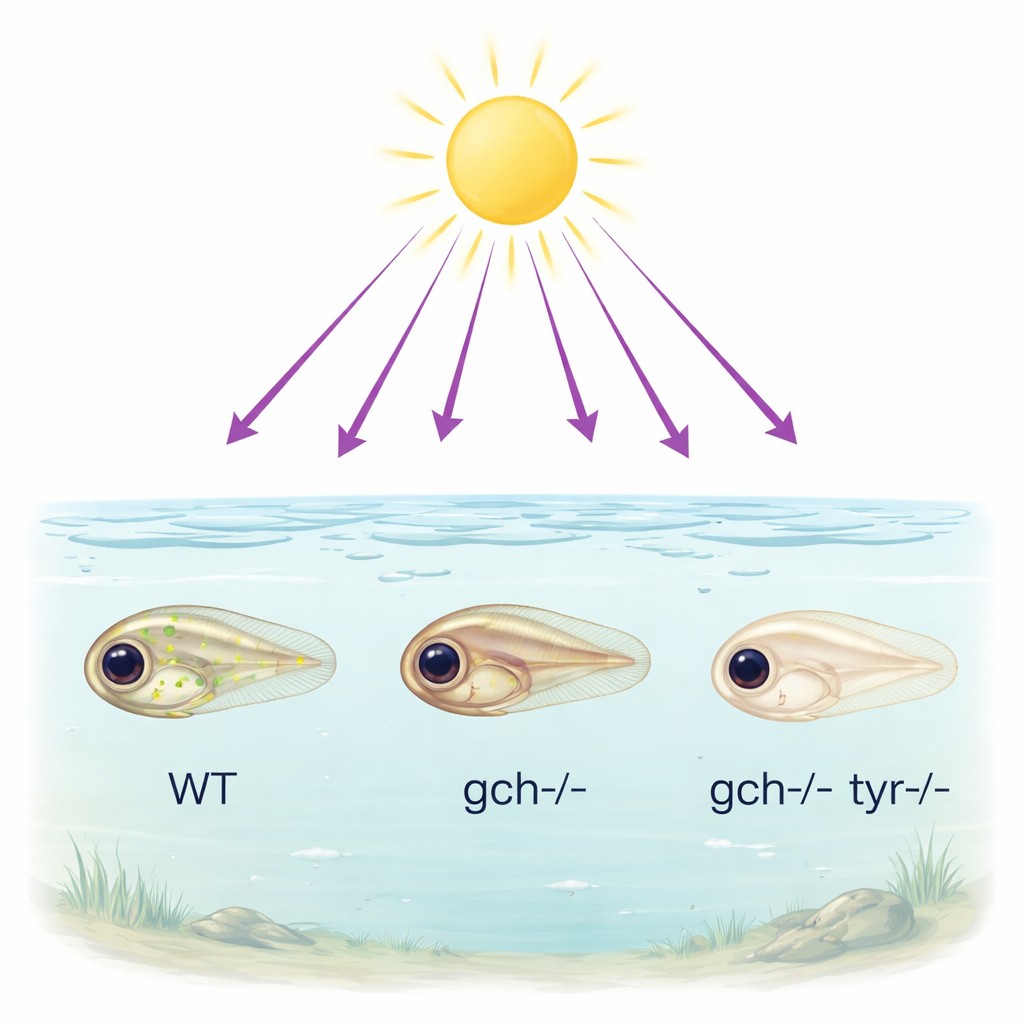
Desert fish living under harsh sunlight
The Arabian killifish (Aphanius dispar) inhabits hot, shallow rivers, estuaries and coastal pools across the Middle East, where shade is scarce and water can reach 40 °C. In these bright, open habitats, both adults and embryos are exposed to intense sunlight from the moment the eggs are laid. Earlier work showed that the embryos develop several layers of pigment cells very early: dark melanophores, strongly fluorescent fluoroleucophores, and reflective iridophores, stacked like a protective shield. This suggested that pigment might do more than create colour patterns – it might act as a living sunblock.
Two kinds of built‑in shields
To test this idea, the researchers used CRISPR/Cas9 gene editing to create Arabian killifish that lacked one or both pigment types. One mutant line (gch−/−) could no longer make the fluorescent pteridine pigment in fluoroleucophores. A second line (gch−/− tyr−/−) lost both the fluorescent pigment and the dark melanin pigment in melanophores, producing near‑albino fish. While adults with only the fluorescent pigment removed looked similar to normal fish, the double mutants were visibly pale, with a loss of dark colour in the skin and eyes. In embryos, these changes were even clearer, allowing a direct comparison of how different pigment combinations affect UV protection.
Testing embryos with intense UV light
The team exposed four‑day‑old embryos from normal, single‑mutant, and double‑mutant fish to strong ultraviolet‑C (UVC) light, a very energetic form often used in laboratory tests of UV damage. They then monitored survival for several days, checked heart rates, and examined the shape and spacing of pigment cells on the yolk surface. They also measured activity of stress‑related genes linked to oxidative damage, protein damage, and DNA repair. Even under doses that are lethal to zebrafish embryos, Arabian killifish embryos proved strikingly robust, hinting that their lifestyle under harsh sun has favoured exceptional UV resistance.
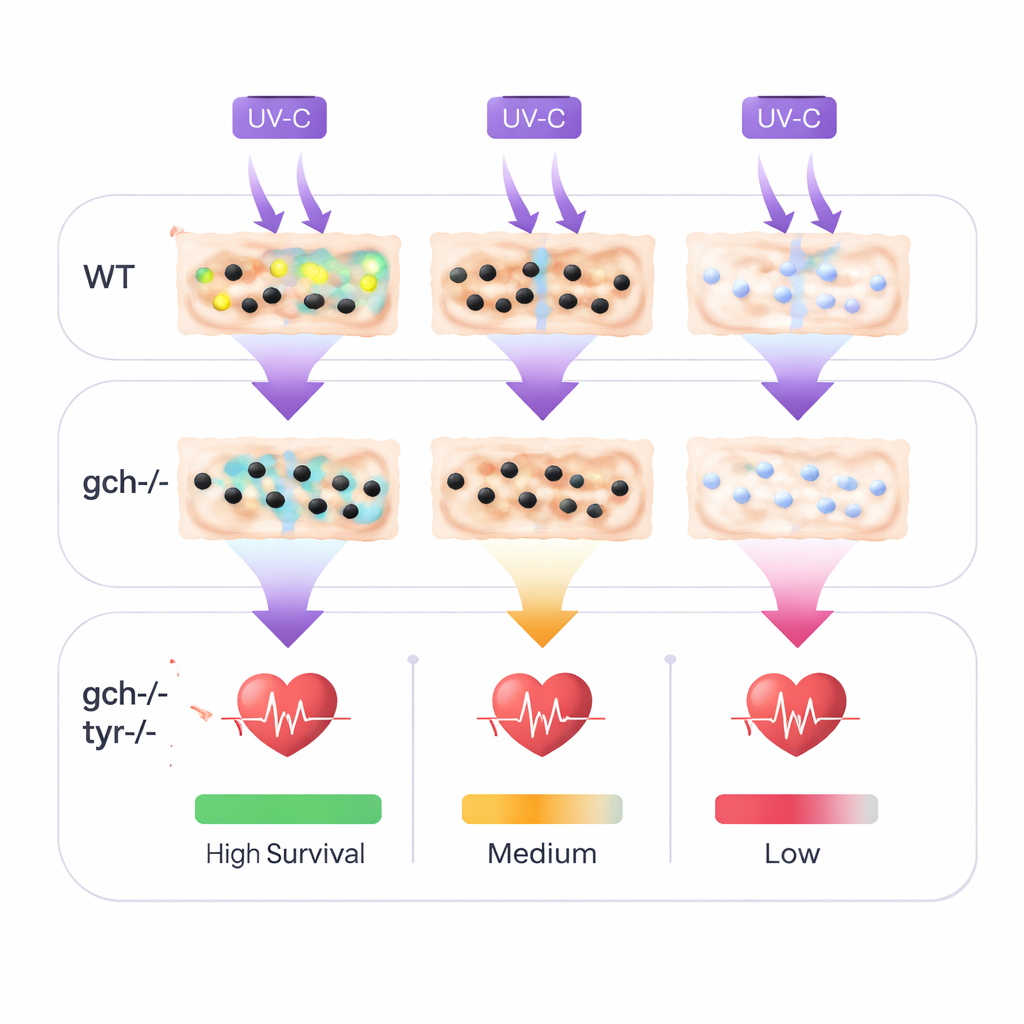
What happened when the shields were removed
Despite this overall toughness, pigment made a clear difference. Embryos lacking both pigments (gch−/− tyr−/−) were the most vulnerable: they showed the highest death rates as UV dose increased, the strongest slowing of heartbeats, and the greatest activation of a key “stop and repair” gene that halts the cell cycle after DNA damage. Embryos missing only the fluorescent pigment (gch−/−) were intermediate – more sensitive than normal fish but less fragile than the double mutants. Across all lines, pigment cells clumped together and changed shape after UV exposure, suggesting an active response to light. At the molecular level, all embryos turned on a gene associated with general oxidative stress, but mutants, especially the double mutants, showed far stronger signals in genes tied to protein damage and DNA repair, indicating heavier cellular injury when pigment was absent.
What this means for nature and for us
Together, the results show that both dark melanin and fluorescent pteridine pigments act as biological sunscreens in Arabian killifish embryos. Melanin strongly limits damage that forces cells to shut down division, while the fluorescent pigment appears to reduce heat and DNA damage, possibly by safely re‑emitting absorbed light. Without these pigments, even this naturally UV‑hardy species suffers greater stress and mortality. Beyond explaining how a small desert fish survives under punishing sunlight, the work points to fluorescent pigments like pteridines as promising, eco‑friendly molecules that could inspire new sunscreen technologies and help improve UV protection in aquaculture species.
Citation: Alenize, M., Minhas, R. & Kudoh, T. Melanophore and fluoroleucophore photo-protect the Arabian killifish, Aphanius dispar, embryo from ultraviolet light. Sci Rep 16, 7091 (2026). https://doi.org/10.1038/s41598-026-37311-6
Keywords: UV protection, fish pigmentation, Arabian killifish, embryo development, biological sunscreen