Clear Sky Science · en
The association of Alzheimer’s disease-related SNPs with mild cognitive impairment susceptibility in the Chinese population
Why our genes matter for memory
As people live longer, many worry about losing their memory or developing dementia, especially Alzheimer’s disease. Before full dementia appears, many older adults go through a “in-between” stage called mild cognitive impairment (MCI), where thinking and memory are noticeably weaker but daily life is still mostly independent. This study asked a simple but powerful question: do known Alzheimer’s-related genes already shape who is more likely to reach this early, warning-stage in a community of older Chinese adults?
A closer look at early memory problems
MCI sits on the long road from normal aging to Alzheimer’s disease. People with MCI have more trouble with memory, attention, language, or planning than would be expected for their age, yet they can often still manage everyday tasks. Worryingly, many of them go on to develop Alzheimer’s within a few years. Catching MCI early could open a window for prevention. Most genetic studies so far have focused on patients who already have Alzheimer’s, and mainly in people of European ancestry. The researchers behind this paper wanted to know whether the same DNA changes tied to Alzheimer’s are already nudging people toward MCI in a Chinese community sample.
Who was studied and what was tested?
The team recruited 400 adults aged 60 and older from neighborhoods in Shanghai: 200 with MCI and 200 cognitively healthy people matched for age and sex. Everyone completed a standard paper-and-pencil test of thinking skills and provided a blood sample. From these samples, the scientists examined 100 specific genetic markers, called single nucleotide polymorphisms (SNPs), that earlier large-scale studies had linked to Alzheimer’s disease. These markers came from genes involved in clearing toxic proteins from the brain, controlling inflammation, handling fats and cholesterol, and maintaining the connections between nerve cells. The group also measured whether each person carried APOE ε4, the best-known genetic risk variant for Alzheimer’s.
Risk and protection written in DNA
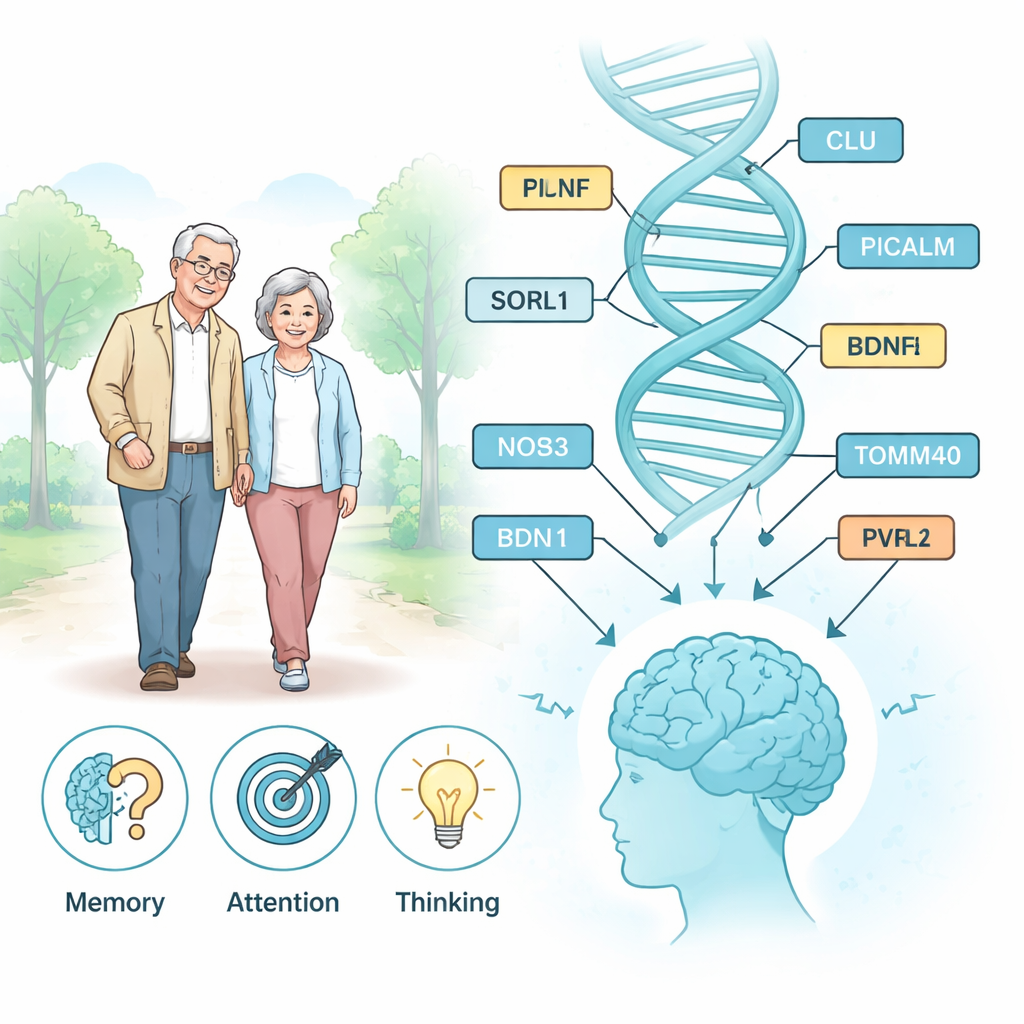
The researchers compared how often each SNP appeared in people with and without MCI, using several statistical approaches that mimic different ways genetic traits can be inherited. They found 15 SNPs in nine genes that were meaningfully linked to MCI. Variants in CLU, SORL1, and PICALM—genes that help move and clear the Alzheimer-related protein amyloid-β—were either protective or risky depending on the exact version present. For example, one CLU variant (rs9331888) and a variant in the MTHFR gene, which is involved in folate and homocysteine metabolism, were consistently tied to higher odds of having MCI. In contrast, a PICALM variant and a NOS3 variant, related to blood vessel and immune function, appeared to lower MCI risk when certain versions were present.
How genes and lifestyle interact
The story did not end with single genes. The team also looked at combinations of SNPs and how their influence changed with factors such as exercise, education, sex, and diabetes. Some risk variants had stronger effects in people who were less physically active, had fewer years of schooling, or lived with diabetes; others showed different impacts in men and women. A TOMM40 variant, which affects energy production in brain cells and sits close to the APOE gene, initially looked risky but lost its effect after accounting for APOE ε4, suggesting that some signals actually reflect the influence of this well-known Alzheimer’s gene. Overall, the results paint MCI as a condition shaped by many small genetic nudges that are amplified or softened by everyday life circumstances.

What this means for preventing memory loss
To a layperson, the central message is that some of the same genetic changes long associated with Alzheimer’s are already at work much earlier, in people who “only” have mild cognitive problems. Certain DNA variants seem to make the brain more vulnerable, while others offer a degree of protection, and their effects can be modified by how much we move, how long we stay in school, and how well we manage conditions like diabetes. Although this study cannot prove cause and effect, it suggests that in the future, combining genetic information with lifestyle measures could help identify individuals at higher risk and guide early, targeted prevention—ideally before serious memory loss takes hold.
Citation: Xie, Z., Tu, W., Ye, XF. et al. The association of Alzheimer’s disease-related SNPs with mild cognitive impairment susceptibility in the Chinese population. Sci Rep 16, 6438 (2026). https://doi.org/10.1038/s41598-026-37309-0
Keywords: mild cognitive impairment, Alzheimer’s genetics, Chinese population, brain aging, precision prevention