Clear Sky Science · en
Consensus control and performance recovery of heterogeneous second-order multi-agent systems via two-time-scale separation approach
Why getting a group to agree matters
From robot swarms to self-driving car platoons and power grids, many modern technologies rely on large groups of devices that must move or act in unison despite noise, delays, and partial failures. Engineers call these collections “multi-agent systems.” When every member can still coordinate smoothly even under uncertainty, the whole system becomes safer, faster, and more efficient. This paper presents a new way to make such groups not only reach agreement but also behave as if the uncertainties were never there in the first place.
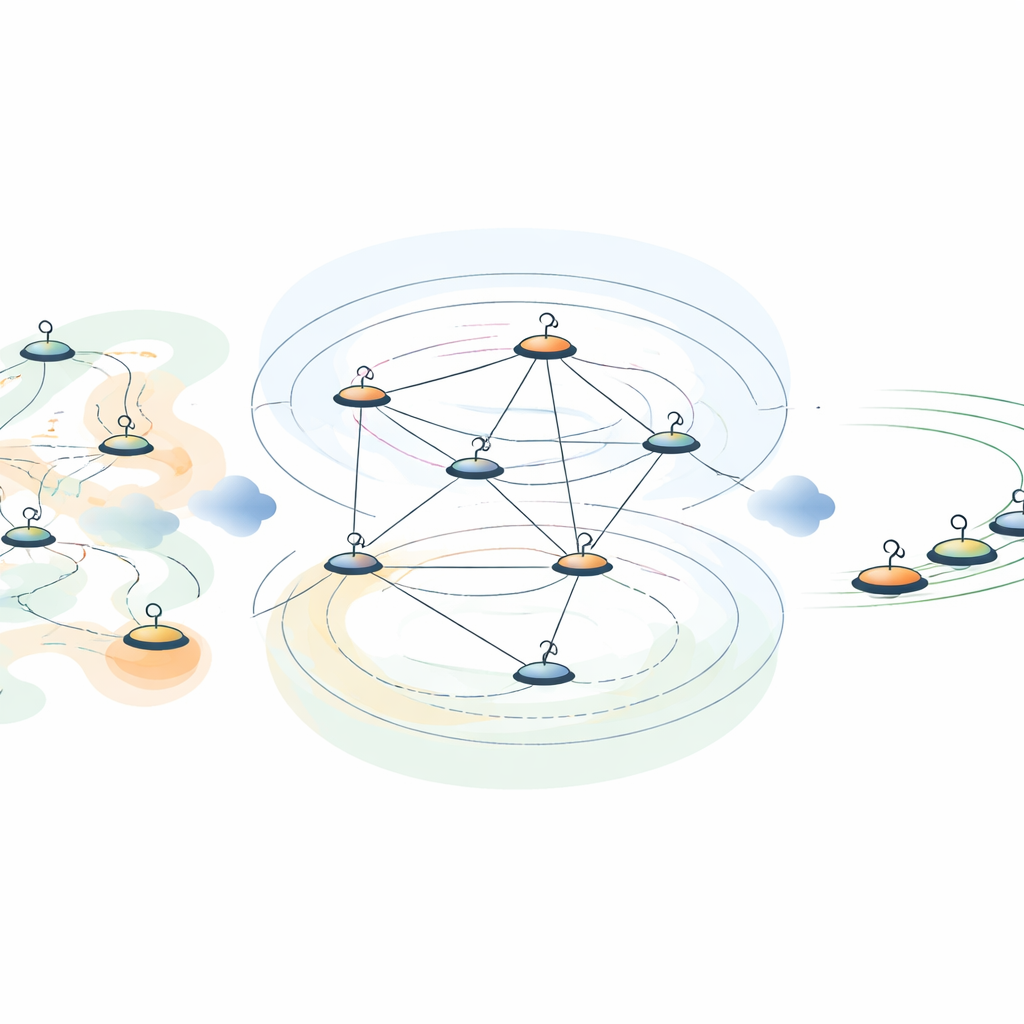
How teams of smart devices try to agree
In a typical coordinated network, one unit plays the role of leader and the others are followers. Each follower can sense only its own state and information from nearby neighbors over a communication graph, which may be arranged in one-way or two-way links. The basic goal, known as consensus tracking, is for all followers to match the leader’s position and speed over time using only these local exchanges. This is essential in applications such as drone formations, vehicle platoons on highways, or coordinated robotic arms in a factory, where centralized control would be too slow or fragile.
Why real-world imperfections create trouble
Real hardware rarely behaves exactly like textbook equations. There are always “unmodeled dynamics” – neglected nonlinear effects, friction changes, or parameter errors – and external disturbances such as wind gusts, sensor noise, or actuator faults. Earlier research on consensus control usually attacked either unmodeled dynamics or disturbances, but seldom both at once. Even when agreement could be guaranteed, the group’s motion often became slower or more oscillatory than the ideal design. In other words, the system might stay stable and eventually synchronize, yet lose its carefully tuned transient behavior that determines how quickly and smoothly agents respond.
A two-speed strategy for cleaning up uncertainties
The authors adapt a technique originally designed for single systems and extend it to networks of second-order agents (systems where both position and velocity matter). They first design a nominal consensus controller for an idealized, perfectly known group. This controller fixes the desired response speed and shape. Then they add a second, much faster mechanism—a high-gain filter—that continuously observes how the network’s error signals evolve. This fast layer infers the combined effect of all hidden nonlinearities, disturbances, and even unknown variations in the leader’s input, and feeds a compensating signal back into the original controller.
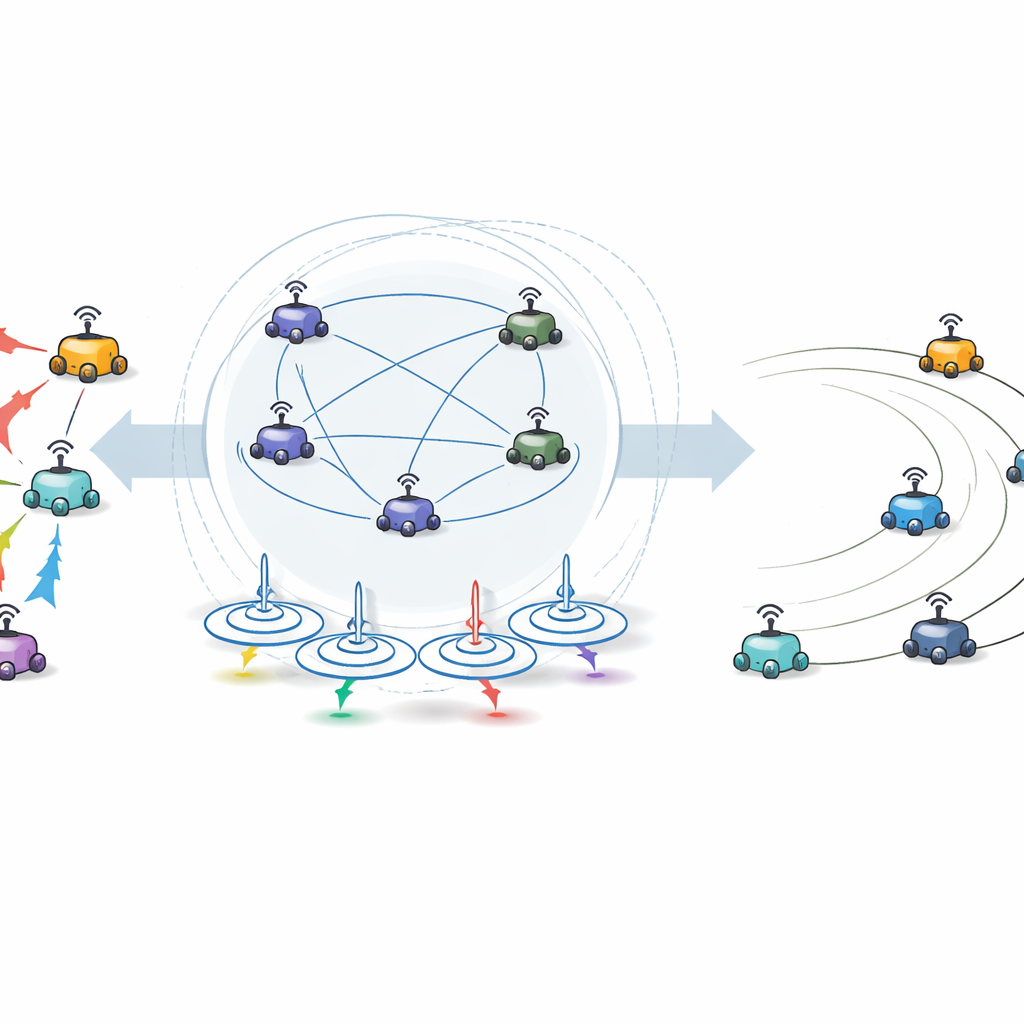
What the math and simulations show
Using Lyapunov stability analysis, the paper proves that with suitable tuning of the filter’s speed, all internal signals in the multi-agent network remain bounded and the consensus errors shrink to zero over time. Crucially, the closed-loop behavior of the uncertain, disturbed system converges to that of the clean nominal design; this is called performance recovery. The authors show that the approach works for both symmetric (undirected) and asymmetric (directed) communication graphs, and that the leader’s actual control input never needs to be known precisely—only an upper bound is required. Numerical studies comparing the method with an earlier robust consensus scheme reveal faster convergence to the leader’s trajectory without extra control effort.
From theory to physical test cases
To highlight practical relevance, the authors apply their method to a network of inverted pendulums, a classic test bed in control engineering. Each pendulum experiences nonlinear gravitational forces and added disturbances on its torque input, while the leader pendulum is also disturbed. Despite these complications, the followers track the leader’s angle and angular speed closely, and their motions remain smooth and well-behaved. The redesigned controller enables the disturbed system to shadow the nominal, disturbance-free trajectories, underscoring that the method can tolerate both modeling errors and environmental noise in realistic devices.
What this means going forward
In summary, the paper introduces a consensus control strategy that lets networks of heterogeneous agents behave as though they were operating in an ideal world, even when hidden effects and disturbances are present. By separating the problem into a slow layer that shapes the desired collective behavior and a fast layer that cancels uncertainties, the method restores the original performance instead of merely keeping the system from failing. This could help future robot swarms, connected vehicles, and smart power systems coordinate more quickly and reliably, though extending the approach to rapidly changing or delayed communication networks remains an open challenge.
Citation: Mohammadalizadeh, S., Arefi, M.M. & Khayatian, A. Consensus control and performance recovery of heterogeneous second-order multi-agent systems via two-time-scale separation approach. Sci Rep 16, 9702 (2026). https://doi.org/10.1038/s41598-026-37308-1
Keywords: multi-agent systems, consensus control, robust coordination, distributed control, performance recovery