Clear Sky Science · en
Microbial communities and biomineralization potential within mountain permafrost of the Devaux ice cave in the Central Pyrenees
Hidden life in a disappearing world
High in the Central Pyrenees, a little-known ice cave called Devaux is quietly shrinking as the climate warms. Inside this frozen cavern, scientists have discovered rich communities of microbes living in ice that can be thousands of years old. These tiny inhabitants not only survive in permanent cold and darkness; they may also help build delicate mineral formations that record past climate. Understanding how this hidden ecosystem works can tell us about the future of mountain permafrost, offer clues for life in other extreme environments, and even inspire new ways to harness microbes for technology.
The cave of three kinds of ice
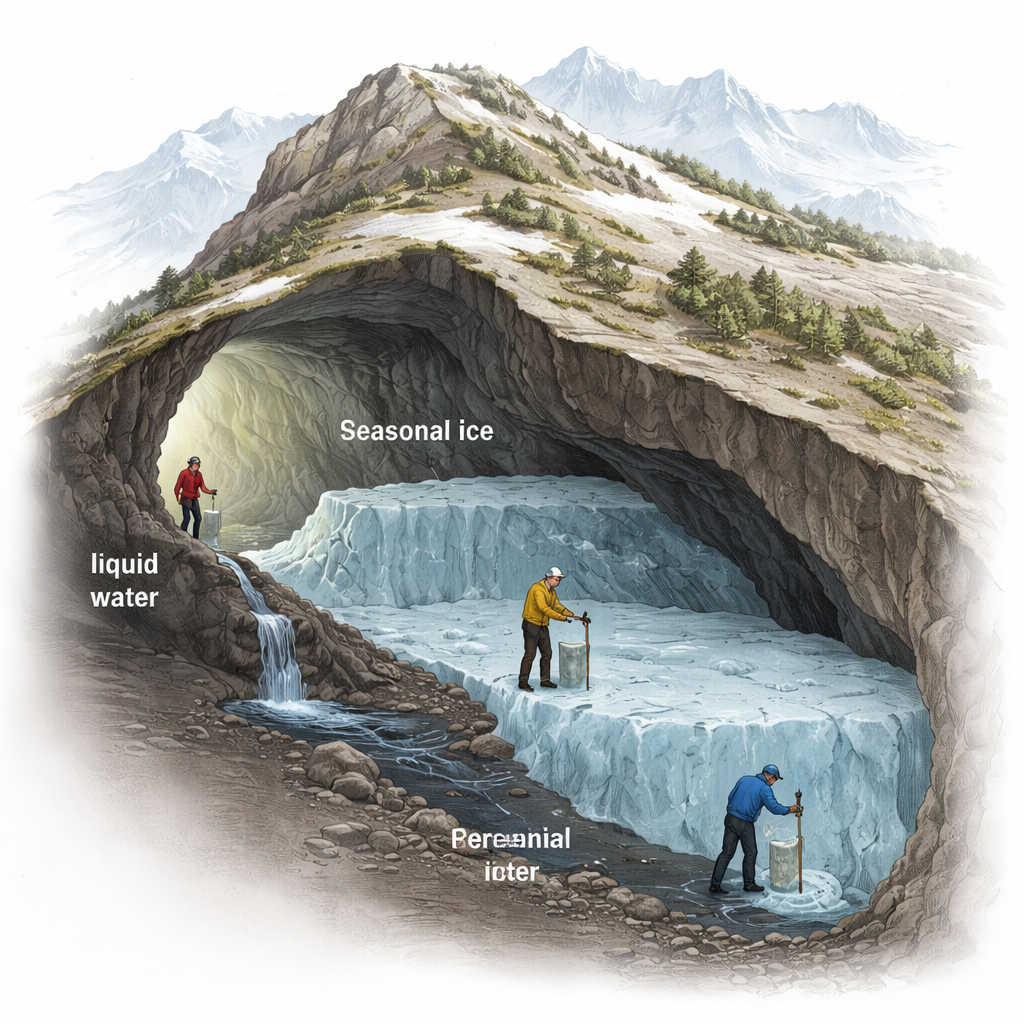
Devaux Cave sits just below the altitude where air temperatures hover around freezing all year. Its interior is divided into distinct zones: flowing river water and dripping water near the entrance, seasonal ice that melts and refreezes each year, and deeper bodies of perennial ice that persist from one year to the next. The researchers sampled all three habitats—liquid water, seasonal ice, and long-lived ice—to compare their chemistry and their living communities. They found that whether water was frozen or liquid was the main factor separating samples: liquid river and drip water were chemically distinct from the ice, especially in their carbon and major ion content, confirming that each part of the cave offers a different environment for life.
Strange minerals shaped by microbes
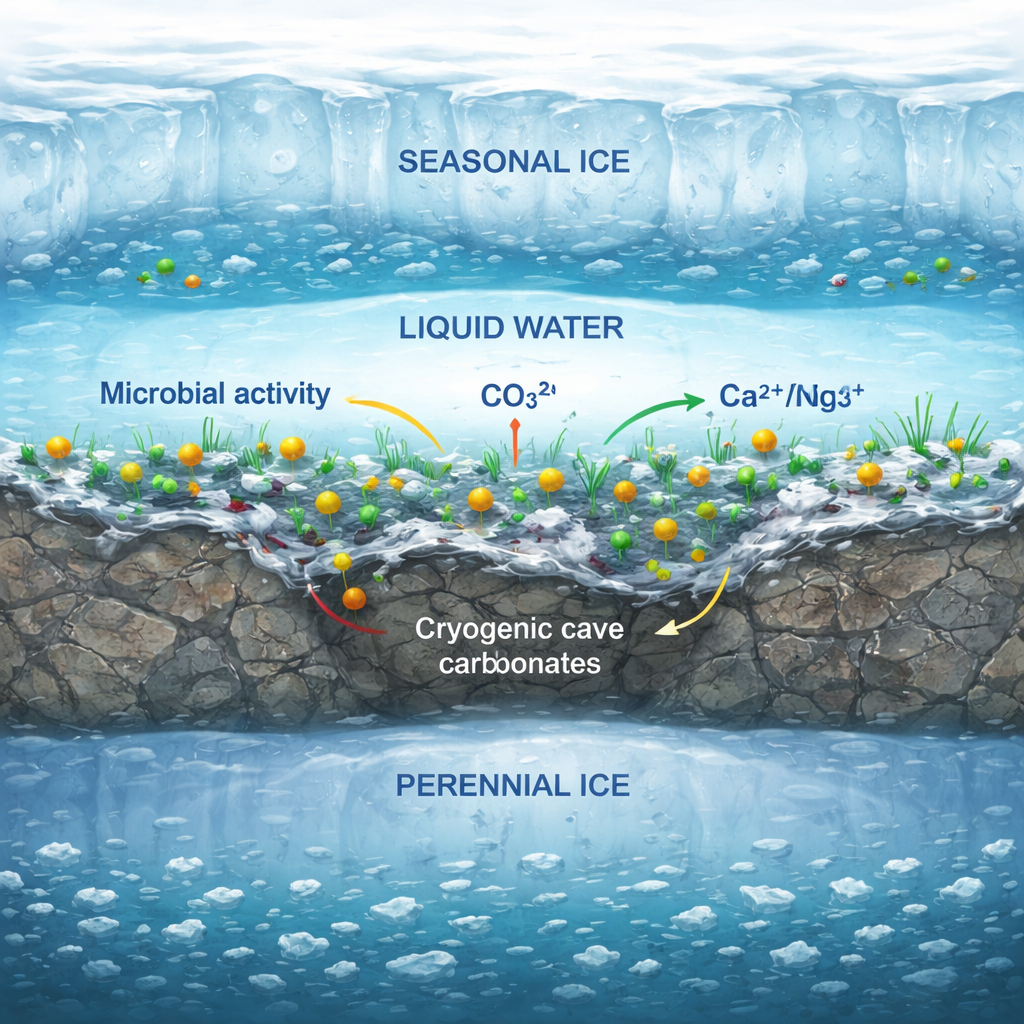
Devaux Cave hosts a suite of unusual minerals called cryogenic cave carbonates, which form when water freezes and forces dissolved substances into tiny pockets of remaining liquid. As this brine becomes more concentrated, minerals such as calcite, aragonite, vaterite, magnesium-rich calcite, and nesquehonite crystallize. Using high-resolution electron microscopes, the team observed globular and needle-like carbonate structures that closely resemble mineral shapes known from other caves to be influenced by microbes. Microbial slime layers and cell surfaces can act as scaffolds where mineral crystals nucleate and grow, especially under slightly alkaline conditions rich in calcium and magnesium. These observations suggest that Devaux’s minerals are not just the product of simple freezing, but also of biological activity.
Communities thriving in the cold and dark
To see who lives in this frozen habitat, the scientists sequenced genetic markers from bacteria, archaea, and microeukaryotes (including fungi and algae). They detected more than 9,000 distinct genetic variants, dominated by bacteria such as Proteobacteria, Actinobacteria, and Patescibacteria—groups commonly found in cold, nutrient-poor environments. Liquid water and seasonal ice near the entrance contained more light-loving organisms, including cyanobacteria and green algae, consistent with their occasional exposure to sunlight. In contrast, deeper perennial ice was enriched in microbes adapted to darkness and scarcity, including genera like Lysobacter that can digest complex organic matter. Fungal genera such as Penicillium and Cladosporium were also abundant, likely recycling the small amounts of organic material available. Remarkably, over half of the eukaryotic sequences could not be matched to known organisms, highlighting a large reservoir of “microbial dark matter” that has yet to be described.
Metabolic tricks that build minerals
Beyond cataloguing species, the team used both targeted gene surveys and full metagenome sequencing to infer what these microbes might be doing. In the perennial ice, they found genes linked to carbon fixation, fermentation, methane metabolism, and the cycling of nitrogen and sulfur—all key parts of the cave’s hidden chemistry. Crucially, they identified genes for enzymes that are known to promote mineral formation: ureases and ammonia lyases that locally raise pH, and carbonic anhydrases that speed up the conversion of carbon dioxide into carbonate ions. They also detected pathways for nitrate and sulfate reduction, processes that can change water chemistry and favor the precipitation of carbonate and sulfate minerals. Although the abundance of these genes is low and direct activity was not measured, their presence, together with the mineral shapes seen under the microscope, strongly supports the idea that Devaux’s microbes help drive bacteria-induced mineral precipitation over long timescales.
Why these frozen microbes matter
Devaux Cave shows that even in apparently lifeless blocks of mountain ice, complex microbial communities survive and subtly reshape their surroundings. Each habitat—flowing water, seasonal ice, and ancient perennial ice—hosts its own blend of organisms and chemical conditions, and together they influence which minerals form and how they grow. For non-specialists, the key message is that microbes can act as quiet engineers of the underground world, leaving behind mineral “fingerprints” that record past conditions. As permafrost and ice caves shrink with climate change, studies like this capture a vanishing archive of both climate history and biological diversity, while offering analogs for icy environments on other planets and moons where similar microbe–mineral partnerships might one day be found.
Citation: Muñoz-Hisado, V., Bartolomé, M., Osácar, M.C. et al. Microbial communities and biomineralization potential within mountain permafrost of the Devaux ice cave in the Central Pyrenees. Sci Rep 16, 6232 (2026). https://doi.org/10.1038/s41598-026-37305-4
Keywords: ice caves, microbial life, biomineralization, permafrost, cryogenic minerals