Clear Sky Science · en
Comparative cumulative index for assessment of regression of oral homogeneous leukoplakia
Why white patches in the mouth matter
Many people develop persistent white patches inside the mouth that do not wipe away. These patches, known medically as oral leukoplakia, are important because a small number can turn into oral cancer over time. Doctors often treat patients with antioxidant supplements to calm irritation and repair tissue, but until now there has been no simple way to compare which antioxidant combinations work best. This study introduces a practical scoring system to help dentists and doctors judge treatment success more clearly and choose therapies more confidently.
Turning a complex problem into a simple score
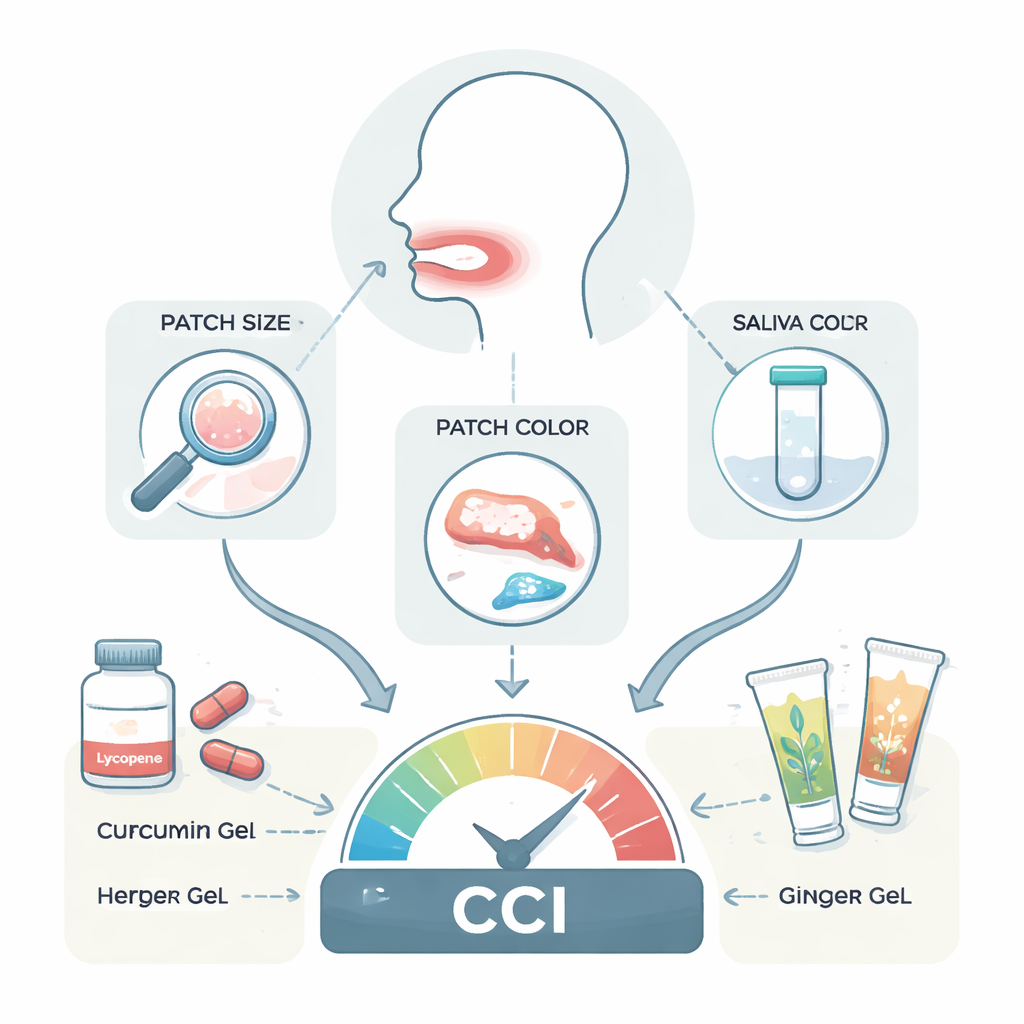
The researchers set out to build a Comparative Cumulative Index, or CCI, a single number that summarizes how well a treatment helps leukoplakia patches improve. They focused on three features that matter to both patients and clinicians: how much the patch shrinks in size, how much its color returns toward healthy pink, and how strongly a saliva test shows that harmful oxidative stress has decreased. Because these features are not equally important, an expert panel of eight specialists in oral medicine, dentistry, biostatistics, and herbal pharmacology agreed on different weights for each. Patch size carried the most weight, patch color was next, and the saliva marker contributed a smaller but still meaningful share.
How the new index was built and tested
To turn these ideas into a working tool, the team created simple scoring rules. Patch shrinkage was measured by tracing the lesion on a transparent grid and calculating how much its area dropped. That percentage change was converted into a size score. Color was rated on a three-step visual scale: whitish, greyish-white, or back to normal mucosal color, with higher scores for more natural-looking tissue. For saliva, they measured levels of malondialdehyde (MDA), a chemical signal of oxidative damage, and converted the percentage drop into a score. Each patient’s three scores were then combined using the agreed weights to produce an overall CCI value between 0 and 100 for a given treatment.
Comparing three antioxidant strategies
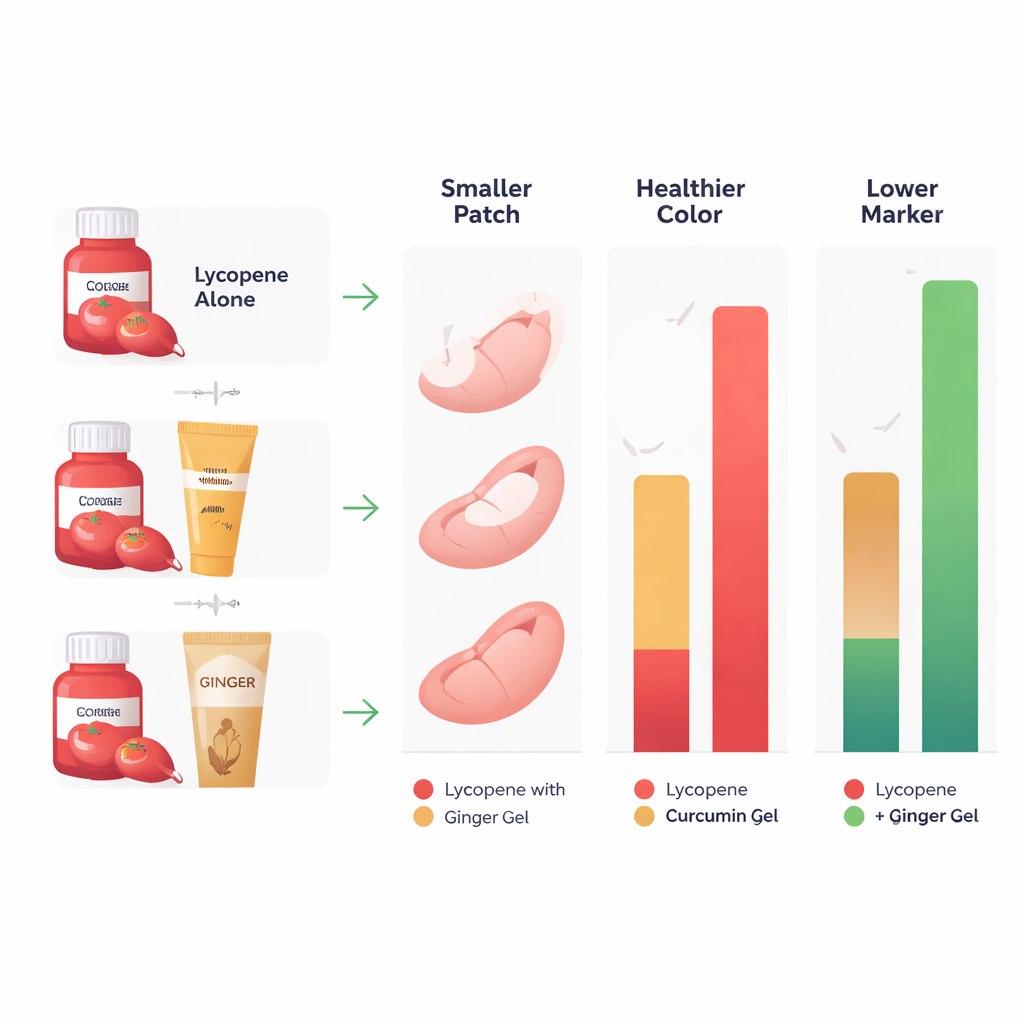
The study enrolled 120 people with homogeneous leukoplakia and divided them into three equal groups. One group received lycopene alone, a tomato-derived antioxidant already used for these lesions. A second group received lycopene plus a curcumin gel, and a third group received lycopene plus a ginger gel. Before treatment, all groups had similar patch sizes, colors, and saliva MDA levels, ensuring a fair comparison. After treatment, all three approaches led to smaller patches and lower saliva markers, but the improvements were not equal. The lycopene-plus-ginger group showed the greatest drop in patch size, the largest normalization of color, and the strongest fall in MDA.
What the scores revealed
When these changes were translated into CCI scores, the differences became easy to see. Lycopene alone achieved a CCI of 34 out of 100, lycopene with curcumin reached 41, and lycopene with ginger achieved 50. In everyday terms, adding ginger gel appeared to give the most balanced benefit across all three key features: the patches got smaller more quickly, looked healthier, and the chemical signs of stress in saliva fell the most. Curcumin gel also improved results compared with lycopene alone, but not as strongly as ginger. The researchers checked that their index was stable and consistent, showing that each component—size, color, and saliva marker—added unique information without overlapping too much.
What this means for patients and clinicians
For people living with worrying white patches in the mouth, this work offers two reassuring messages. First, it supports the idea that antioxidant-based treatments, especially combinations that include herbal gels such as ginger, can help patches regress and mouth tissue look and behave more normally. Second, the new CCI gives dentists and doctors a clearer yardstick to judge progress rather than relying on impressions alone. While the study was done at a single center and needs to be repeated and refined in larger, more diverse groups, the index lays the groundwork for more objective, fair comparisons of future therapies. In time, tools like the CCI could help ensure that patients receive treatments proven to give the greatest overall improvement in both appearance and underlying mouth health.
Citation: Chandak, R., Lohe, V., Chandak, M. et al. Comparative cumulative index for assessment of regression of oral homogeneous leukoplakia. Sci Rep 16, 6200 (2026). https://doi.org/10.1038/s41598-026-37304-5
Keywords: oral leukoplakia, antioxidants, ginger, curcumin, salivary biomarkers