Clear Sky Science · en
Decoding environmental regimes and spring phytoplankton bloom occurrence in the central Yellow Sea
Why Spring Blooms in a Busy Sea Matter
Every spring, microscopic plants called phytoplankton briefly transform the central Yellow Sea into a green, life-filled soup. These tiny drifters fuel fish stocks, support seabirds and marine mammals, and help draw carbon dioxide out of the air. Yet their “boom and bust” cycle is sensitive to shifting weather and climate. This study asks a simple but powerful pair of questions: when, exactly, does the big spring bloom happen, and what combination of light, temperature, mixing, and air–sea exchanges makes it thrive or fail?
Watching the Sea Wake Up
Using 21 years of satellite data from 2003 to 2023, the researchers tracked daily changes in chlorophyll-a, a pigment that reveals how much phytoplankton is near the surface. They focused on the central Yellow Sea, a shallow shelf between China and the Korean Peninsula that is strongly influenced by monsoon winds, river runoff, and dust and pollution from the atmosphere. By averaging all years together, they found a repeatable pattern: phytoplankton biomass rises from February, peaks in April, and falls back by early summer. To move beyond broad averages, they used a statistical method to split this seasonal curve into four stages—growth, peak, decline, and termination—based on where the data showed sharp regime shifts rather than on arbitrary calendar dates. 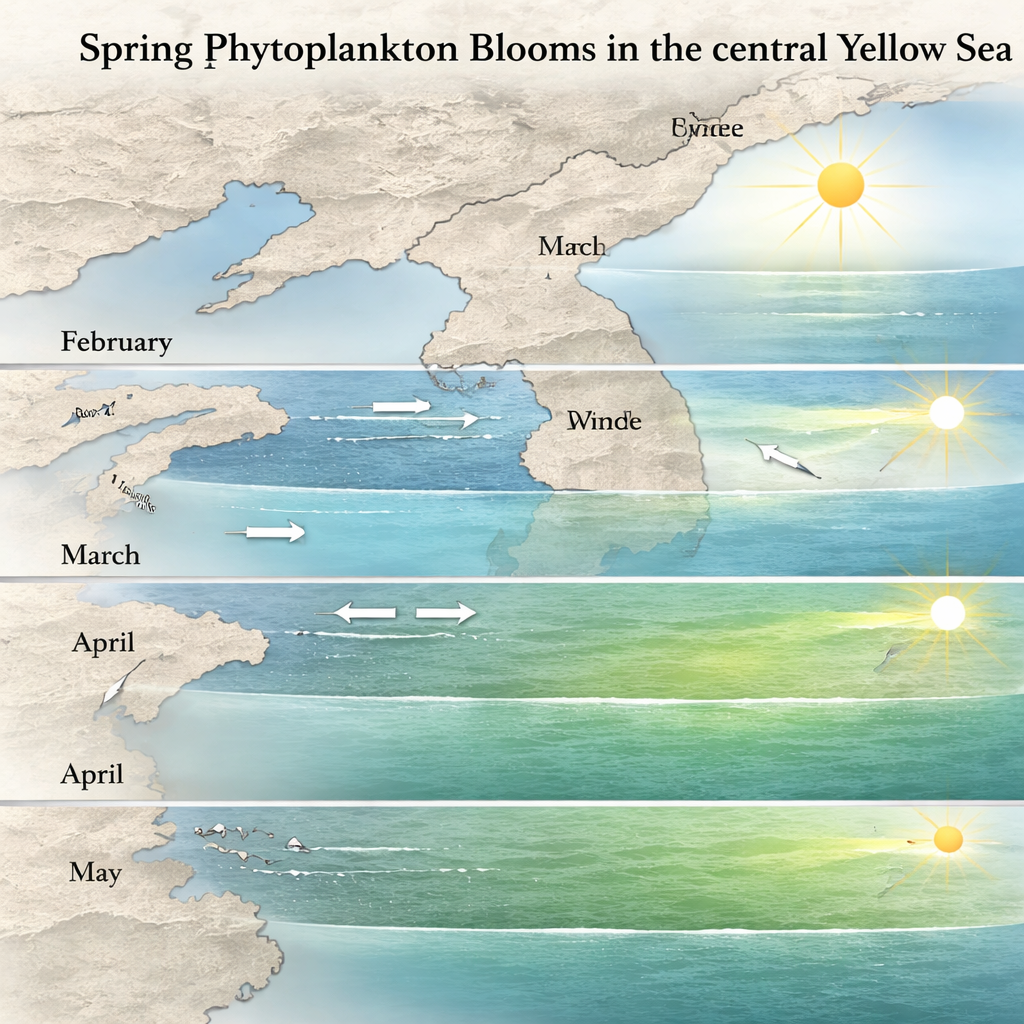
Four Acts in a Spring Performance
The team’s four stages describe a typical year in detail. From early February to early April, the “initial” phase sees modest but steady growth under low light and cool water. Around early to mid-April, light becomes strong enough and the upper ocean sufficiently shallow and stable that phytoplankton can bloom rapidly, forming a clear “peak” stage lasting about 10 days. As waters keep warming into late April and early May, the “decline” stage sets in: chlorophyll falls as temperature rises above roughly 14 °C and physical conditions become less favorable. By mid-May through June, in the “termination” stage, surface waters typically exceed about 17 °C and the bloom is effectively over, with chlorophyll dropping well below bloom levels.
Decoding the Ocean’s On/Off Switches
To pinpoint which environmental conditions separate bloom from non-bloom days, the authors turned to a decision-tree machine-learning model. Feeding in daily values of day-of-year, sea surface temperature, light, mixed layer depth, wind-driven convergence or divergence, aerosol loading, and rainfall, the model learned simple numerical thresholds that explain when blooms are likely. Timing itself—captured by the calendar day—accounted for most of the predictive power, followed by temperature and mixed layer depth. Before about 30 April, blooms tend to occur when the upper ocean is relatively shallow (around 65 m or less), light is at least moderate, and surface waters are still relatively cool. After this date, as the surface warms beyond about 17 °C, bloom conditions almost never appear. Other factors from the atmosphere—dust and pollution, winds, and rain—play smaller roles in determining if a bloom happens at all, but they do help modulate how big it becomes.
Different Years, Different Bloom Stories
Not every year in the 21-year record looks the same. The authors used their stage-based framework to classify each year into “Normal,” “Late,” or “None” types, depending on where and how sharply the chlorophyll curve peaked. In Normal years, the bloom surges in April and then collapses quickly, matching the classic picture. In Late years, the early stages are sluggish and the peak shifts toward May, as favorable light and mixing conditions persist longer. In None years, such as 2020, chlorophyll never forms a strong, distinct maximum: temperatures warm too early, mixing remains less favorable, and atmospheric inputs do not provide much extra boost. By comparing these types with the decision-tree thresholds, the study shows that the basic timing is mostly governed by the seasonal march of temperature, light, and mixing, while the atmosphere fine-tunes how dramatic the bloom becomes. 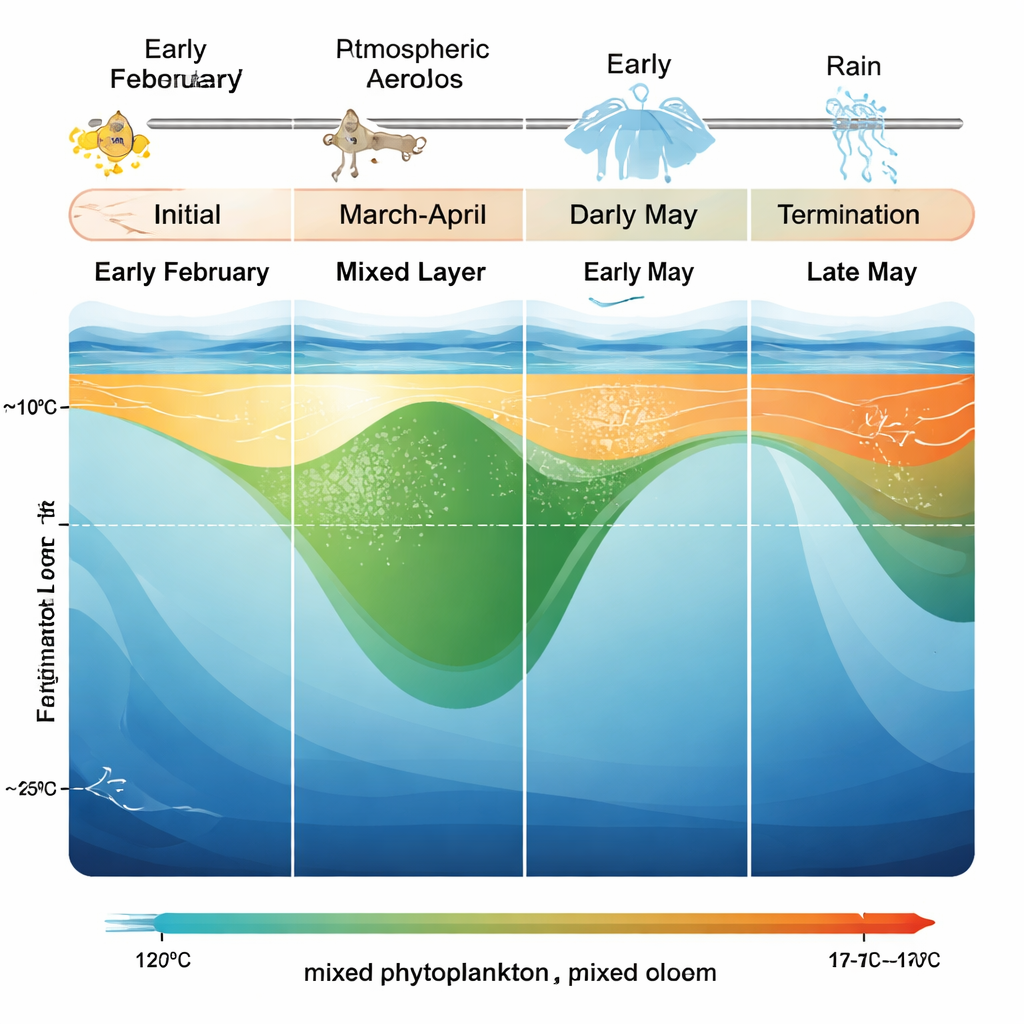
What This Means for a Changing Ocean
For non-specialists, the takeaway is that the spring bloom in the central Yellow Sea is neither random nor driven by a single factor. It follows four recognizable stages tied to simple, measurable conditions: how warm the surface is, how deeply the upper ocean is mixed, and how much light it receives. Dust, pollution, winds, and rain can strengthen or weaken the bloom, but only when that physical backdrop is right. By combining satellite records with transparent machine-learning tools, this work offers a practical recipe for tracking and predicting future blooms—knowledge that can help fisheries managers, pollution regulators, and climate scientists anticipate how this busy sea will respond as the region continues to warm and human pressures grow.
Citation: Baek, JY., Shin, J., Yang, HJ. et al. Decoding environmental regimes and spring phytoplankton bloom occurrence in the central Yellow Sea. Sci Rep 16, 6496 (2026). https://doi.org/10.1038/s41598-026-37301-8
Keywords: phytoplankton bloom, Yellow Sea, satellite oceanography, climate-driven ocean change, marine ecosystems