Clear Sky Science · en
Estimation and optimization of reinforcement parameters for composite material using a machine learning approach
Stronger plastics from everyday ingredients
From cars to appliances, many products rely on plastic parts that must be light yet strong. Engineers often boost performance by mixing plastics with hard particles such as metal. But choosing exactly how much metal to add and how big the particles should be is a slow, trial‑and‑error process. This study shows how modern machine learning can help designers quickly find the best recipe for these metal‑reinforced plastics, saving time, cost, and material waste.
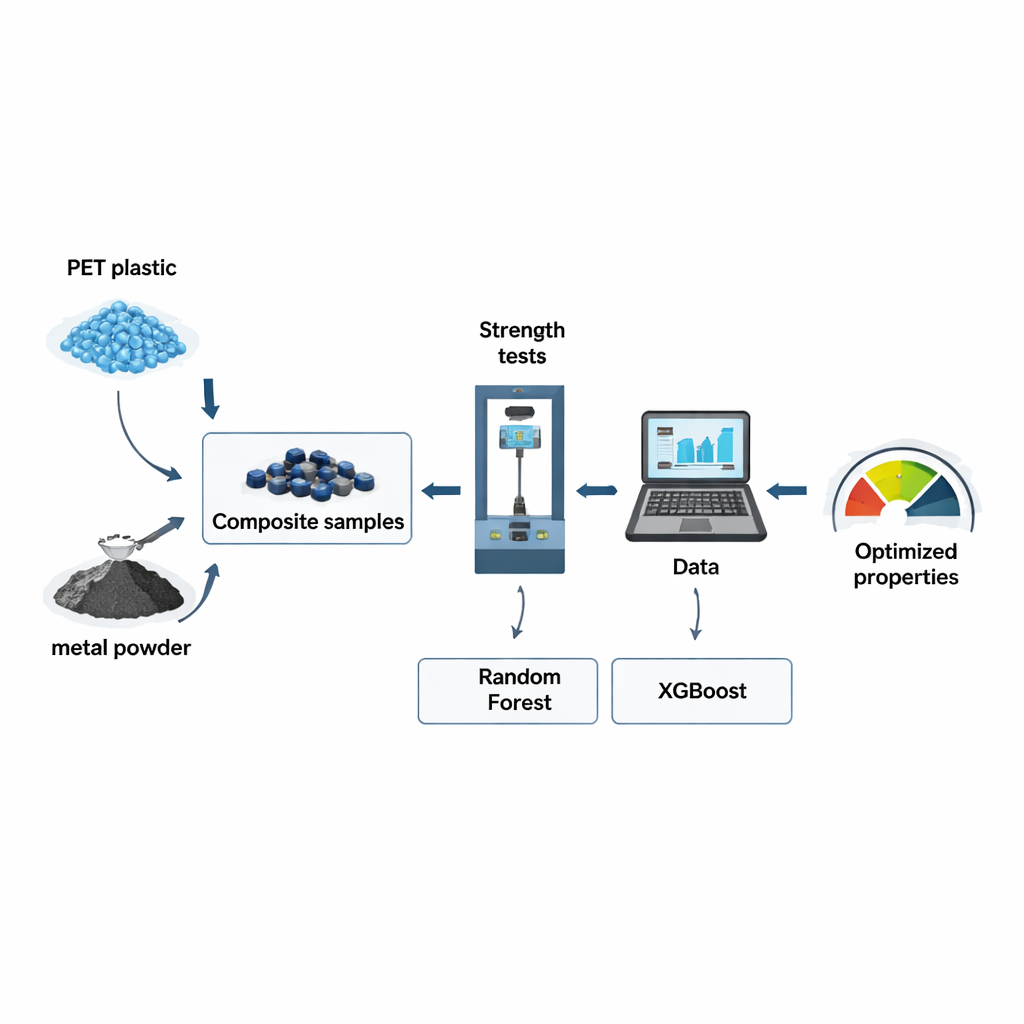
Mixing metal powder into common plastic
The researchers worked with a widely used plastic called polyethylene terephthalate, or PET—the same basic material found in many bottles and textiles. They created a new composite by blending PET with fine metal powder and then forming the mixture into flat sheets using a compression mold, a standard industrial process. To see how the recipe affected performance, they varied two key ingredients: the size of the metal particles (smaller than 2 micrometers, between 2 and 4 micrometers, and larger than 4 micrometers) and the amount of metal in the plastic, from 0 to 4 percent by weight in small steps.
Measuring how the new material behaves
From each batch of composite, the team cut test pieces and measured three practical properties. Tensile strength describes how much a sample can be stretched before it breaks, while flexural strength measures how much it can resist bending. Percentage elongation tells how far the material stretches, acting as a marker of ductility or flexibility. Standard testing machines pulled and bent the samples until failure, and the resulting data were recorded. The group also used high‑resolution electron microscopes and elemental analysis to confirm that the metal particles were spread throughout the plastic and to visualize how they sat inside the PET matrix. These images helped connect microscopic structure with macroscopic performance.
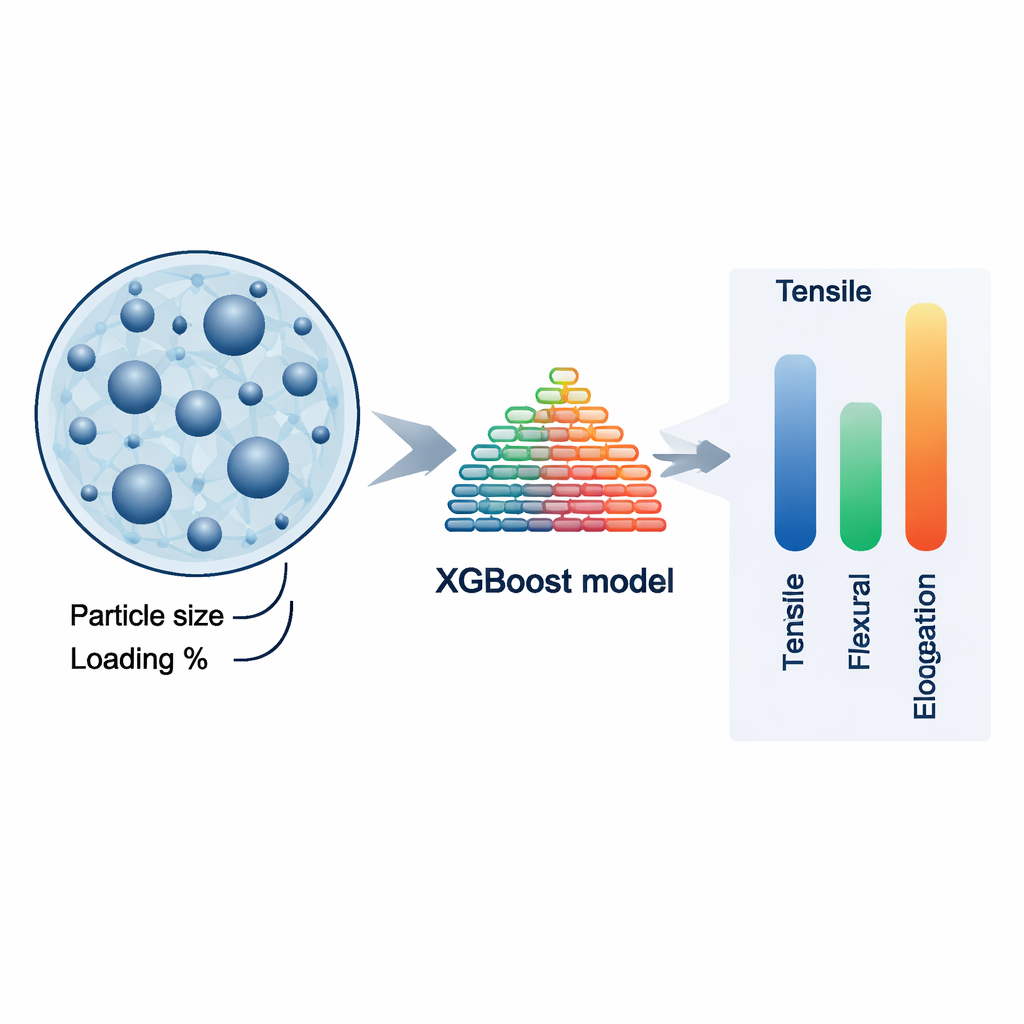
From statistics to smart prediction
As a first step, the authors applied a traditional statistical tool known as response surface methodology. This approach uses a carefully planned set of experiments to map how inputs—here, particle size and metal content—affect outputs such as strength and elongation, and to suggest a combination that balances all three. The analysis pointed to an intermediate metal content of just over 1 percent and a mid‑range particle size as a good compromise, giving moderate improvements in strength and stretch without pushing any one property to an extreme.
Letting algorithms learn the best recipe
The team then turned to machine learning to go beyond these initial estimates. They trained two different decision‑tree based models, called Random Forest and XGBoost, on the full set of test results. The algorithms learned how changes in particle size and loading influenced tensile strength, flexural strength, and elongation. By checking the models against unseen data using five‑fold cross‑validation, the researchers could judge how well the algorithms generalized rather than simply memorizing the measurements. Several quality checks were used, including how closely predicted values matched real ones and how large the average errors were.
Why XGBoost comes out ahead
Both machine learning approaches were able to capture the main trends in the data, but XGBoost clearly performed better. It predicted tensile strength and the other properties with much higher consistency, showing tighter agreement with experiments and lower error values than Random Forest. Because XGBoost builds its decision trees step by step to correct earlier mistakes, it can more easily follow the subtle trade‑offs between particle size, metal loading, and the resulting gains in stiffness versus loss of stretch. The model also allowed the authors to quantify which inputs mattered most, reinforcing the idea that a modest amount of well‑distributed metal powder can significantly enhance PET’s mechanical behavior.
What this means for future materials
In simple terms, the study demonstrates that a computer can learn from a relatively small set of carefully designed tests how a new metal‑plastic blend will behave, and then use that knowledge to guide better designs. Instead of fabricating and breaking dozens of extra samples, engineers could ask an XGBoost model which combination of particle size and metal percentage is most likely to meet their strength and flexibility targets. While this work focused on stretching and bending, the same framework could later be extended to other practical properties such as compression and shear, helping accelerate the development of safer, lighter, and more efficient composite materials.
Citation: Dandekar, Y.V., Rajput, M.S., Kumar, R.S. et al. Estimation and optimization of reinforcement parameters for composite material using a machine learning approach. Sci Rep 16, 6862 (2026). https://doi.org/10.1038/s41598-026-37295-3
Keywords: metal reinforced plastic, polymer composites, machine learning materials, XGBoost modeling, mechanical properties