Clear Sky Science · en
Assessing the impact of novel hybrid floating breakwater-WEC systems on hydrodynamic performance and sustainable energy outputs
Turning Harbor Barriers into Clean Power Plants
Coastal cities spend huge sums building walls to calm waves so ships can dock safely and shorelines do not erode. This study asks a simple but powerful question: what if those protective barriers could also act as quiet power plants, generating clean electricity from the very waves they tame? By reshaping a floating breakwater and adding a compact air-turbine, the researchers show how to combine coastal protection with renewable energy in a single floating structure.
Why Waves Are an Untapped Energy Treasure
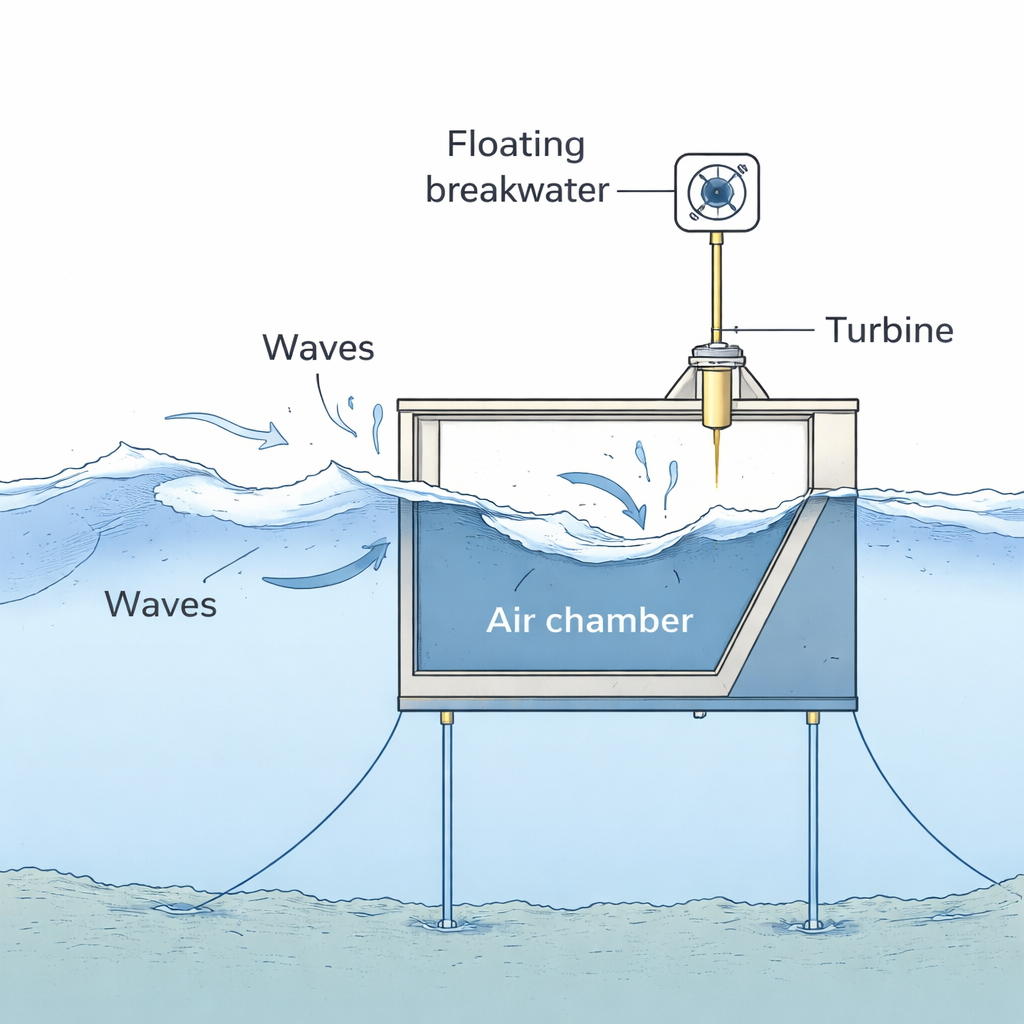
Ocean waves carry dense, predictable energy, yet most coasts still rely on fossil fuels. Many devices have been proposed to harvest wave power, but they can be complex, costly, or hard to maintain at sea. One of the simplest concepts is the oscillating water column: a hollow box partly submerged in the water, open underneath so waves push the internal water surface up and down. This motion squeezes and releases a trapped cushion of air, driving it back and forth through a turbine connected to a generator. The appeal is that only the air turbine has moving parts, while the rest is a rugged shell that can double as a breakwater.
Building and Testing a Floating Wave Shield
To explore this idea, the team built scale models of a suspended floating breakwater with a built-in oscillating water column and tested them in a 13-meter wave flume. Regular waves of different heights and periods rolled down the tank toward four versions of the structure, each with a different shape at the back wall of the chamber. Transparent walls let the researchers watch the water surface rise and fall, while wave gauges measured how much of each incoming wave was reflected, transmitted, or lost to turbulence. A pressure sensor tracked how strongly the trapped air was squeezed, and a small Wells turbine—with blades designed to spin in the same direction regardless of airflow reversal—converted air motion into electrical power, monitored by volt and amp meters.
How Shape Controls Wave Calming and Power Output
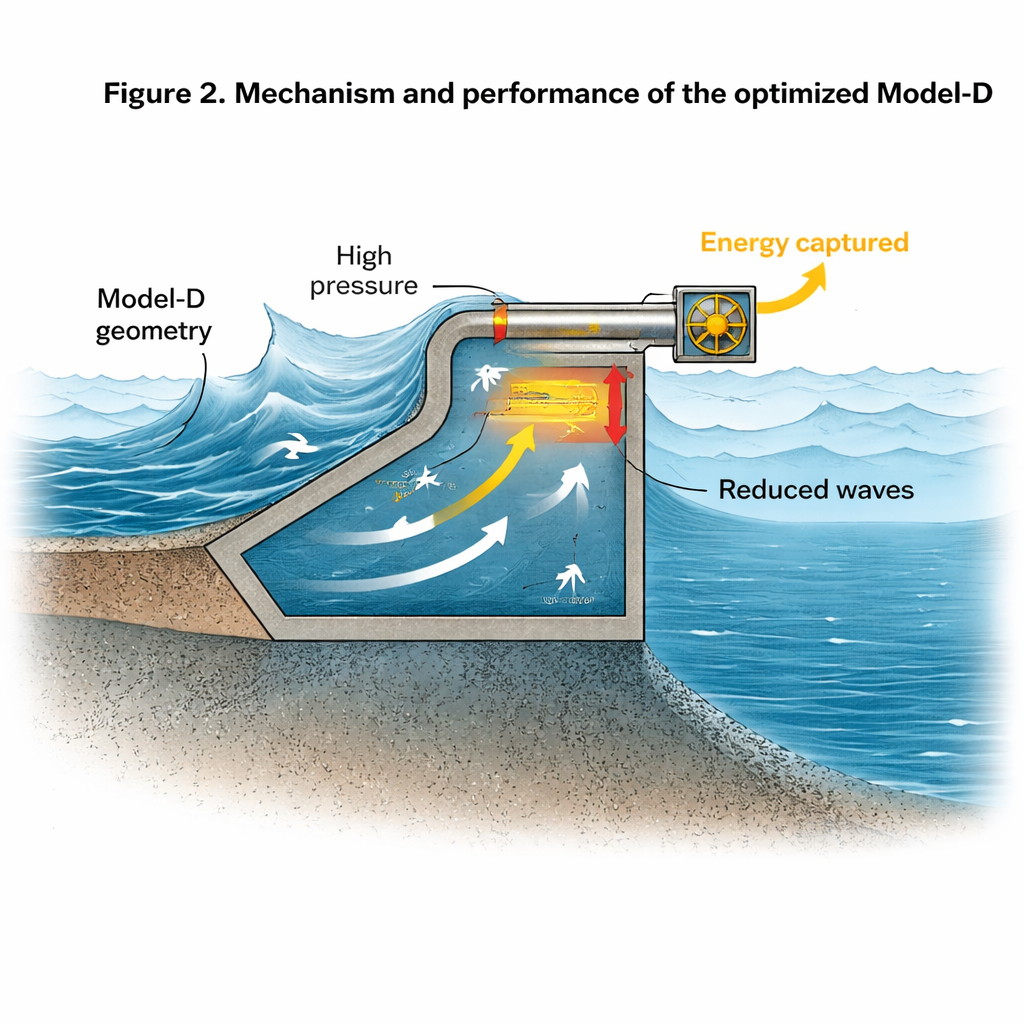
The central design question was how the geometry of the rear wall and the depth of the front opening influence performance. The team compared a simple box-like pontoon with three more advanced versions, including one with a long sloping rear wall (Model-D). They found that the ratio of device width to wave length and the draft, or submerged depth of the front wall, strongly affected behavior. As the relative width increased, wave reflection initially dropped—meaning less energy was bounced back seaward—and then rose again. At certain settings, particularly for Model-D, reflection became very low while energy loss inside the structure soared, showing that the waves were being tamed not by bouncing off, but by being converted into air motion and turbulence within the chamber.
The Standout Design: A Gentle Slope with Powerful Effects
Among the four shapes, Model-D—with its long sloping rear wall and a moderately deep front opening—proved the most effective. At a representative deeper water level, it combined low reflection with high dissipation of wave energy and strong air pressure swings in the chamber. In practical terms, that means smaller, calmer waves pass behind the structure while a significant share of the incoming energy is converted into pneumatic power and then electricity. The researchers estimate that a full-scale version operating in Mediterranean-like seas could deliver several kilowatts continuously, enough to run navigation lights, environmental sensors, or small desalination units along a harbor while also reducing wave impacts on ships and piers.
What This Means for Future Coasts
For non-specialists, the takeaway is straightforward: by carefully shaping a floating breakwater and adding a simple air-driven turbine, it is possible to build structures that both shield shorelines and quietly generate renewable power. The optimized sloping-wall design tested here performs well across a range of sea states, suggesting it could be adapted to many semi-sheltered coasts and harbor entrances. While further tests in larger tanks and in irregular, stormy waves are still needed, this work points toward a future where coastal defenses do double duty—protecting communities and helping to power them from the endless rise and fall of the sea.
Citation: Hamed, B., Elkiki, M., Abdellah, S. et al. Assessing the impact of novel hybrid floating breakwater-WEC systems on hydrodynamic performance and sustainable energy outputs. Sci Rep 16, 7189 (2026). https://doi.org/10.1038/s41598-026-37290-8
Keywords: wave energy, floating breakwater, oscillating water column, coastal protection, renewable power