Clear Sky Science · en
RT-GalaDet as a real-time model for screening surface-associated health abnormalities in fish
Why farmers care about spotting sick fish fast
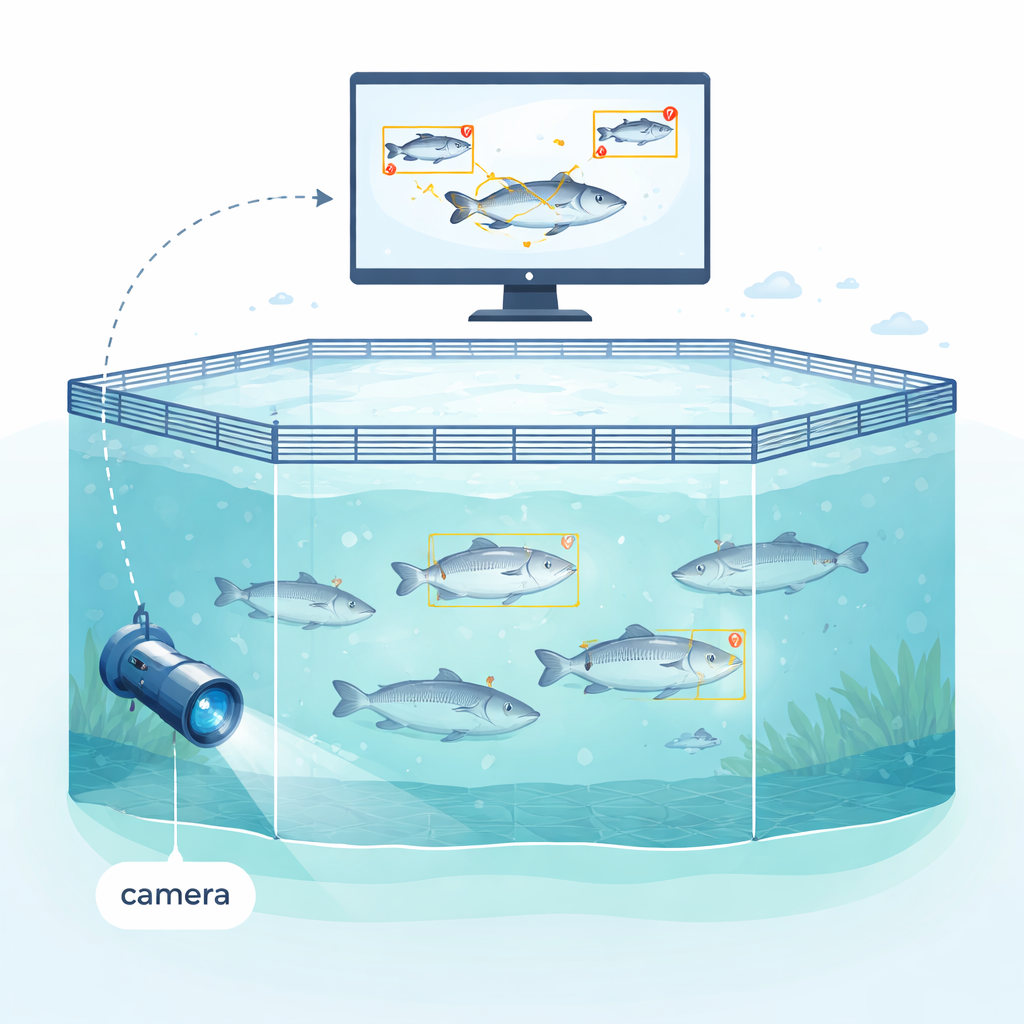
Fish farms now supply a huge share of the world’s seafood, but disease can sweep through crowded tanks or sea cages in days, killing animals and wiping out profits. Farmers usually rely on catching fish by hand and inspecting them one by one, a stressful and slow process that can miss early signs of trouble. This study introduces RT‑GalaDet, a computer-vision system that watches fish through cameras and flags small surface problems—such as spots, sores, and fin damage—in real time, without ever taking the fish out of the water.
Watching fish without touching them
The researchers set out to build a tool that could continuously monitor the visible health of farmed fish, much like an automatic security camera for diseases. Instead of nets and manual checks, cameras capture underwater images while fish behave naturally. A specialized artificial intelligence model then scans each image and draws boxes around individual fish, identifying both the species and its apparent health status. This non-invasive approach aims to give farmers fast warnings when something looks wrong on a fish’s skin, fins, or eyes, so they can intervene before a local problem turns into a farm-wide outbreak.
Teaching the system what “healthy” and “sick” look like
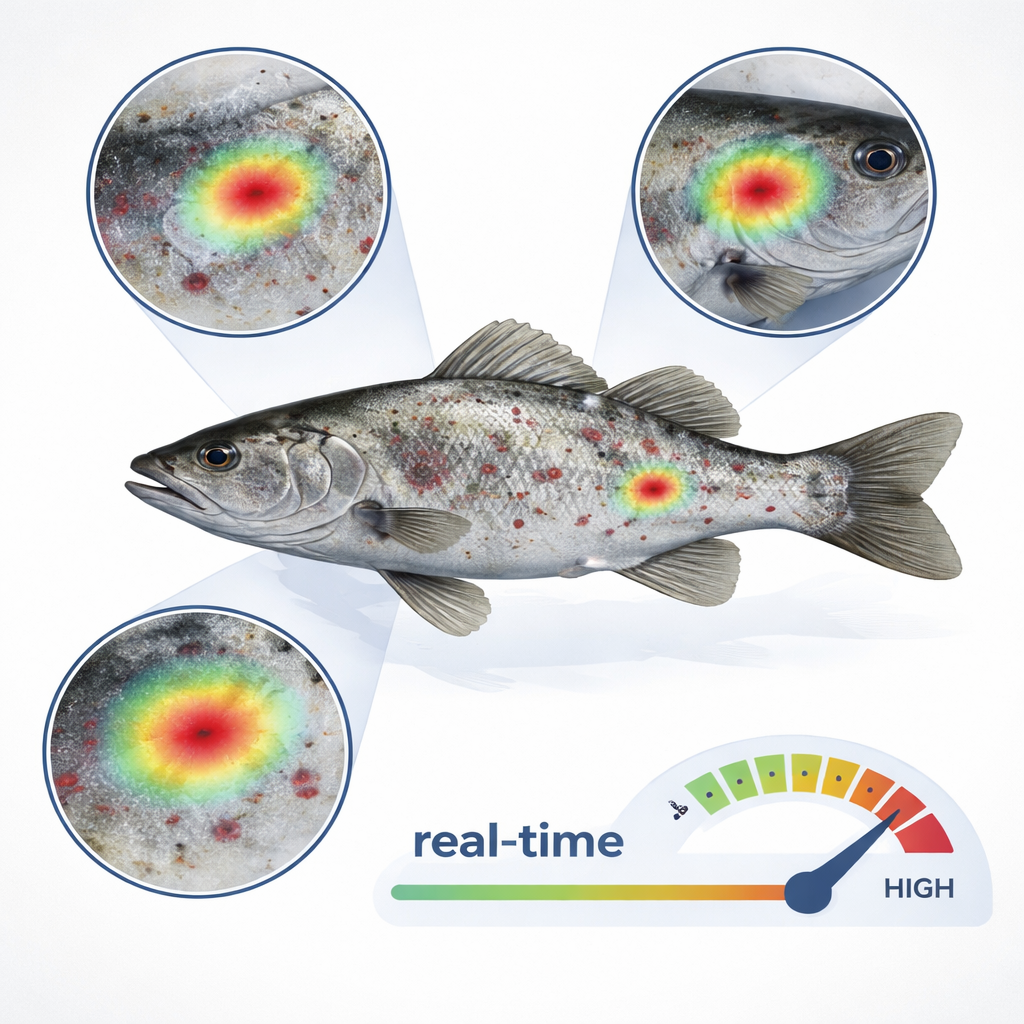
To train RT‑GalaDet, the team used a public collection of more than 5,600 images of four common farmed species: striped beakfish, black sea bream, Korean rockfish, and red sea bream. Each fish in every picture was outlined and labeled not just by species, but also by one of five surface conditions: healthy, bleeding, ulcer, eye injury, or fin injury. This created 20 precise categories, such as “black sea bream – ulcer” or “red sea bream – fin injury.” Because real farms produce many more healthy fish than sick ones, the researchers carefully balanced the dataset and used copying-and-pasting of diseased fish into new scenes, along with gentle contrast and sharpening, so the model could learn to recognize rare but important symptoms even when they are tiny or partly hidden.
How the new model sees small details quickly
RT‑GalaDet builds on a recent family of fast detectors, but redesigns the inner structure to better handle the challenges of underwater images. Murky water, uneven light, and busy backgrounds can easily hide the small spots and edge changes that mark early disease. The authors combine two kinds of “vision” inside the model: one part looks broadly across the whole image to find fish in cluttered scenes, while another part concentrates on very local textures and colors to tease out small lesions from normal patterns on scales and fins. At the same time, they streamline the middle layers of the network so it runs efficiently, reducing the amount of computation without giving up accuracy. This balance allows the system to process video at more than 50 frames per second while still paying attention to very fine details.
How well it works and where it struggles
When tested against a range of popular real-time detectors, including several versions of the widely used YOLO family, RT‑GalaDet generally matched or beat them in both accuracy and speed. It correctly labeled fish and their surface condition in the vast majority of cases, achieving high precision (few false alarms) and high recall (few missed sick fish). The model remained reasonably robust when the team simulated tougher environments—dimmer lighting and cloudier water—though performance dipped slightly, especially for subtle problems such as eye damage and small ulcers. The authors note that their data mostly came from controlled tank conditions and that deeper or dirtier waters, crowded cages, and species with very different body shapes will pose additional challenges.
What this means for fish farms
For fish farmers and aquatic veterinarians, RT‑GalaDet is not a replacement for full disease diagnosis, which still requires expert judgement and sometimes lab tests. Instead, it acts as an early-warning and evidence-gathering tool: it can watch large numbers of fish around the clock, highlight individuals that show worrying surface changes, and provide clear visual snapshots for follow-up. By catching problems sooner and reducing the need for stressful manual inspections, such systems could help farms cut losses, improve animal welfare, and manage treatments more precisely. As cameras and computing hardware become cheaper and as models like RT‑GalaDet are extended to more species, real-time, automated fish health monitoring may become a routine part of modern aquaculture.
Citation: Peng, X., Xiao, Z. & Yu, Y. RT-GalaDet as a real-time model for screening surface-associated health abnormalities in fish. Sci Rep 16, 6951 (2026). https://doi.org/10.1038/s41598-026-37288-2
Keywords: fish disease detection, aquaculture monitoring, computer vision, real-time object detection, underwater imaging