Clear Sky Science · en
Neurobehavioral outcomes at 12 months in very preterm infants monitored with continuous glucose monitoring at birth compared with full-term infants
Why tiny babies and blood sugar matter
Every year, many babies arrive weeks before their due date and spend their first days in intensive care. Parents and doctors know these very early births can affect how children grow, move, and learn, but predicting which babies will struggle is hard. This study followed very premature babies through their first year of life, asking two big questions: can more sensitive lab tests spot early signs of difficulty that standard checkups miss, and does how well a baby’s blood sugar is controlled in the first week shape their early brain development?
Two groups of babies, one key difference
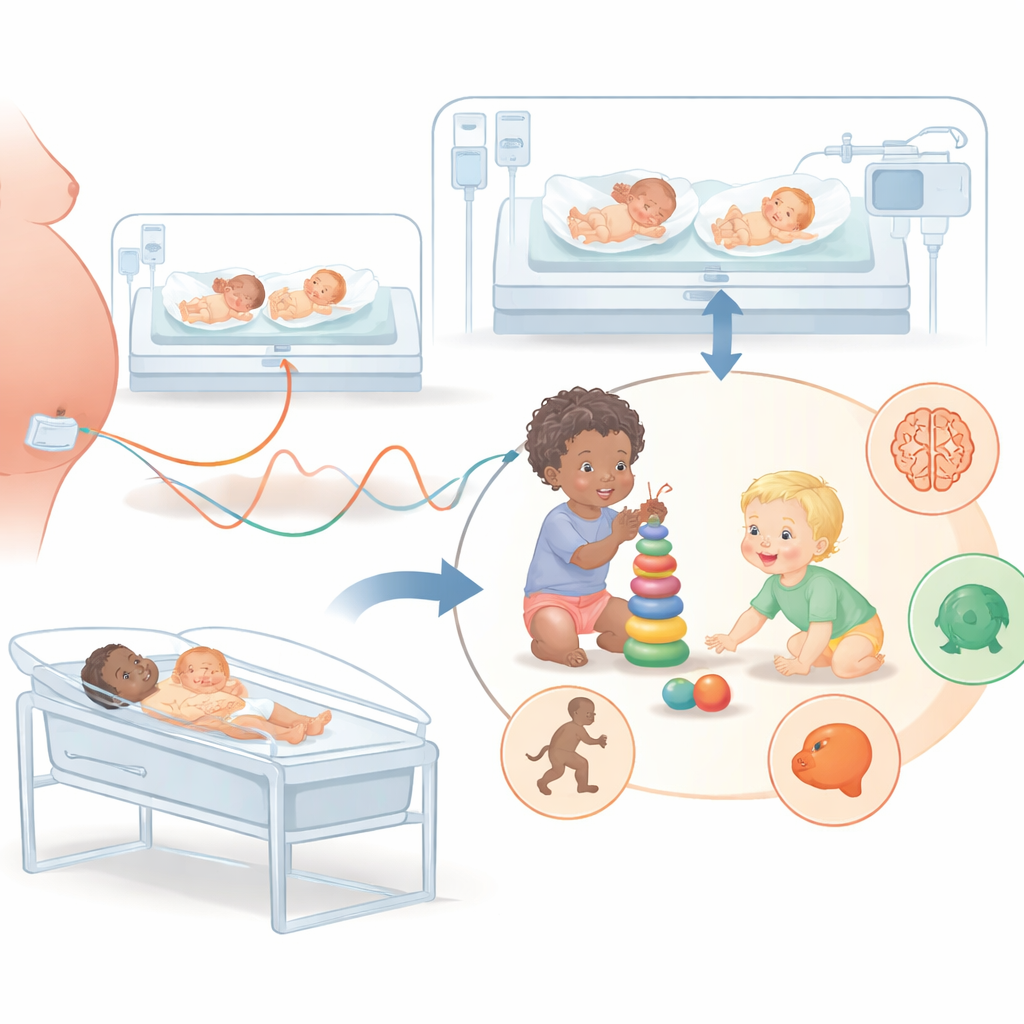
The researchers compared two sets of infants. One group was born very preterm (at or before 32 weeks of pregnancy, or very small at birth) and cared for in a neonatal intensive care unit. These babies wore a tiny sensor called a continuous glucose monitor during their first days, which tracked their blood sugar around the clock. The second group was made up of full-term babies born after a typical pregnancy, who did not need this intensive monitoring. All children were invited back at about 12 months of corrected age, meaning the preterm babies were assessed based on when they should have been born, not the date they actually arrived.
Looking beyond standard checkups
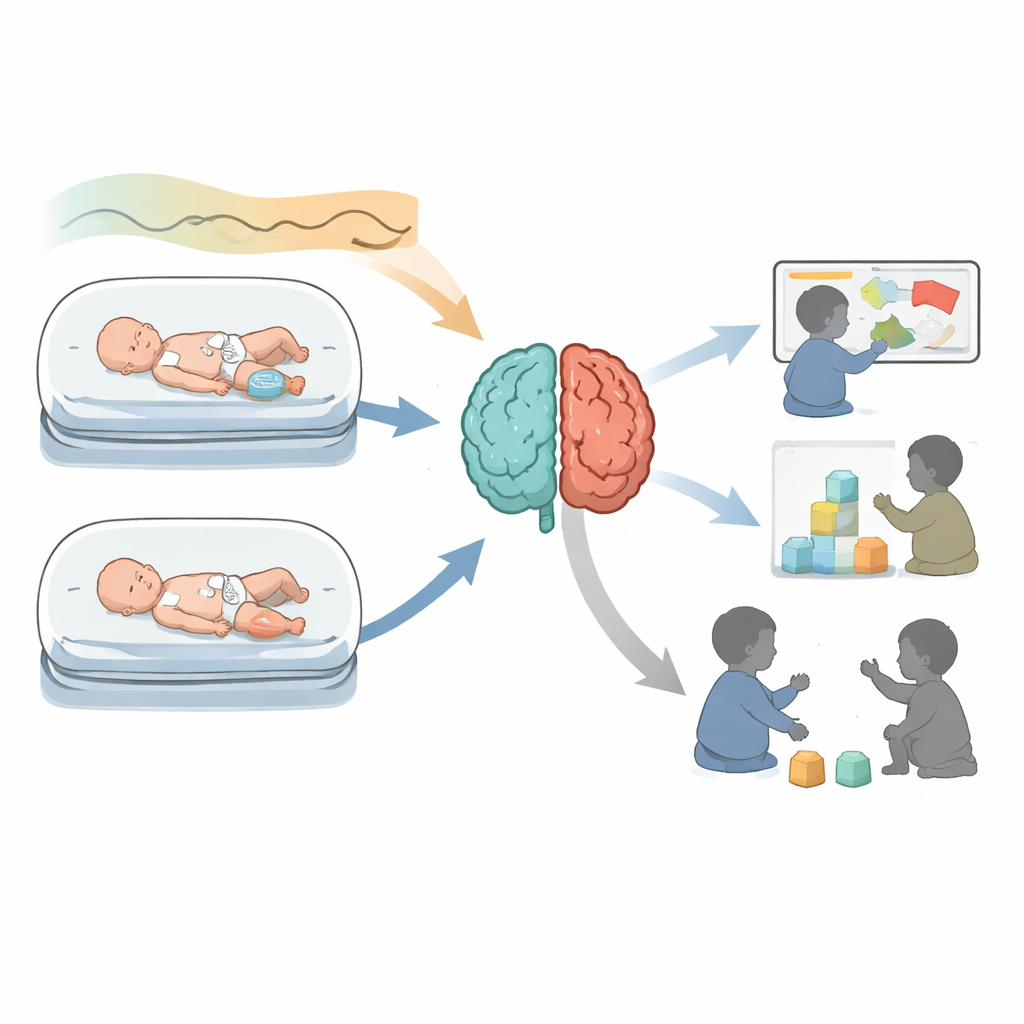
At one year, both groups were assessed with a widely used developmental test that measures thinking skills, movement, language, and social-emotional abilities. The full-term babies scored higher on thinking, movement, and especially language, even though most very preterm babies still fell within the “normal” range. To dig deeper into subtle differences that these broad scales might miss, the team also used two computer-based eye-tracking tasks. One task measured how quickly babies could shift their gaze from one object to another, a window into their ability to control and redirect attention. The other tested how well babies could keep track of changing objects on a screen, tapping into early visual short-term memory.
Early attention and memory under the microscope
Both very preterm and full-term babies showed the basic pattern expected in the attention task, suggesting that the core ability to shift gaze was in place at 12 months. However, performance among the very preterm infants was much more variable, hinting at less consistent attentional control within this group. In the memory task, neither group clearly preferred the stream of changing objects over the unchanging one, which is what researchers typically look for. Still, full-term babies showed more consistent behavior between easier and harder versions of the task, while very preterm babies did not, suggesting that their early memory processes may be developing differently even when group averages look similar.
Blood sugar swings and the growing brain
The most distinctive feature of this study was the continuous tracking of blood sugar in very preterm babies during their first week of life. Instead of relying on a few finger-prick measurements, the researchers could see how long each baby stayed within a healthy range and how much their levels fluctuated over time. They found that babies whose blood sugar was more stable—spending more time in the target range and showing less variability—tended to do better in certain areas at 12 months. In exploratory analyses, tighter glucose control was linked to stronger performance in aspects of visual short-term memory and better language scores, especially for the expressive side of language, such as making sounds and using early words.
What this means for families and care teams
For families of very preterm babies, the message is both cautious and hopeful. On average, these children still lag behind their full-term peers in thinking, movement, and especially language at one year, and their attention and memory skills may be more fragile and uneven. At the same time, the study suggests that careful management of blood sugar in the first days of life could be one factor that supports better early brain development, particularly for memory and language. Because this was a relatively small, single-center study and many influences on preterm development are intertwined, the authors stress that more research is needed. Still, their findings point to continuous glucose monitoring and sensitive lab-based tasks as promising tools for tailoring early care and follow-up, with the long-term goal of giving very preterm babies the best possible start.
Citation: Lasagni, C., Cusinato, M., Guiducci, S. et al. Neurobehavioral outcomes at 12 months in very preterm infants monitored with continuous glucose monitoring at birth compared with full-term infants. Sci Rep 16, 9489 (2026). https://doi.org/10.1038/s41598-026-37286-4
Keywords: very preterm infants, continuous glucose monitoring, neurodevelopment, early language development, visual attention and memory