Clear Sky Science · en
Formation of advanced soliton dynamics through the M-fractional regularized long-wave equation
Why strange waves matter
Waves are everywhere: in oceans and rivers, in the ionized gas around stars, and even in signals traveling along optical fibers and inside the brain. Most of the time we picture waves as regular ripples, but nature also produces isolated "humps," sudden spikes, and step-like fronts that hold their shape over long distances. These robust wave packets, known as solitons, can carry energy without quickly fading or spreading out. The paper explores new ways to describe and predict such exotic waves in settings like shallow water and plasma, where the usual equations are not quite enough.
A refined lens for real-world waves
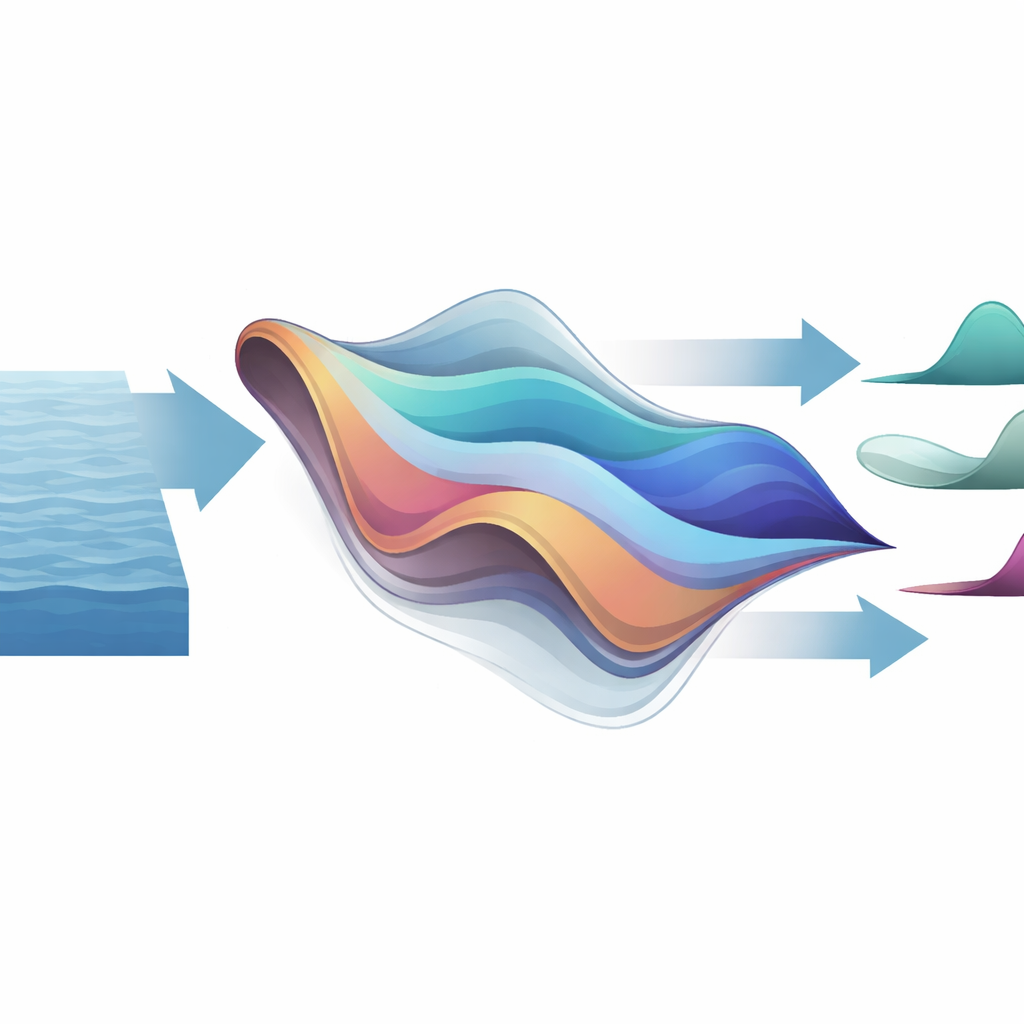
Many complex systems are modeled with nonlinear partial differential equations, which capture how waves change as they move and interact. In practice, however, real materials and fluids often have memory and internal structure: their response depends not only on what is happening now, but also on what happened a short while ago. To account for this, researchers use "fractional" derivatives, which allow rates of change to come in non‑integer orders, adding a controlled form of memory to the equations. In this work, the authors focus on a version of the regularized long-wave (RLW) equation, a standard model for long waves in shallow water, plasmas, and ion-acoustic media, and extend it with a time-fractional ingredient called a conformable derivative. This creates the time-fractional RLW (Tf-RLW) model, better tuned to capture the subtle behavior of solitary waves in real environments.
Three mathematical toolkits for taming complexity
Finding exact, closed-form wave shapes for such equations is notoriously difficult. Instead of relying on a single technique, the authors bring together three analytical schemes: the modified F-expansion method, a newly introduced extended modified F-expansion method, and a unified method. Each approach assumes a general template for the traveling wave and then systematically determines the coefficients and auxiliary functions that make this template satisfy the governing equation. By rewriting the Tf-RLW model in terms of a traveling coordinate that combines space and fractional time, they reduce the problem to an ordinary differential equation and apply these schemes to uncover entire families of exact soliton-like solutions.
A menagerie of solitary and rogue waves
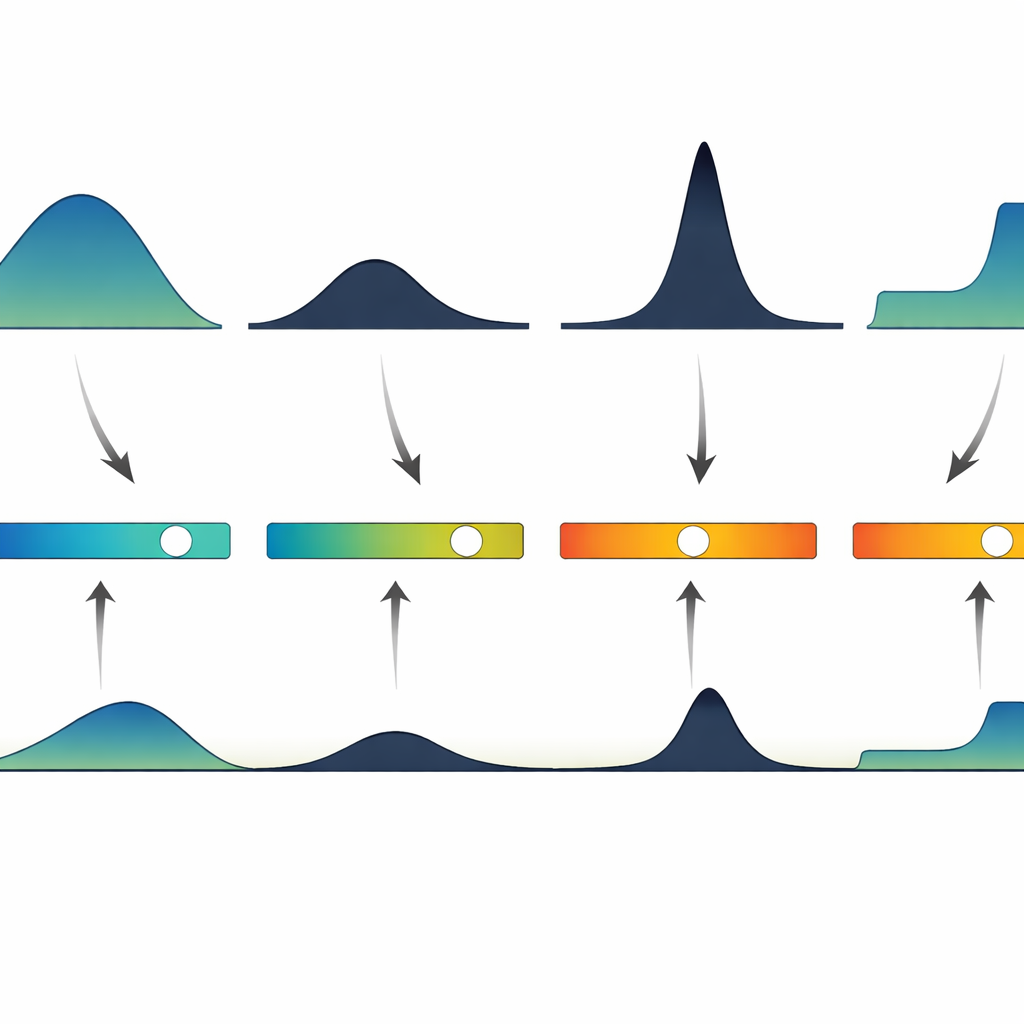
The combined methods reveal a rich collection of wave patterns. Among them are bright bell waves (isolated humps on a flat background), dark bell waves (localized dips), kink waves (step-like fronts connecting two different levels), and more intricate structures like periodic rogue waves and kinky-periodic bell waves. The fractional parameter, which measures how strongly the system "remembers" its past, plays a central role in shaping these patterns. As this parameter varies, a simple kink can transform into a local breather-like structure, a dark bell can sharpen into a rogue spike, and periodic pulses can stretch, bend, or change amplitude. The authors visualize these behaviors with three-dimensional surfaces, color density maps, and two-dimensional slices that show how the height and width of the waves respond to changes in fractionality.
Testing stability and comparing with earlier work
Exact solutions are only physically meaningful if they are stable enough to persist under small disturbances. To check this, the authors use a Hamiltonian-type quantity that measures the overall "energy" of a wave pattern and derive a criterion relating it to the wave’s speed. Applying this test to representative solutions shows that at least some of the newly found solitary waves are stable, meaning they could genuinely appear in realistic settings such as coastal wave tanks or plasma devices. The study also sets its results alongside earlier work on the RLW equation, which often produced only a few bright-bell or kink solutions, sometimes numerically. Here, by using three complementary analytical tools within the fractional framework, the authors obtain a broader and more varied zoo of waveforms than previously reported.
What this means in simple terms
In essence, the paper shows that by slightly generalizing the way we describe change in time—allowing it to be "fractional" rather than strictly first order—we gain a much more flexible and realistic picture of how solitary waves form and evolve. The three solution methods act as different lenses on the same problem, together exposing bright, dark, spiky, and step-like waves that remain coherent and, in some cases, provably stable. For engineers and physicists concerned with tsunami mitigation, signal transmission, or plasma control, these results offer a catalog of possible wave behaviors and a set of tools for predicting when and how such waves may arise in the real world.
Citation: Hossain, M.M., Roshid, HO., Ullah, M.S. et al. Formation of advanced soliton dynamics through the M-fractional regularized long-wave equation. Sci Rep 16, 7973 (2026). https://doi.org/10.1038/s41598-026-37284-6
Keywords: soliton waves, fractional calculus, regularized long-wave equation, conformable derivative, rogue waves