Clear Sky Science · en
Empathy and mentalization as mediators between childhood maltreatment and social decision-making during adulthood
Why early hurt can echo in adult choices
Many adults carry invisible scars from childhood abuse or neglect, yet still have to navigate workplaces, friendships, and families that depend on trust and fairness. This study asks a deceptively simple question with big everyday stakes: how does early mistreatment change the way people make decisions about sharing, helping, or punishing others later in life? By peering into the emotional processes that link childhood experiences to adult choices, the researchers highlight not only risks, but also potential levers for healing and prevention.
From early wounds to adult social life
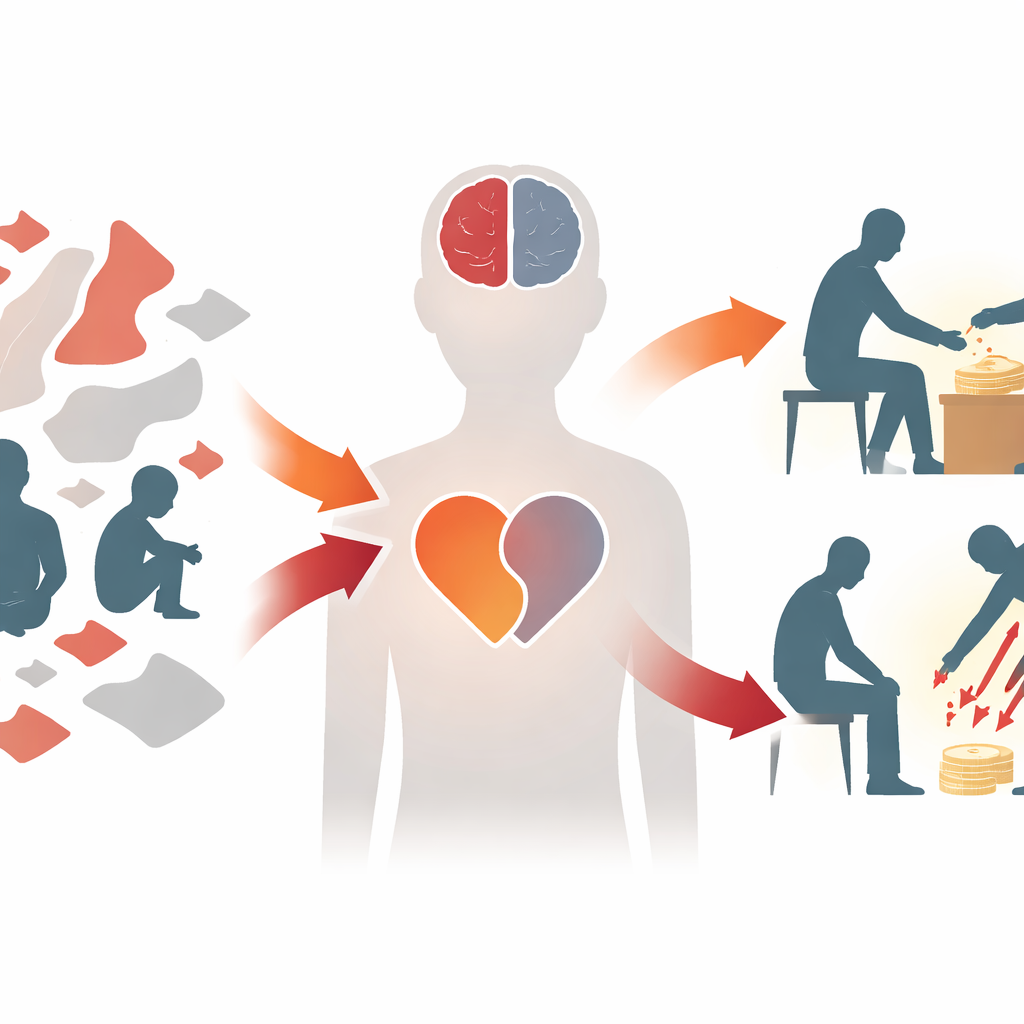
Childhood maltreatment—physical, emotional, or sexual abuse, and neglect—is tragically common worldwide and can derail emotional and social development. Two key skills shaped in early relationships are empathy (feeling with or about others) and mentalization (making sense of one’s own and others’ inner worlds). Past work has shown that early harm can blunt or distort both abilities. What has been less clear is how these changes show up when adults face real choices about whether to cooperate, share resources, or punish others for their behavior. This study set out to trace that path: from self-reported severity of childhood maltreatment, through empathy and mentalization, to concrete patterns of social decision-making.
Games that reveal hidden social habits
To do this, 327 adults recruited online completed standard questionnaires about childhood maltreatment, different facets of empathy, and mentalization. They then played a set of simple one-time economic “games” often used by psychologists and economists to model social dilemmas. In some games, players could share money-like points with others, revealing how inclined they were to cooperate when there was nothing to gain from reputation. In others, they could spend their own points to punish unfair players who broke sharing norms—or, more unusually, to punish partners who had actually behaved fairly and cooperatively, a pattern called antisocial punishment. Because each game was played only once, the choices captured participants’ baseline social tendencies rather than strategies built up over repeated interactions.
Two striking patterns in how people treat others
Surprisingly, higher levels of childhood maltreatment did not simply make people less cooperative or more punitive across the board. Instead, the link between early adversity and adult social choices showed up in two very specific situations. First, people who reported more severe maltreatment were less likely to act fairly toward another person when they knew a third-party observer could step in to punish unfairness. In other words, even under social scrutiny and clear moral pressure, they were more inclined to take resources from someone else. Second, those same individuals were more likely to spend their own resources to punish partners who had behaved cooperatively toward them—a paradoxical reaction that turns fairness itself into a target.
How feeling with others bends behavior
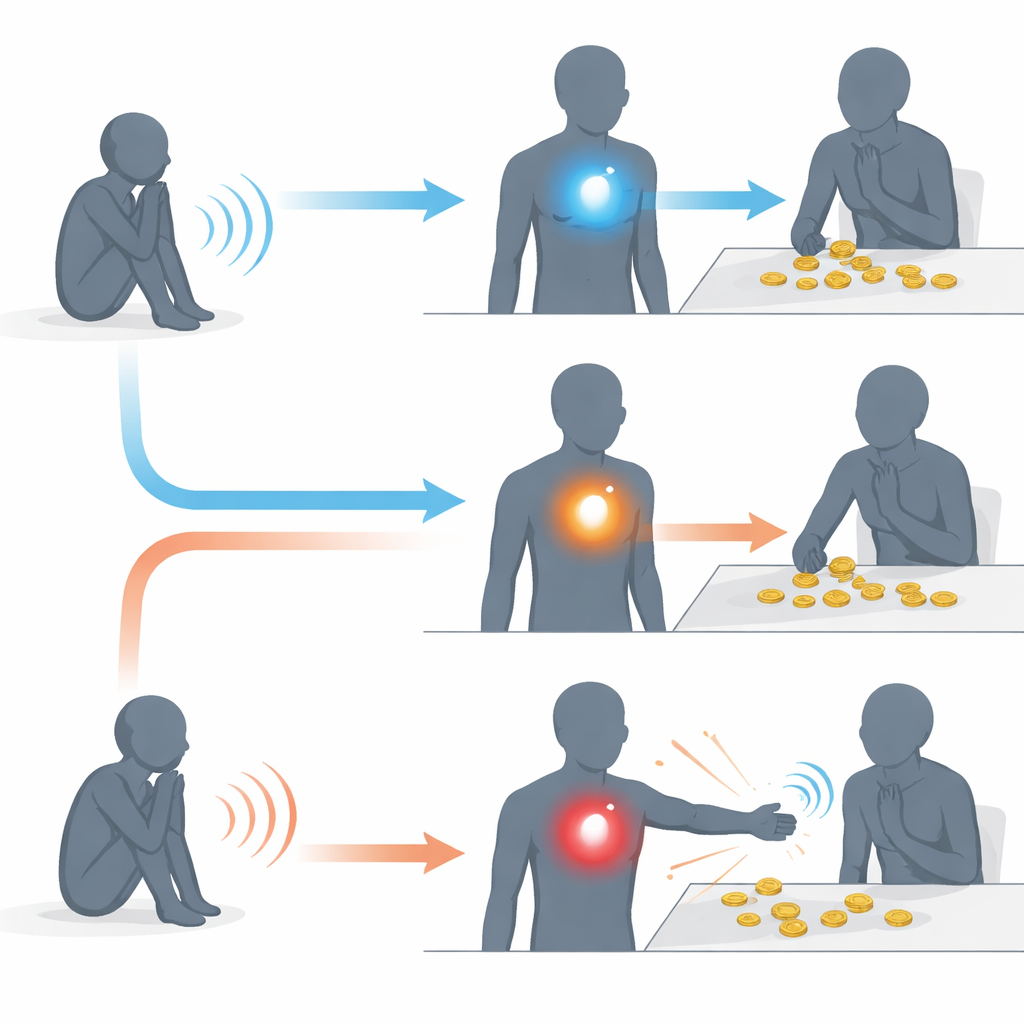
To understand why these patterns emerged, the authors examined different ingredients of empathy. They distinguished between “affective resonance,” in which a person emotionally echoes someone else’s feelings (for example, feeling uneasy when seeing another in pain), and “affective dissonance,” in which their emotions run opposite to the other’s suffering (for example, feeling a flicker of satisfaction when someone else is distressed). Statistical models showed that reduced resonance explained the link between maltreatment and failure to cooperate under observation: people who had experienced more childhood harm were less likely to emotionally tune in to the person they could hurt, and this blunted attunement made it easier to act selfishly. In contrast, heightened dissonance—taking less emotional discomfort, or even some pleasure, in the other’s disadvantage—explained the connection between maltreatment and antisocial punishment of cooperative partners.
Thinking about minds matters, but feeling shifts the scales
Mentalization—the capacity to reflect on what others think and feel—was also lower in participants with greater maltreatment histories and was related to their decisions when examined on its own. Yet when empathy and mentalization were tested side by side, the affective components of empathy carried the weight. This suggests that simply understanding another person’s perspective is not enough to steer social behavior toward fairness if the emotional resonance is missing or inverted. For people shaped by early trauma, the heart’s response to others’ emotions may be a more decisive driver of cooperation or spite than the mind’s ability to reason about intentions.
What this means for healing and everyday life
For a layperson, the takeaway is that some seemingly cold, selfish, or even cruel choices in adulthood may be rooted less in “bad character” and more in emotional wiring reshaped by early harm. The study shows that childhood maltreatment can dampen the natural emotional pull to avoid hurting others and, in some cases, tilt feelings in the opposite direction, making it easier to punish even those who play fair. Because these pathways run through specific aspects of empathy rather than broad personality traits, they offer hopeful targets for change. Interventions that gently rebuild the capacity to feel with others—and to notice when feelings of satisfaction at another’s misfortune arise—may help people with trauma histories make choices that are more aligned with fairness, connection, and long-term well-being.
Citation: Benoit, S., Maheux, J., Gamache, D. et al. Empathy and mentalization as mediators between childhood maltreatment and social decision-making during adulthood. Sci Rep 16, 9111 (2026). https://doi.org/10.1038/s41598-026-37273-9
Keywords: childhood maltreatment, empathy, social decision-making, antisocial punishment, economic games