Clear Sky Science · en
Surgical hematoma removal promotes skeletal muscle recovery in a rat laceration model
Why clearing a muscle bruise might speed your recovery
From weekend warriors to elite athletes, many people suffer torn or badly bruised muscles that leave behind painful pools of blood called hematomas. Doctors usually treat these injuries conservatively with rest and ice, and only sometimes operate to remove the trapped blood. This study used a rat model to ask a simple but important question: if you clear out that blood early, does the muscle actually heal and regain strength faster?
A closer look at muscle injuries and blood buildup
When a muscle is badly torn, tiny blood vessels rupture and leak blood into the tissue, forming a hematoma. That pocket of blood does more than just cause a visible bruise: it can stir up strong inflammation, trigger pain, and, over time, be replaced by stiff scar tissue that weakens the muscle. In real-world sports medicine, surgeons decide whether to drain a hematoma based on size, location, and symptoms, but there has been surprisingly little basic science explaining how removal changes healing inside the muscle itself. The authors set out to fill this gap using a controlled injury to the tibialis anterior, a major muscle along the shin, in laboratory rats.
Testing early surgical clean-up in rats
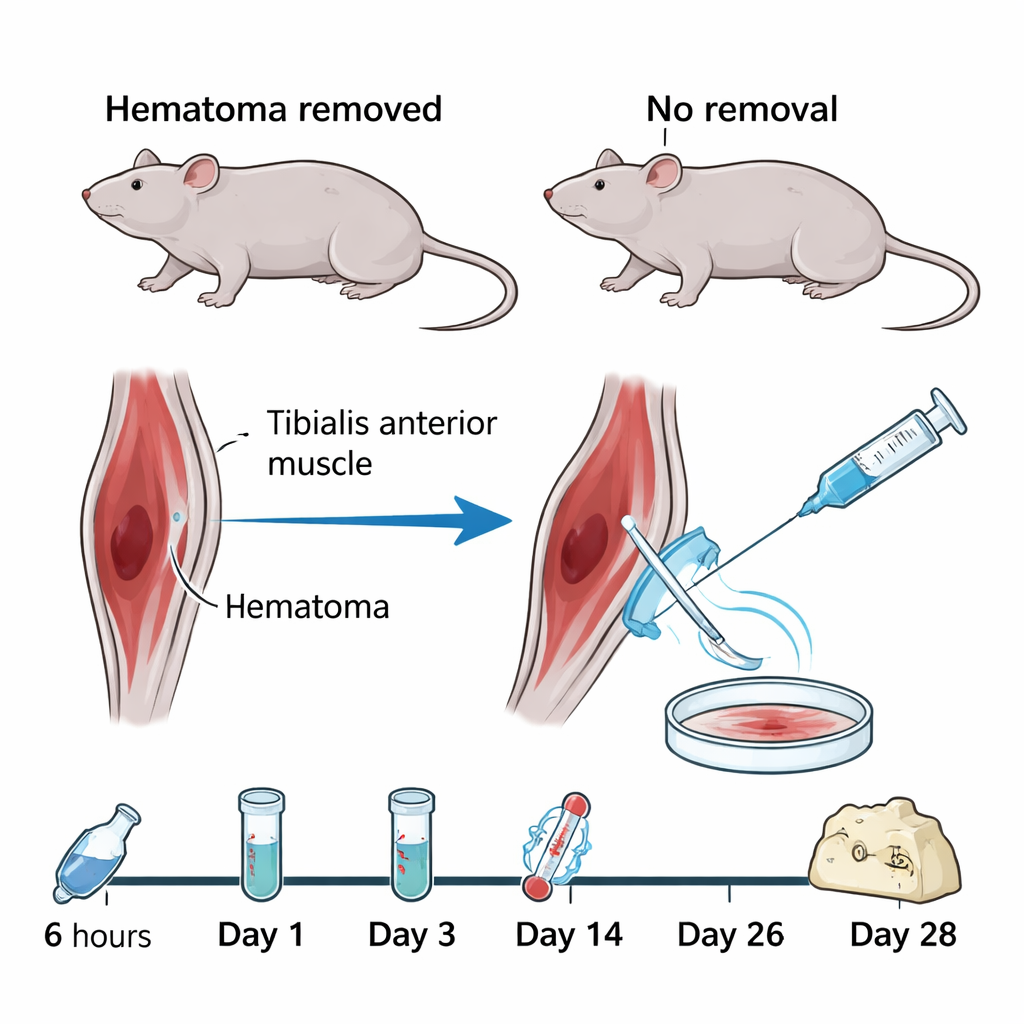
The researchers created a standardized cut in the shin muscle of both hind limbs in each rat. Six hours later, they left one side alone as a control and surgically flushed out the hematoma on the other side using sterile saline. Over the following hours and weeks, they measured how large the remaining hematoma was, how much tissue looked abnormal under the microscope, how strong the muscle contractions were, and which genes linked to inflammation and healing were switched on. This design let them directly compare, within the same animal, how muscles healed with or without early hematoma removal.
Less blood, less inflammation, stronger muscles
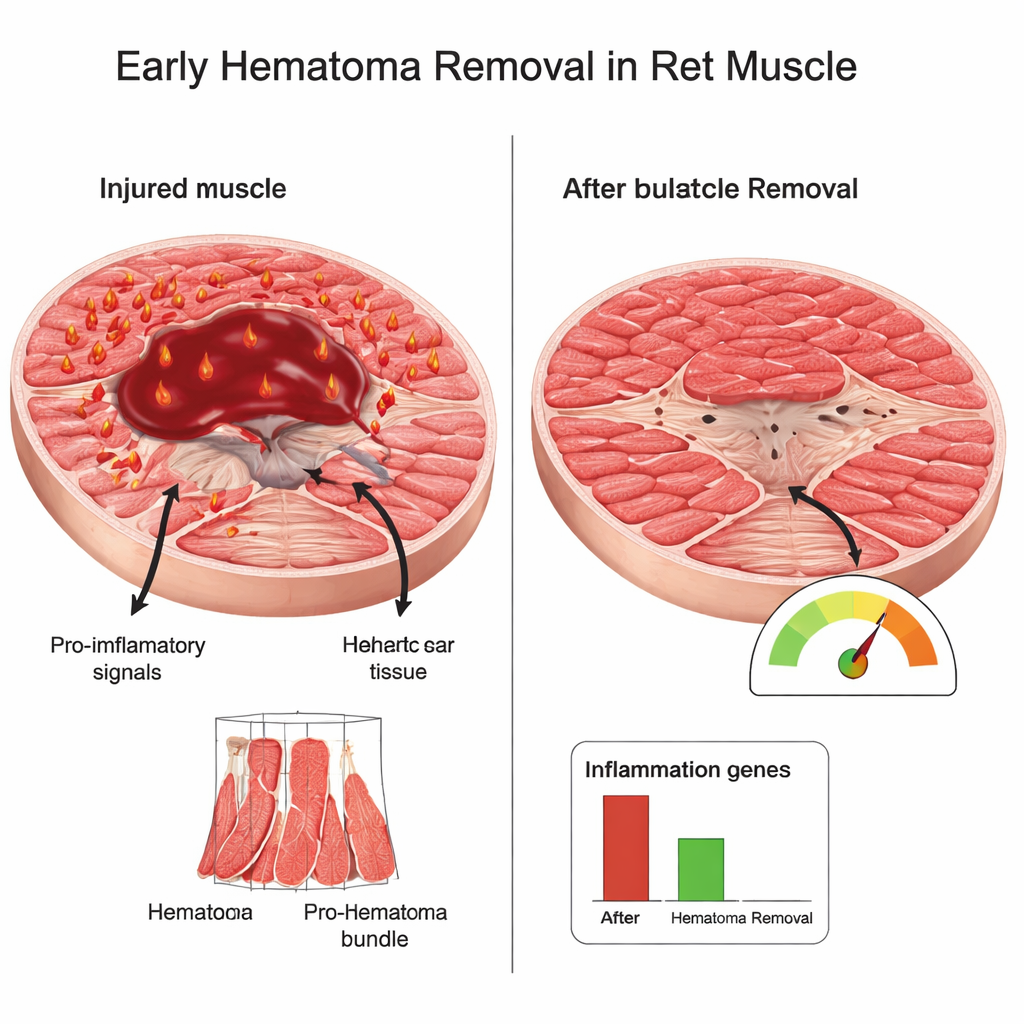
Within 24 hours, muscles that had been cleaned out showed a clearly smaller hematoma than untreated muscles. At 3 and 14 days after injury, the area of abnormal tissue—regions where fibers were disorganized, spaces between cells had widened, and inflammatory cells had piled up—was also significantly smaller when the hematoma had been removed. This structural advantage translated into performance: by day 3, the treated muscles produced a higher fraction of normal twitch and tetanic (sustained) force than untreated muscles, and this strength benefit persisted through days 14 and 28. Importantly, these effects were seen in both male and female rats, and simple reopening of the wound without actually removing the hematoma did not improve recovery.
What was happening at the molecular level
To understand why the muscles behaved differently, the team analyzed gene activity in the injured tissue during the first few days, when inflammation is at its peak. In muscles where the hematoma had been removed, many genes that drive inflammation and inflammatory pain—such as several interleukins, tumor necrosis factor, enzymes that produce inflammatory molecules, and nerve growth factor—were expressed at markedly lower levels. Markers of immune cells called macrophages, which flock to damaged tissue, were also reduced. In contrast, genes that guide muscle cell growth and differentiation did not differ much between groups. This suggests that early hematoma removal mainly works by curbing excessive inflammation and limiting the spread of damaged, fibrotic tissue, rather than by directly boosting the muscle’s built-in regeneration program.
How surgery compares to anti-inflammatory drugs
The researchers also compared surgery with meloxicam, a commonly used anti-inflammatory painkiller. Animals given meloxicam had lower expression of several inflammatory genes, including the well-known COX-2 enzyme, and showed some improvement in muscle twitch force compared with no treatment. However, rats that underwent hematoma removal still had smaller areas of abnormal tissue and better recovery of both twitch and sustained force than those treated with the drug alone. This finding implies that physically clearing the blood and debris from the injury site may offer benefits that medication alone cannot match, likely by preventing the formation of bulky scar tissue that mechanically weakens the muscle.
What this could mean for injured people
For now, these results apply to a specific type of cut injury in rats, and more work is needed to determine the best timing, how this translates to common strains and contusions, and how to balance surgery against simpler treatments. Nonetheless, the study supports the idea that when a large muscle hematoma is present, early, carefully performed removal may not just ease pain but also limit inflammation, reduce long-term scarring, and help the muscle regain strength more fully. In the future, this kind of evidence could guide doctors in deciding when prompt hematoma management should be part of the initial strategy for treating serious muscle injuries.
Citation: Ren, Y., Kanamoto, T., Miyazaki, R. et al. Surgical hematoma removal promotes skeletal muscle recovery in a rat laceration model. Sci Rep 16, 6206 (2026). https://doi.org/10.1038/s41598-026-37267-7
Keywords: muscle injury, hematoma removal, inflammation, muscle recovery, sports medicine