Clear Sky Science · en
Non-destructive prediction of carbonization indices in biochar derived from underutilized forest biomass using ATR-IR chemometric modeling
Turning Forest Leftovers into Climate Helpers
Across the world, mountains of branches, treetops, and other forest leftovers are burned or left to rot, quietly releasing their carbon back into the air. This study explores how those underused forest scraps can be turned into biochar—a charcoal-like material that locks away carbon for decades or centuries. Even more, it shows how the quality of that biochar can be checked quickly and without destroying it, using light-based measurements instead of slow, expensive lab tests. 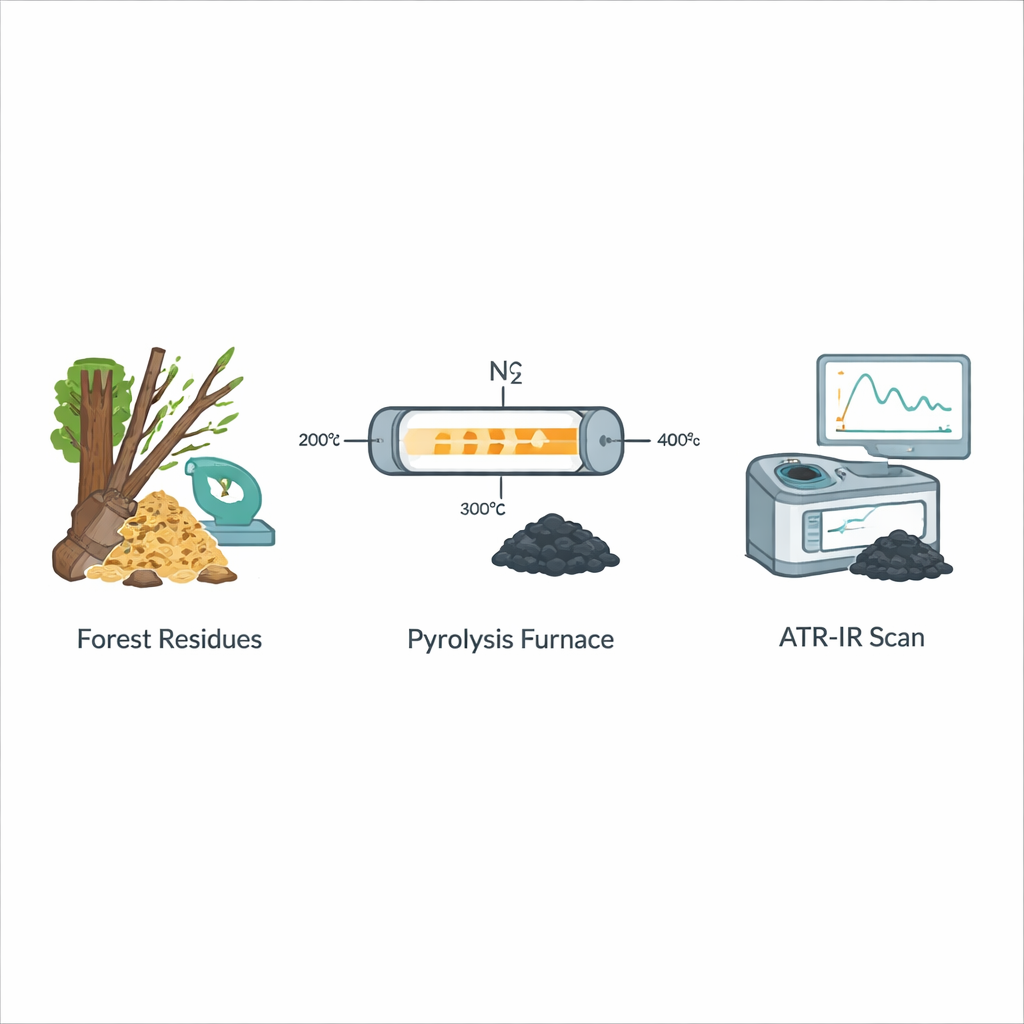
From Waste Wood to Stable Carbon
In South Korea alone, more than a million tons of forest residues go largely unused each year. The authors of this paper see that not as waste, but as raw material for biochar, which can improve soils, store carbon, and serve in filters or energy devices. They produced biochar from this mixed forest biomass at three moderate heating temperatures—200 °C, 300 °C, and 400 °C—under oxygen-free conditions so the wood would not burn, but slowly turn into a carbon-rich solid. Traditional chemical analysis showed that as temperature increased, carbon content rose while hydrogen and oxygen dropped, meaning the material became more coal-like, more stable, and better suited to long-term carbon storage.
Reading Biochar with Invisible Light
Measuring those chemical shifts normally requires specialized machines that burn tiny portions of the sample, making testing slow and costly. Instead, the researchers used attenuated total reflectance infrared (ATR-IR) spectroscopy, which shines invisible infrared light on the surface of the biochar and records how different chemical bonds vibrate. Each sample produced a detailed “fingerprint” spectrum. To prepare these fingerprints for analysis, the team digitally cleaned and normalized them, then applied mathematical techniques that sharpen overlapping signals. They also used a method called principal component analysis to confirm that the spectra changed in a clear, ordered way as the heating temperature increased, reflecting the gradual loss of water-loving groups and the growth of rigid, ring-shaped carbon structures.
Teaching a Model to Predict Carbon Quality
To turn spectra into useful numbers, the researchers built chemometric models—essentially, statistical translation tools—that link the infrared fingerprints to key carbonization indices: the percentage of carbon, and the atomic ratios of oxygen-to-carbon (O/C) and hydrogen-to-carbon (H/C). Using partial least squares regression, they trained the model on many repeated measurements, carefully checked its performance with cross-validation, and removed data points that behaved like outliers. The refined models predicted all three indices with striking accuracy (with R² values above 0.94), meaning that for new samples, the infrared spectrum alone can reliably estimate how carbonized and stable the biochar is. 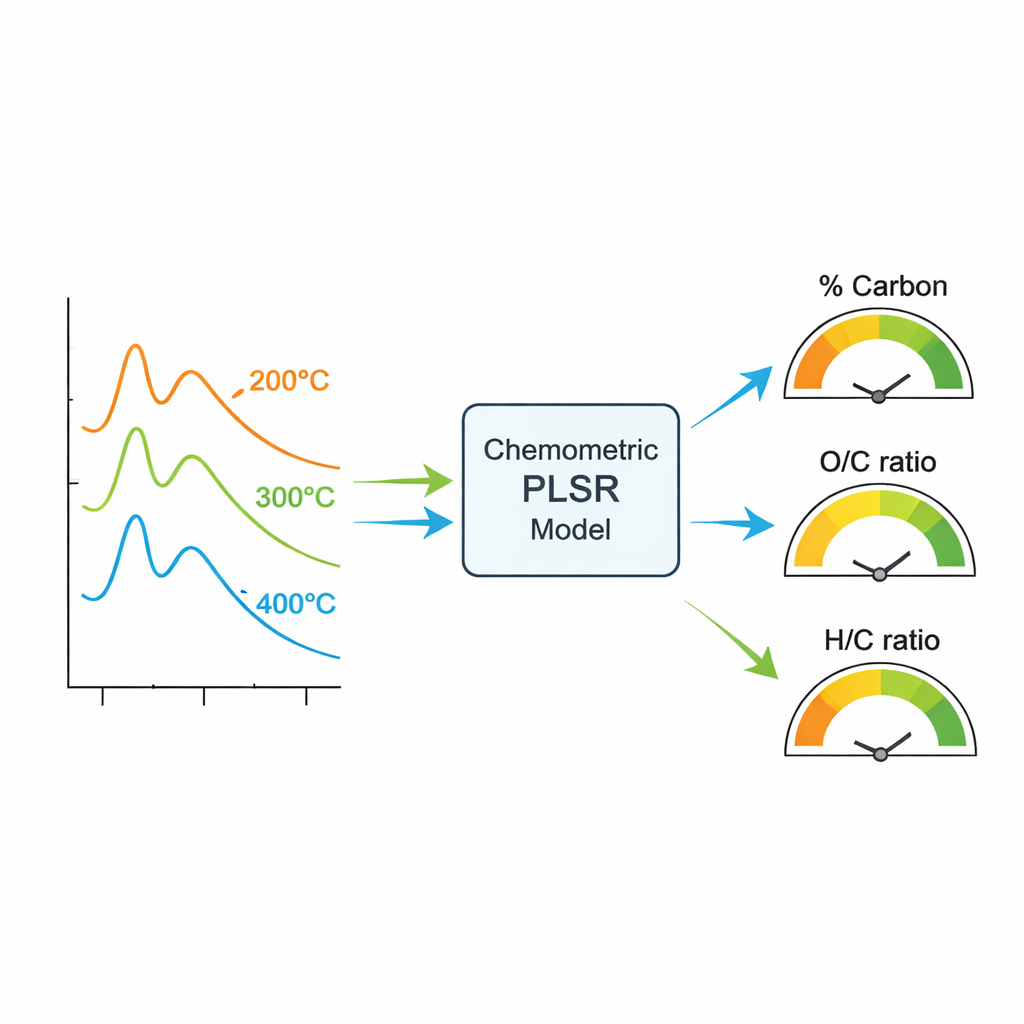
Finding the Most Telling Signals
Beyond accuracy, the team wanted to understand which parts of the spectrum mattered most. They calculated “variable importance” scores that highlight the wavelengths carrying the strongest clues about carbon quality. Regions linked to the breakdown of carbohydrates and the growth of aromatic, ring-like carbon structures stood out. These same regions also emerged in their earlier pattern analysis, giving confidence that the model was not a black box but reflected real chemical changes inside the material. The fact that such performance was achieved with relatively simple, transparent statistics—rather than opaque machine-learning systems—makes the approach easier to adopt and trust in practical settings.
What This Means for Climate and Forest Use
For a layperson, the bottom line is that this work turns a difficult, destructive lab test into a quick “scan” that leaves the sample intact. By pointing an infrared sensor at a pinch of biochar, producers could estimate on the spot how much carbon it holds and how stable that carbon is. This could speed up quality control, support smarter use of forest residues, and help scale up biochar as a tool for locking atmospheric carbon into solid form. While the current model is tuned to one type of biomass and specific heating conditions, the same strategy can be expanded to more feedstocks and furnaces, paving the way toward more reliable, climate-friendly biochar production.
Citation: Kim, Y., Hwang, C., Shin, H. et al. Non-destructive prediction of carbonization indices in biochar derived from underutilized forest biomass using ATR-IR chemometric modeling. Sci Rep 16, 6054 (2026). https://doi.org/10.1038/s41598-026-37261-z
Keywords: biochar, forest biomass, carbon sequestration, infrared spectroscopy, chemometric modeling