Clear Sky Science · en
Experimental and numerical study on temperature characteristics of geosynthetics-reinforced soil retaining walls in Taklimakan Desert
Why Desert Walls and Heat Matter
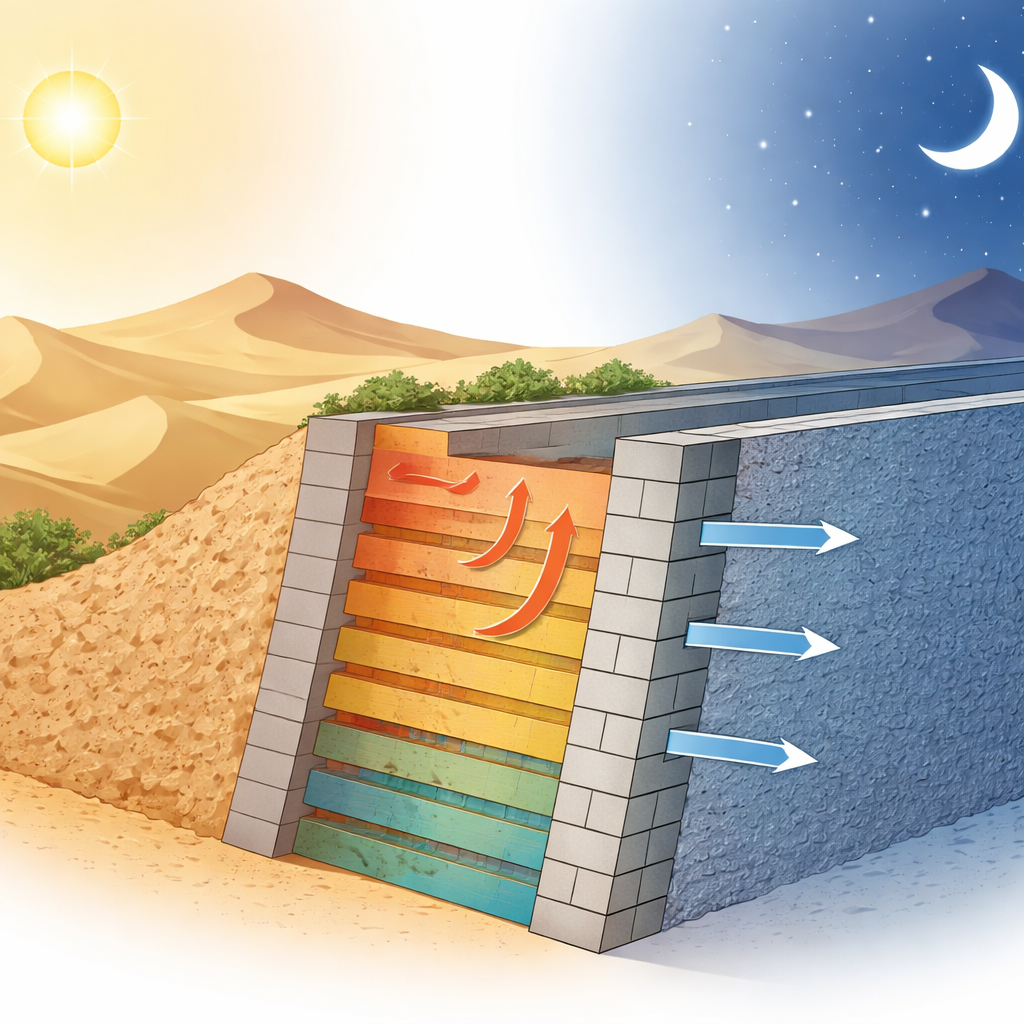
Across the world’s great deserts, roads and bridges depend on tall earth walls to hold up lanes and ramps. These structures, called reinforced soil retaining walls, are cheaper and easier to build than solid concrete walls, but they must survive brutal swings in temperature—from scorching days to bitterly cold nights and winters. This study looks inside one such wall in China’s Taklimakan Desert to find out how heat and cold actually move through the sand and reinforcing layers over the course of years, and what that means for the long‑term safety of desert highways.
Building a Desert Wall in the Lab
The researchers began by recreating a highway retaining wall in a temperature‑controlled chamber. Instead of full size, they built a carefully scaled‑down model: stacked modular blocks formed the visible face, layers of plastic geogrid acted like hidden belts reaching back into the soil, and dry desert sand from the Taklimakan served as the backfill. Dozens of temperature sensors were buried at different heights and depths inside the wall. The team then drove the chamber through a series of temperature steps mimicking a full year in the desert, from summer heat above freezing to winter lows well below, and repeated this cycle five times to see how the wall’s internal temperatures evolved.
How Heat Creeps In and Out
Measurements from the model wall showed that the sand near the exposed surfaces—the front face and the road at the top—responded strongly to changes in air temperature, while regions buried deeper stayed comparatively stable. When the air heated or cooled, the hottest and coldest points inside the wall appeared later in time, and this delay grew with each cycle because the dry sand conducts heat poorly. Close to the face and top, temperatures rose and fell in regular waves that echoed the outside climate, but the waves shrank and smoothed out as they traveled inward. Some sensors near the back and bottom behaved oddly because of small gaps and insulation imperfections in the test setup, highlighting how real‑world boundary conditions can complicate temperature patterns.
From Lab Wall to Full‑Scale Highway
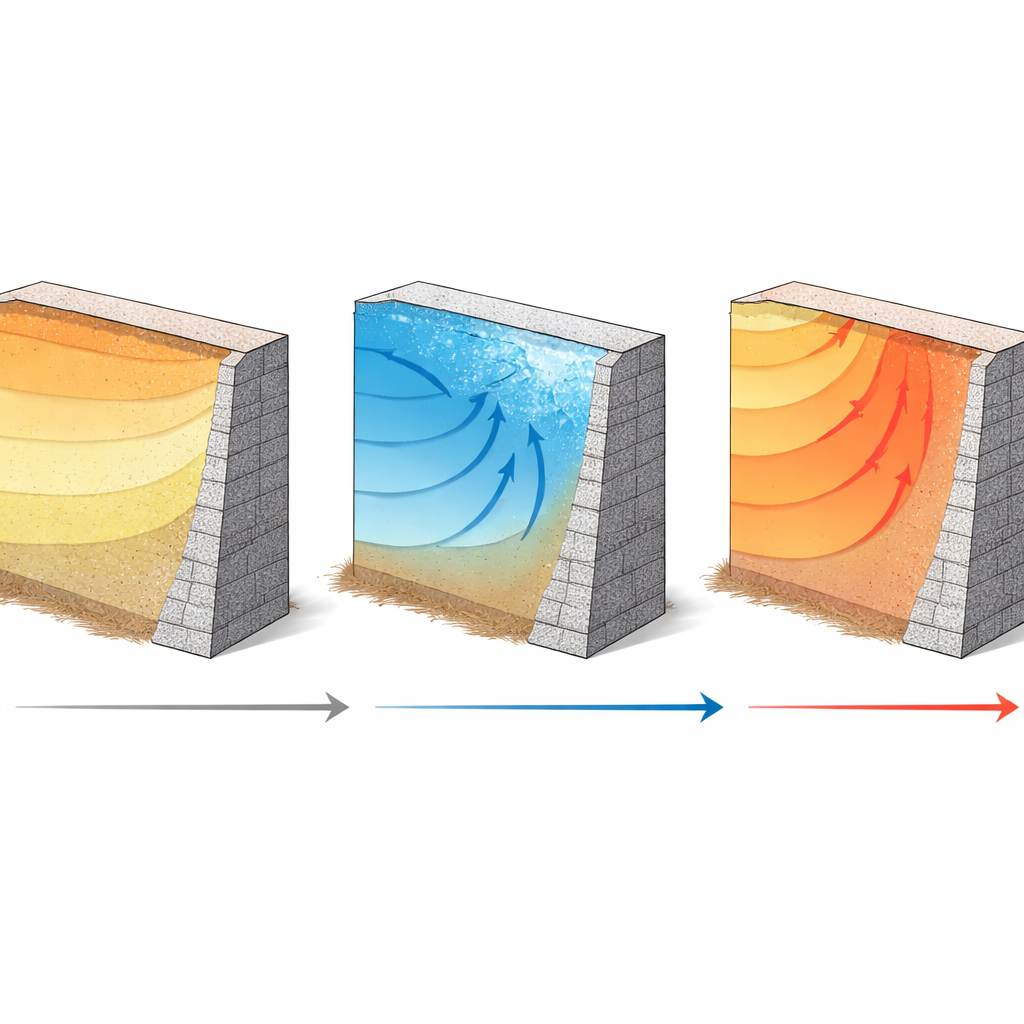
To understand what happens in an actual road embankment over several years, the team built a detailed computer model that reproduced the test wall and verified it against the laboratory data. Once the match was good, they scaled up to a full‑size wall typical of Taklimakan highways, including a thick asphalt pavement on top and the effect of solar radiation heating the outer surfaces. Using real desert temperature records, they simulated five years of daily heating and cooling. The results showed that when outside temperatures were at their yearly low, cold penetrated the wall in a curved “hyperbolic” pattern, with the strongest cooling near the exposed face and crest. With each passing year, both the depth of winter freezing below the road and the horizontal reach of frozen sand into the wall slowly increased.
Hidden Cold and Hot Cores Inside the Wall
The long‑term simulations revealed that the internal temperature field does not just swing smoothly up and down. As temperatures rise from winter to summer, a pocket of especially cold sand forms near the upper front corner of the wall—a “freezing core” created because cold reaches this area from both the face and the road surface and then drains inward only slowly through the low‑conductivity sand. Later in the year, as the desert cools from its hottest period, a mirror‑image “heated core” of trapped warmth appears in nearly the same region. Over a full annual cycle, the wall’s interior shifts from a simple layered pattern, to a core‑dominated state, and back again, while deeper regions near the base remain close to their initial moderate temperature.
Zones That Deserve Extra Care
By slicing the simulated wall horizontally and plotting temperature across these slices, the authors identified “temperature‑sensitive zones” where conditions change sharply with time and distance. In the band extending a few meters behind the face—especially near the top—temperatures fluctuate strongly and gradients are steep, which can weaken sand strength, strain the bond between blocks, sand, and geogrid, and promote problems like frost heave, cracking, or long‑term material fatigue. Farther back, temperatures become nearly constant and close to the starting value, meaning the soil there is largely insulated from the harsh desert climate.
What This Means for Safer Desert Roads
In plain terms, the study shows that extreme desert temperatures mainly threaten the “skin” of reinforced soil walls and a limited depth of material just behind it, not the entire mass. However, the most critical structural elements—the face blocks, near‑surface sand, and reinforcing layers close to the front—sit exactly in this sensitive zone where freezing and heating cores develop over the years. Understanding how deep and how strongly these temperature effects reach gives engineers a clearer basis for choosing backfill materials, detailing reinforcement, and planning maintenance so that desert highways can better withstand decades of thermal punishment.
Citation: Gao, Y., Meng, K., Wang, S. et al. Experimental and numerical study on temperature characteristics of geosynthetics-reinforced soil retaining walls in Taklimakan Desert. Sci Rep 16, 7861 (2026). https://doi.org/10.1038/s41598-026-37260-0
Keywords: desert infrastructure, retaining walls, temperature cycles, geosynthetic reinforcement, aeolian sand