Clear Sky Science · en
Clinical relevance of tissue copper, selenium, and cadmium alterations in colorectal cancer
Why tiny metals in our gut matter
Colorectal cancer is one of the most common and deadly cancers worldwide, yet we still rely heavily on invasive tests like colonoscopy to find and track it. This study looks at something far less obvious but potentially powerful: the pattern of tiny metals and minerals inside bowel tumors compared with nearby healthy tissue. By examining how elements such as copper, selenium, and cadmium shift inside the colon, the researchers explore whether these hidden chemical fingerprints could help us better understand, classify, and one day diagnose colorectal cancer.
Hidden chemistry inside colon tumors
Our bodies depend on trace elements—metals and minerals needed in very small amounts—for essential tasks like controlling damage from oxygen, maintaining DNA, and running enzymes. But when their levels drift out of balance, they can fuel disease. The team studied tissue from 62 patients with colorectal cancer, always taking a pair of samples: one from the tumor and one from nearby normal-looking colon. Using a highly sensitive technique that detects metals at extremely low levels, they measured ten elements, including copper (Cu), manganese (Mn), zinc (Zn), selenium (Se), and cadmium (Cd). They then used both classical statistics and machine-learning tools to see which patterns lined up with how advanced the cancer was and with basic patient traits such as sex and place of residence.
A consistent copper signal and shifting defenses
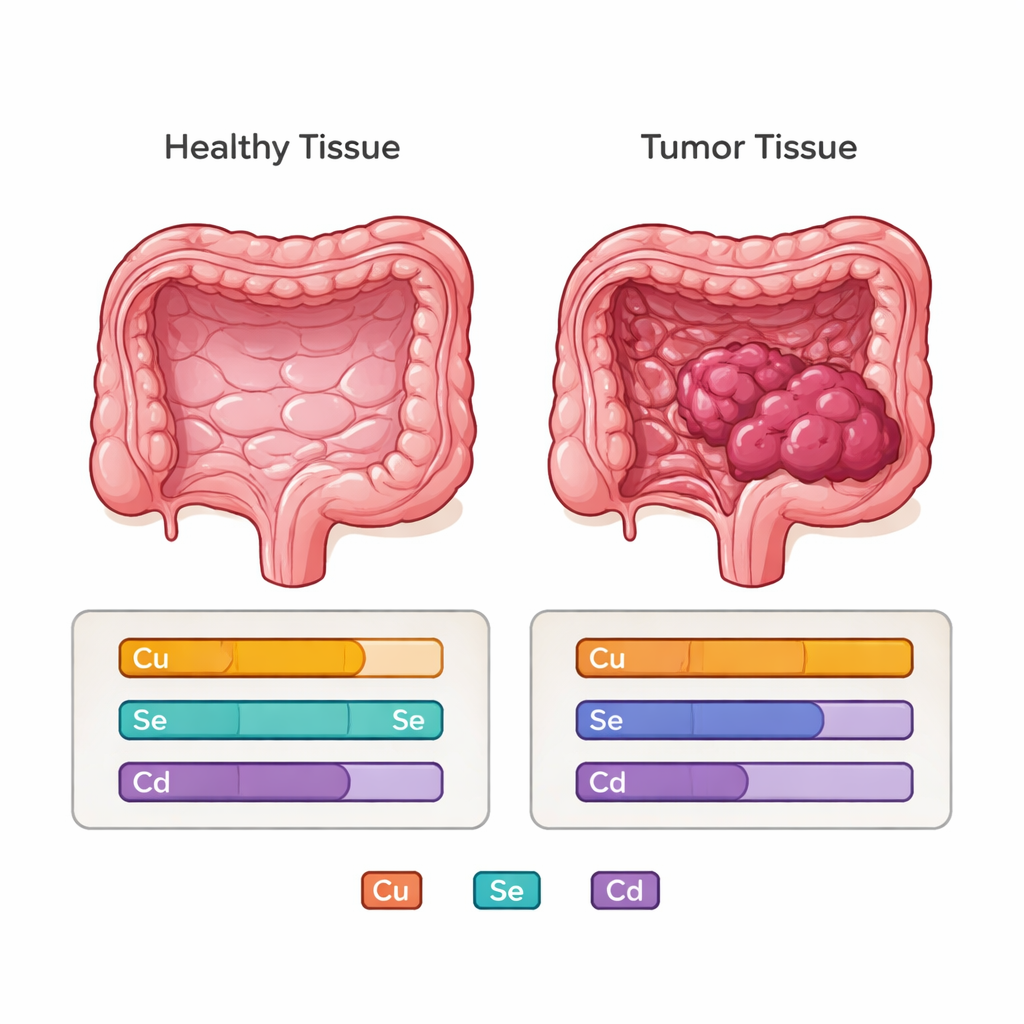
The comparison between tumor and healthy tissue revealed a clear chemical tilt. Tumors generally contained more copper and manganese and less selenium and cadmium than the tissue right next to them. When the researchers broke the data down by cancer stage, they saw a dynamic picture: in early stages, several protective elements such as selenium, zinc, strontium, and cadmium tended to be depleted in tumors. By stage 3, the pattern shifted toward pronounced increases in copper and manganese inside cancerous tissue. Patients whose lymph nodes were involved and those in more advanced Tumor Node Metastasis categories were especially likely to show higher tumor copper and manganese, along with lower selenium, in their tumor samples.
Links to sex, environment, and metal ratios
The chemistry of the tissue also reflected who the patients were and where they lived. Women had higher cadmium levels in their healthy colon tissue than men, echoing previous findings from blood studies. People living in large cities tended to have more selenium in healthy tissue than those from villages, although after strict statistical correction most location-based differences were modest. When the team looked not only at single elements but at ratios between them, striking contrasts emerged: copper-to-zinc and manganese-to-zinc ratios were clearly higher in tumors, while the iron-to-copper ratio was lower. These shifts suggest that tumor tissue favors conditions that promote oxidative stress, damaged cell defenses, and the growth of new blood vessels that feed the cancer.
Letting algorithms sift the chemical clues
To see which measurements mattered most for classifying how advanced a patient’s cancer was, the researchers turned to a feature-selection algorithm called Boruta. This method repeatedly tests which variables carry real information beyond random noise. As expected, standard medical indicators such as lymph node status and staging category ranked highly. But one chemical feature repeatedly stood out alongside them: whether copper was increased in the tumor compared with that patient’s own healthy tissue. This relative copper rise, rather than any absolute cutoff value, emerged as a stable marker linked to both overall clinical stage and Tumor Node Metastasis classification, even in a relatively small patient group.
What this means for patients
For lay readers, the message is that colorectal tumors do not just look different under the microscope—they also carry a distinct metal signature. Tumors in this study tended to hoard copper and manganese while losing selenium and cadmium relative to nearby healthy bowel. The standout finding is a consistent increase in copper within tumor tissue that tracks with how advanced the cancer is. While this research does not yet offer a new screening test, it shows that measuring trace elements directly in tissue, and focusing on how they change within each person, could deepen our understanding of tumor biology and support future biomarker discovery. With larger, follow-up studies that also track diet and environmental exposures, these elemental fingerprints might one day aid in more precise diagnosis and treatment planning for colorectal cancer.
Citation: Kiełbus, M., Wojnicka, J., Prystupa, A. et al. Clinical relevance of tissue copper, selenium, and cadmium alterations in colorectal cancer. Sci Rep 16, 6700 (2026). https://doi.org/10.1038/s41598-026-37256-w
Keywords: colorectal cancer, trace elements, copper, selenium, biomarkers