Clear Sky Science · en
Effects of mass concentration and curing age on the mechanical properties and damage evolution of aeolian sand backfill
Filling Hidden Voids to Keep Mines Safe
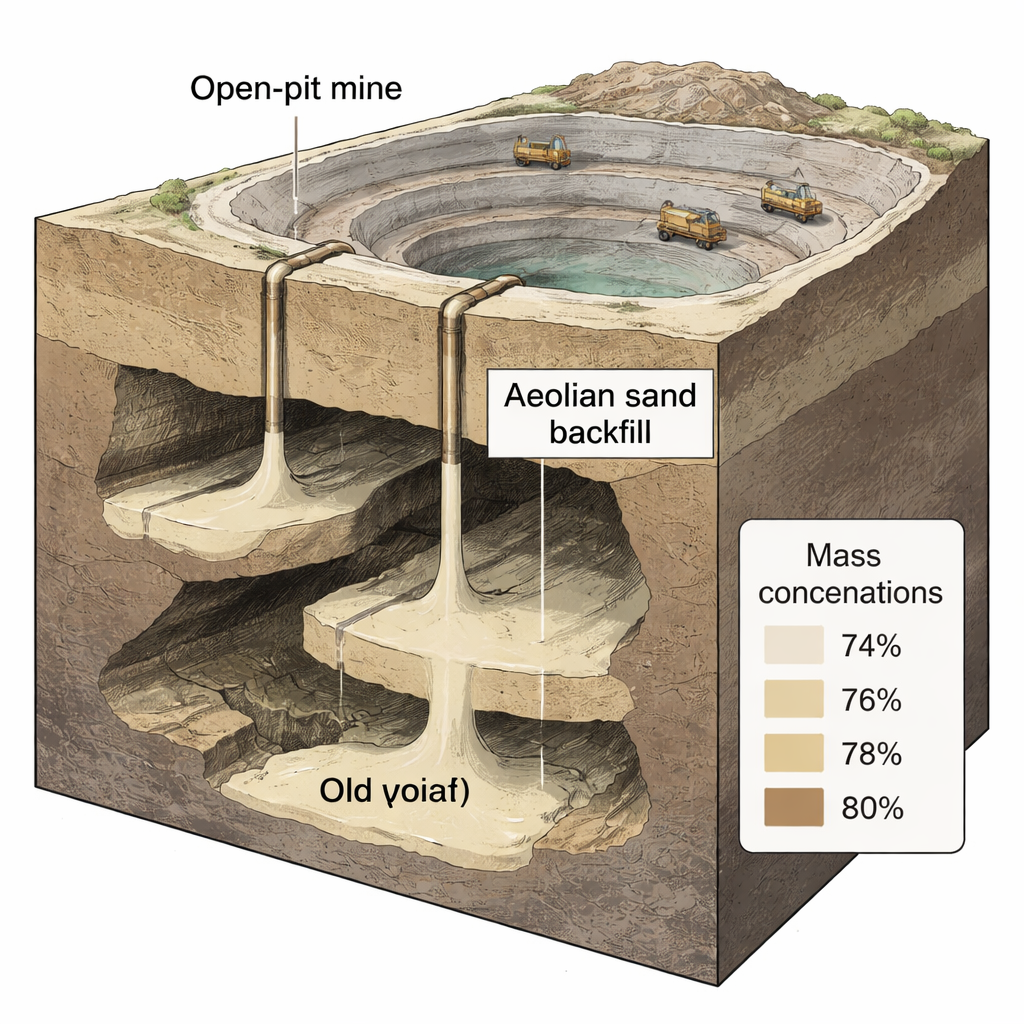
Far beneath some open-pit coal mines lie older underground tunnels and empty spaces, called goafs, left behind by past mining. If these hidden voids are not properly supported, the ground above can sink or collapse, threatening workers, equipment, and nearby communities. This study explores how to turn wind-blown desert sand into a strong, reliable backfill material that can safely support the rock above these old voids while also recycling local waste and reducing the need for scarce river sand.
Turning Desert Sand into a Support Material
The researchers focused on aeolian sand—fine, wind-blown sand common in north-western China—as a main ingredient of mine backfill. They blended this sand and loess (a silt-rich soil) with a binder made from cement and fly ash, then added water to create a pumpable slurry. Once pumped into underground voids, this mixture hardens into a solid “artificial rock” that props up the overlying layers. To see how well this material performs, the team prepared standard-sized cylinders with different “mass concentrations” (the proportion of solid material in the mix) ranging from 74% to 80%, and cured them for different lengths of time from 3 to 28 days.
Testing Strength, Stiffness, and Failure
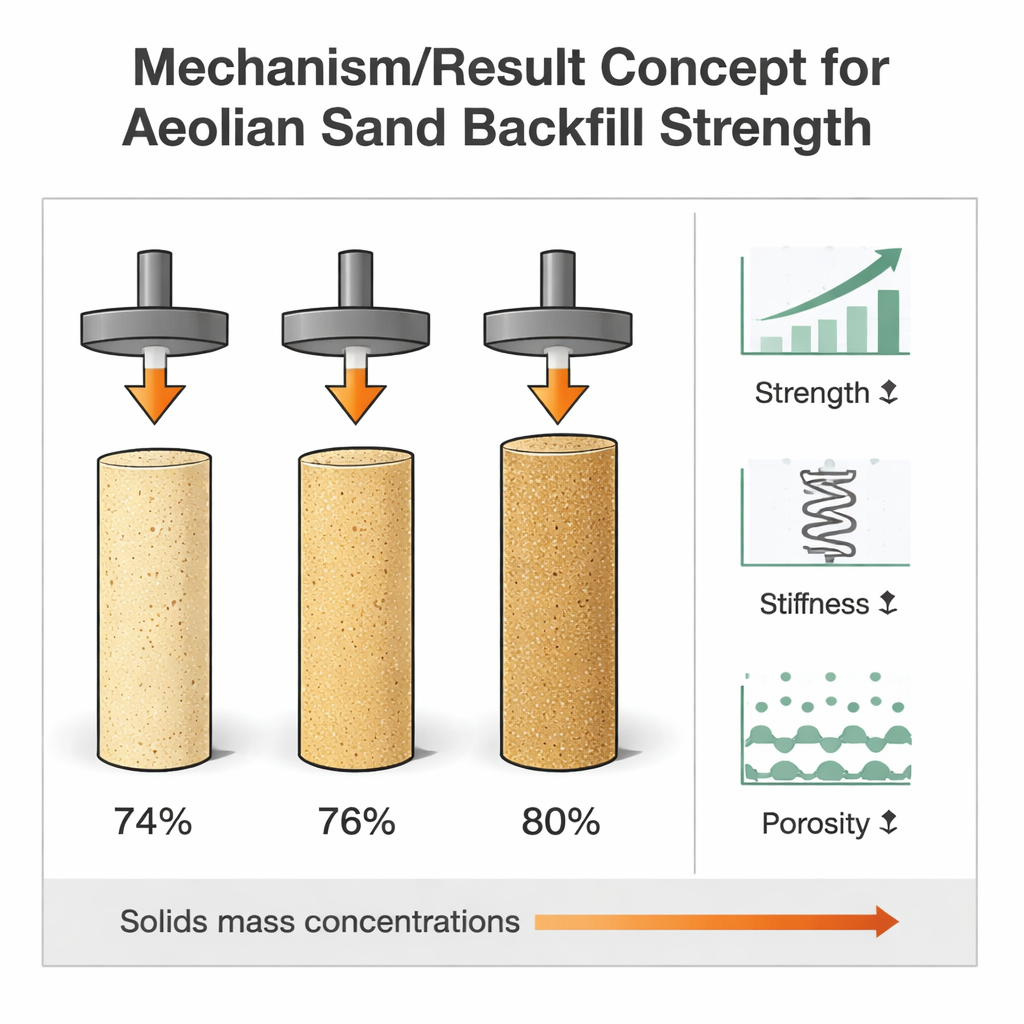
The hardened samples were squeezed in a compression machine until they broke, while sensors listened for tiny cracking sounds inside the material. These tests showed that both the load the samples could carry (strength) and how stiff they were (how little they deformed under load) rose steadily as the mix was made denser. At a mass concentration of 80% and 28 days of curing, the material reached its highest strength and stiffness. Time also mattered: strength did not grow in a straight line, but instead increased rapidly in the first two weeks and then more slowly, as cement and fly ash continued to react with water and knit the grains together.
Listening to Cracks and Tracking Energy
To better understand how the material fails, the team used acoustic emission monitoring—essentially “listening” for microscopic crack activity—and analyzed how mechanical energy was stored and released during loading. At lower concentrations, cracking started earlier and spread gradually throughout the sample, producing many small signals and a gentler, more ductile failure. At higher concentrations, the internal structure was more uniform and tightly bonded, so the material could store more elastic energy, like a compressed spring. Just before failure, this stored energy was released suddenly, producing a burst of intense acoustic signals and a sharp, brittle break. As concentration increased, the share of input energy stored elastically rose, while the share lost to permanent damage and friction fell, revealing a shift toward stronger but more abrupt failure.
Seeing the Inner Structure
The researchers also examined the material’s internal structure under a powerful microscope. In mixes with lower solid content, the binder could not fully fill the gaps between sand and soil grains; the result was a loose, porous structure with many pathways for cracks to form and grow. As mass concentration increased, more reaction products formed and filled these voids, tying particles together into a denser, more even network. At the highest concentration, the backfill appeared compact and well bonded, with far fewer pores. This microscopic picture matched the mechanical test results: denser, better bonded structures led to higher strength and stiffness, but also to more sudden, brittle failure when overloaded.
What This Means for Safer, Cleaner Mining
For non-specialists, the message is straightforward: by carefully tuning how much solid material is in the mix and how long it is allowed to cure, engineers can turn abundant desert sand into a strong, predictable support for old underground mine workings. Higher concentrations and adequate curing time create a denser, more uniform “artificial rock” that carries more weight and provides more reliable support, though it tends to fail more suddenly if pushed beyond its limits. These insights give mine designers practical guidance on choosing mix recipes and curing times that balance safety, material use, and environmental impact in open-pit coal mines.
Citation: Zhao, G., Zhang, Y., Zhang, G. et al. Effects of mass concentration and curing age on the mechanical properties and damage evolution of aeolian sand backfill. Sci Rep 16, 6321 (2026). https://doi.org/10.1038/s41598-026-37254-y
Keywords: mine backfill, aeolian sand, underground void stability, cemented fill strength, open-pit coal mining