Clear Sky Science · en
Patterns and associations of summer thermal comfort and students’ physical activity in campus green spaces
Why campus shade matters on hot summer days
As summers grow hotter, many college students face a quiet dilemma: go outside to move, play, and relax, or stay indoors to avoid the heat. This study looks closely at how different kinds of campus green spaces—open plazas, leafy gardens, and casual recreation lawns—shape students’ comfort and willingness to be active on a hot Chinese campus. Its findings offer practical lessons for any university trying to protect student health and keep outdoor life thriving in a warming world.
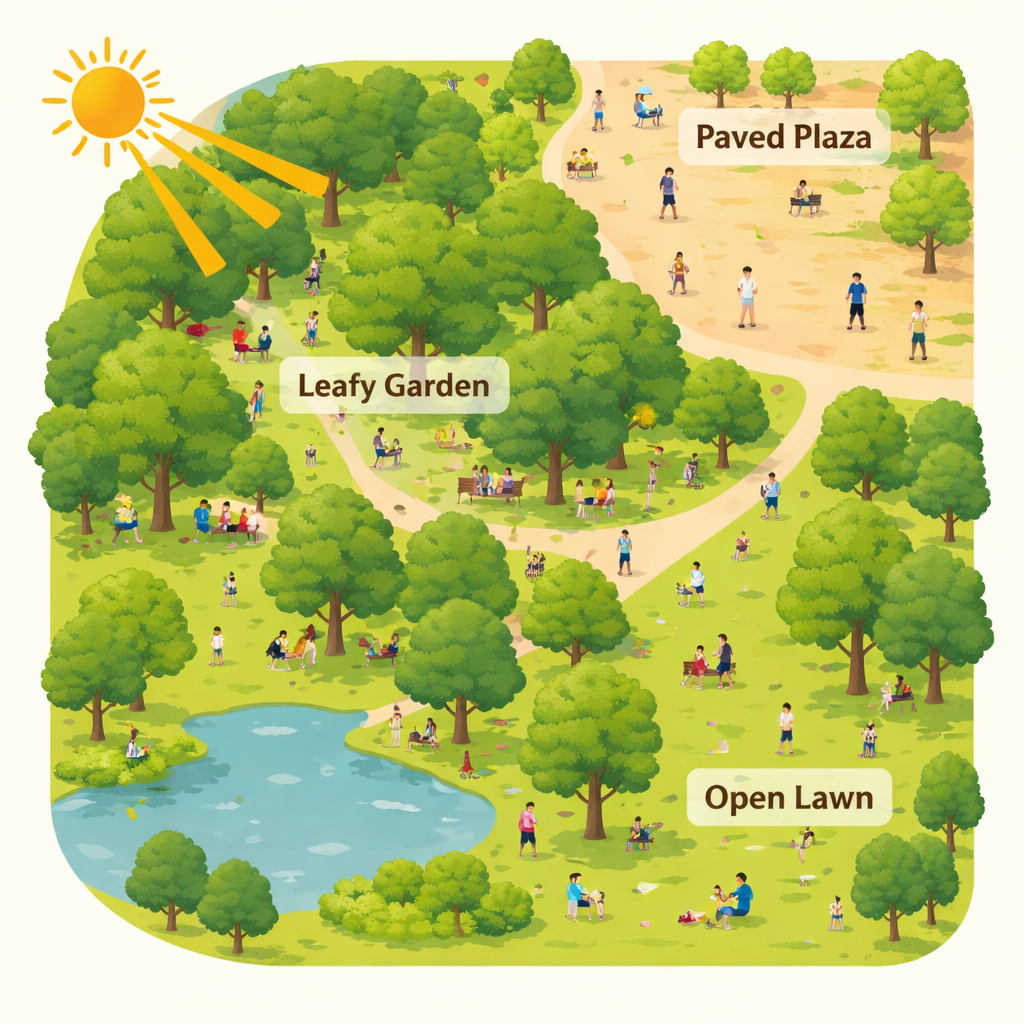
Different outdoor spots, different heat realities
The researchers focused on the West Campus of Yangtze University, a tree‑rich but heat‑exposed campus in central China. They selected ten representative outdoor areas and grouped them into three everyday types: plaza‑type spaces dominated by paving and surrounded by buildings; rest‑type spaces that feel like small gardens, with dense tree cover and benches; and leisure‑type spaces such as lawns or waterfront edges used for informal recreation and sports. Over several typical summer days, they combined on‑site weather measurements, nearly a thousand questionnaires, and thousands of direct observations of how many students used each space and what they were doing.
Tracking heat and comfort through the day
To translate the weather into what people actually feel, the team used a comfort index called Physiological Equivalent Temperature, which blends air temperature, sunlight, humidity, and wind into a single "feels‑like" value. Across the day, all spaces heated up from morning to early afternoon and cooled toward evening, but not equally. Plaza‑type spaces warmed fastest and peaked near a sweltering 42 °C on this scale, reflecting hard pavement and little shade. Rest‑type garden spaces stayed much cooler, peaking around 32–33 °C thanks to tree canopies and evapotranspiration from leaves. Leisure‑type lawns fell in between. Even in the cooler evening window, differences remained: shaded gardens stayed the most thermally comfortable overall.
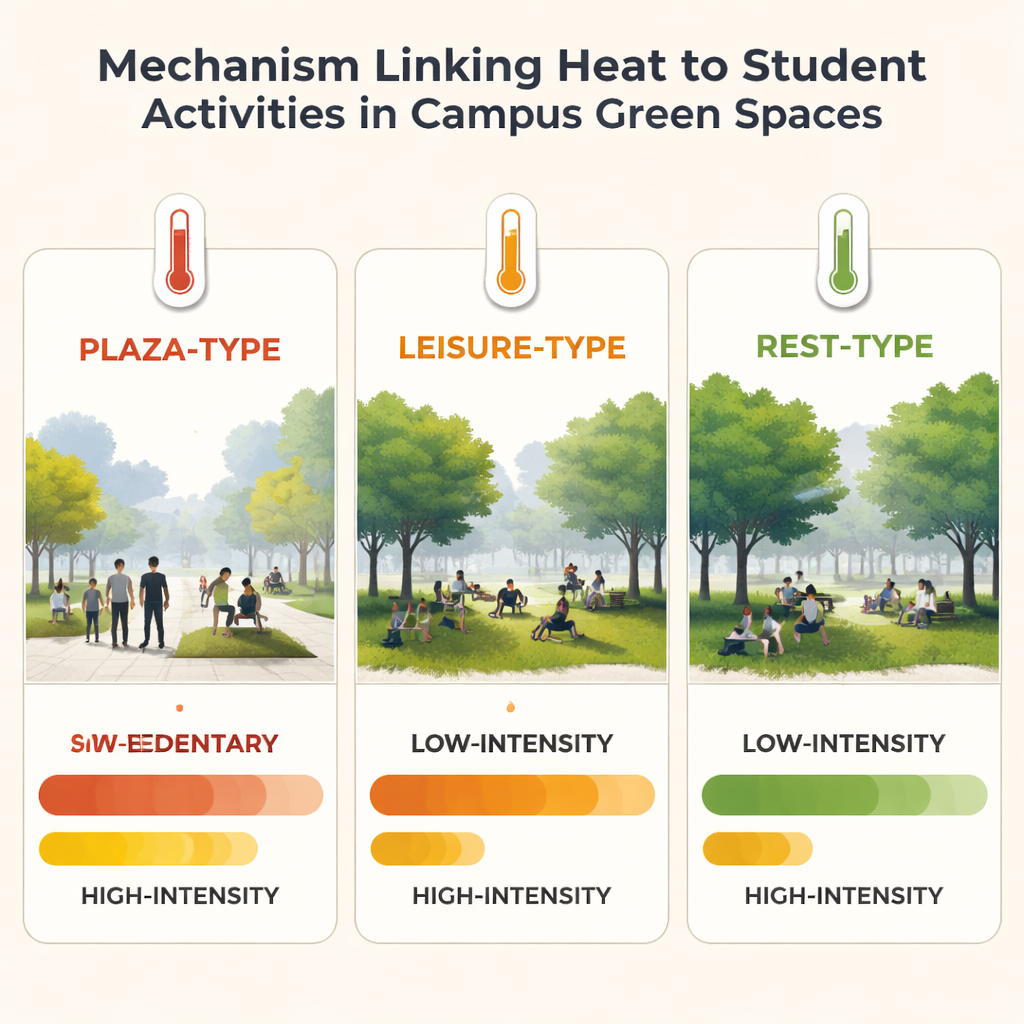
How students changed their habits with heat
Student behavior closely followed these comfort patterns. In total, researchers recorded 3864 separate activity events and grouped them as sitting or standing still, low‑intensity movement like strolling or playing board games, moderate activities such as brisk walking or badminton, and high‑intensity sports like running or skipping rope. Leisure‑type spaces were the busiest overall, especially in the late afternoon and early evening, when outdoor life surged again after the midday heat. Yet during the hottest hours, activity dropped sharply across all space types, with plaza‑type squares becoming especially under‑used. Rest‑type gardens, despite being the thermally best places on campus, attracted only medium levels of use, suggesting that factors like visibility, access, or amenities also shape where students choose to go.
The hidden cost to gentle movement
By linking comfort levels to activity counts, the study uncovered a subtle but important pattern: gentle forms of movement were the most sensitive to heat. As the heat index rose, both sitting and low‑intensity activities declined the most, particularly in exposed plazas where each extra degree Celsius was tied to nearly one fewer person walking or quietly playing. Moderate and especially high‑intensity sports appeared less affected in the data, likely because they tend to be shorter, more deliberate sessions by motivated participants who may adjust timing, pick the shadiest spots, or simply push through the discomfort. In contrast, casual, everyday movement is easier to give up, meaning that rising heat quietly erodes the simple outdoor habits that support daily health.
Designing campuses that work with the heat
For a lay observer, the takeaway is straightforward: not all green spaces are equal when the weather turns extreme. Shaded garden‑like areas can cut heat stress dramatically, yet they must also be easy, attractive, and socially inviting to draw regular use. Open lawns and plazas, meanwhile, need better shade, cooler materials, and smart scheduling of events to remain safe and appealing at midday. The authors argue that by understanding when and where students retreat from heat—and which kinds of activities disappear first—campus planners can redesign outdoor areas to act as true "cool refuges". Done well, this means future campuses where students can still walk, talk, study, and play outside on summer days, even as the climate continues to warm.
Citation: Xiong, S., Guo, X., Lu, B. et al. Patterns and associations of summer thermal comfort and students’ physical activity in campus green spaces. Sci Rep 16, 6130 (2026). https://doi.org/10.1038/s41598-026-37253-z
Keywords: campus green space, thermal comfort, student physical activity, urban heat, heat-resilient design