Clear Sky Science · en
Field-based experimental investigation of energy and exergy performances of a novel solar thermal air collector
Turning Sunshine into Useful Warm Air
Keeping homes warm, drying food, or preheating fresh air for buildings usually means burning fuel or using electricity. This study explores a smarter way: a redesigned solar air heater that uses only sunlight to warm moving air more efficiently. By carefully shaping the metal pieces that guide air inside the collector, the researchers show how to squeeze more useful heat from the same sunshine—an idea that could cut energy bills and emissions in homes, farms, and small industries.
Why Better Solar Heating Matters
Our modern lifestyle relies heavily on fossil fuels for heating, transport, and electricity. These fuels are finite and a major source of climate‑warming carbon dioxide. Flat plate solar air collectors—essentially shallow boxes that trap sunlight to warm air—offer a clean alternative for jobs like crop drying, space heating, and ventilation preheating. They are simple and relatively cheap, but one big weakness holds them back: the hot metal plate inside does not hand its heat to the flowing air as effectively as it could, so much of the captured solar energy is wasted. Improving that heat hand‑off is the focus of this work.
A New Interior Design for Solar Collectors
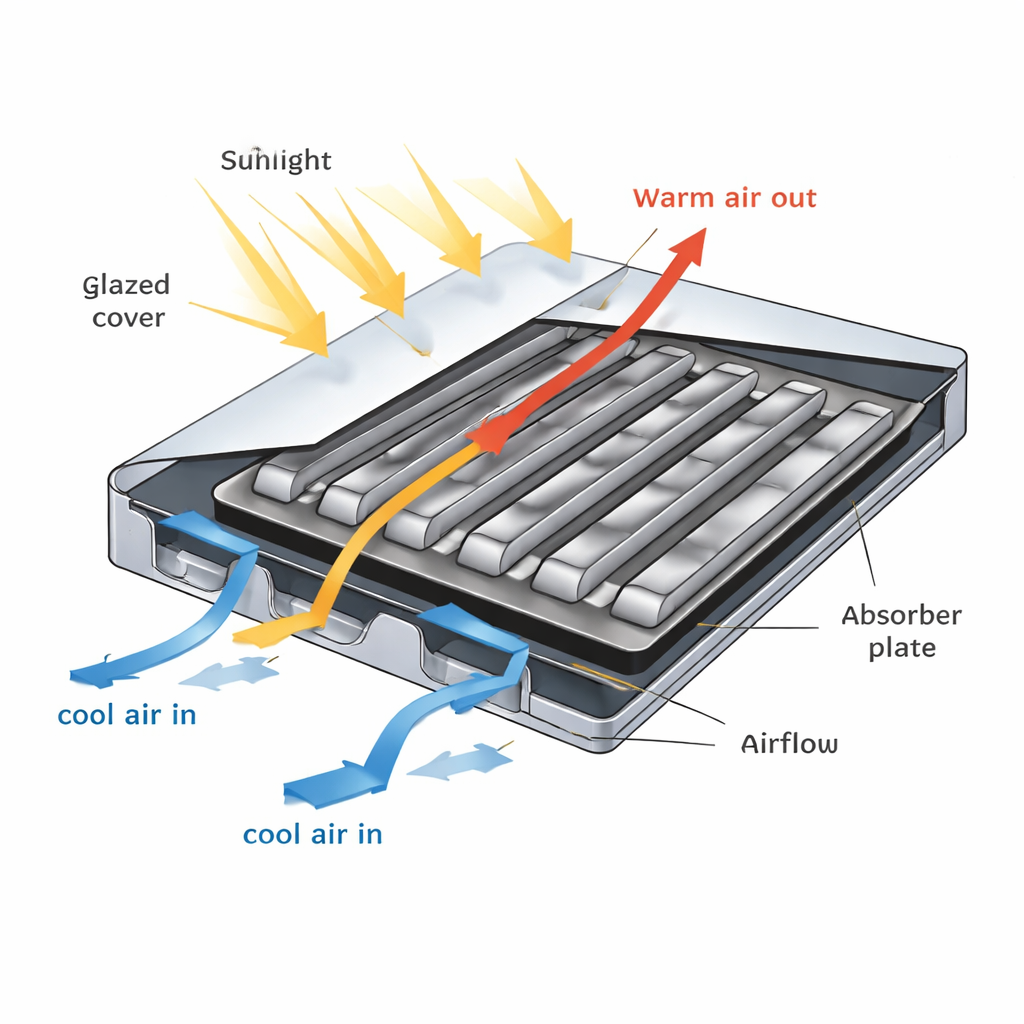
The team built a full‑scale outdoor test system in Malaysia based on a flat plate solar air collector. Inside, they added rows of novel hollow "semi‑stadium" fins—metal pieces shaped like a rounded arch, with a hollow interior—arranged in several staggered levels. Near the air inlet, they installed small baffles, like tiny walls, to stir and redirect the incoming air so it brushes more thoroughly against the hot surfaces. The air takes a double pass: it first flows along one channel, bends around a U‑turn section, and then returns through another, picking up additional heat each time. This combination of special fins, baffles, and double‑pass layout is designed to increase contact between air and hot metal without making the system overly complex.
Measuring Heat Gain and Useful Work
Over three sunny days, the researchers ran the collector at three different air flow rates—slow, medium, and fast—and measured temperatures at many points, along with sunlight levels and weather conditions. They then calculated two types of performance. The first, called energy efficiency, answers: "What fraction of the incoming solar power turns into heat carried out by the air?" The second, called exergy efficiency, looks at how much of that heat is truly useful for doing work, such as providing a strong temperature lift for drying or heating. To check their measurements, they also built a detailed computer model of air flow and heat transfer and compared its predictions with the outdoor data.
What the Experiments Revealed
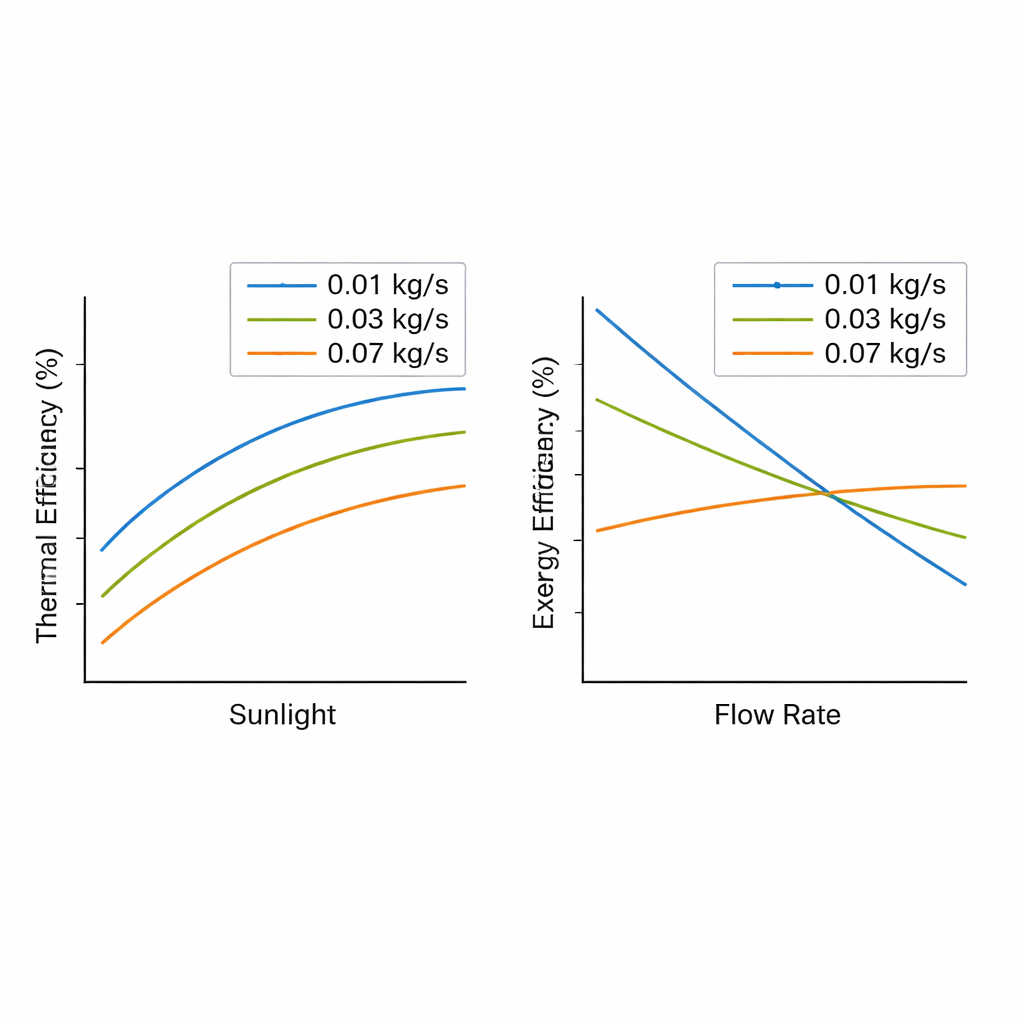
The redesigned collector reached energy efficiencies between about 13% and 72%, with the best value—71.91%—occurring under strong sunlight (about 800 watts per square meter) and the highest air flow. In simple terms, under good sun and fast airflow, nearly three‑quarters of the sunlight hitting the device became useful heat in the outgoing air. However, the story changes when looking at exergy, the measure of how valuable that heat is. The highest exergy efficiency, 17.06%, occurred at the lowest air flow. At slow flow rates, the air spends more time inside and leaves much hotter, which is especially helpful for tasks like drying food or heating a room, even though the total heat output is somewhat lower. As the air moves faster, more heat is collected overall, but each unit of heat becomes slightly less "high‑grade" and exergy efficiency drops.
Why This Design Is Promising
For non‑specialists, the bottom line is straightforward: by reshaping the metal fins inside a solar air collector and guiding the air more cleverly, this system gets much more from the same sunlight than earlier designs. At high flow, it is excellent at harvesting large amounts of heat efficiently; at low flow, it delivers hotter air that is especially useful for drying and space heating. The fact that both outdoor experiments and computer simulations agree—and that performance surpasses several earlier studies—suggests this approach is ready to be adapted for real‑world solar dryers, building ventilation, and other low‑temperature heating needs, helping move everyday energy use toward a cleaner future.
Citation: Rahmat, M.A.A., Ibrahim, A., Al-Aribe, K.M. et al. Field-based experimental investigation of energy and exergy performances of a novel solar thermal air collector. Sci Rep 16, 6621 (2026). https://doi.org/10.1038/s41598-026-37250-2
Keywords: solar air collector, solar thermal, renewable heating, energy efficiency, exergy analysis