Clear Sky Science · en
Evaluation of nano glass as a partial cement replacement on the fresh mechanical durability thermal and microstructural properties of cement paste
Turning Trash Glass into Tougher Buildings
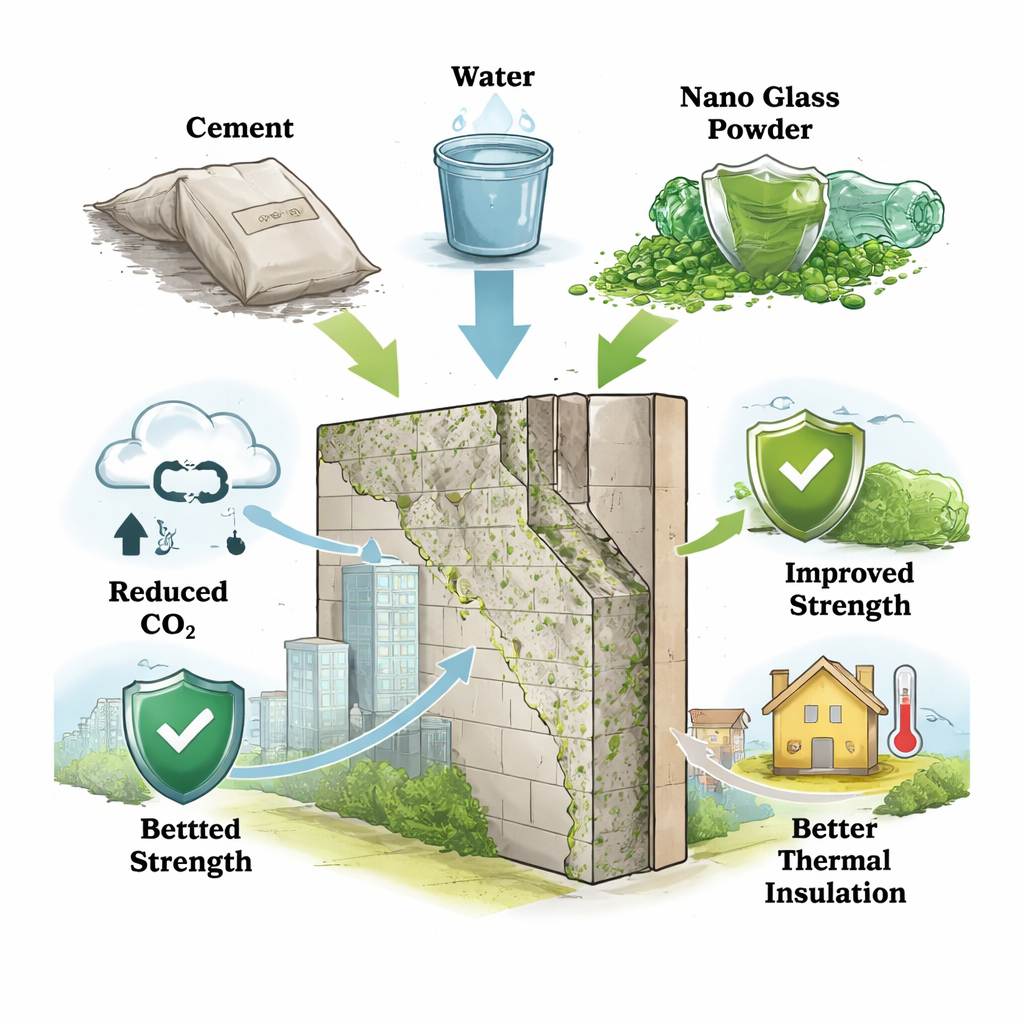
Every day, millions of glass bottles are tossed away, while making the cement that holds our buildings together pumps out huge amounts of carbon dioxide. This study explores a simple but powerful idea: grind waste glass down to an ultra-fine “nano” powder and blend it into cement paste, the glue of concrete. The researchers ask whether this recycled nano glass can make building materials stronger, longer‑lasting, and better at holding in heat—while cutting cement use and helping the planet.
Why Waste Glass and Cement Need Each Other
Cement production is energy‑hungry and responsible for a large share of global carbon dioxide emissions. At the same time, waste glass is piling up in landfills around the world because it does not break down naturally. Glass, however, is rich in the same basic ingredients that help cement harden. When ground into extremely fine particles, it can react with cement in helpful ways instead of simply acting as inert filler. This makes nano glass a promising partner: it could reduce the amount of cement needed in construction and give a second life to a stubborn waste material.
How the Nano Glass Mixes Were Put to the Test
The team made a series of cement pastes in which 0 to 50 percent of the cement was replaced by nano glass powder. They kept the water content the same and measured how easy the mixtures were to work with in their fresh state, then tested hardened samples for compressive and bending strength, resistance to acid attack, performance after exposure to fire, the way they conducted heat, how much water they absorbed, and how much they shrank as they dried. To see what was happening inside at the microscopic level, they also used X‑ray diffraction and electron microscopy to examine how the nano glass changed the tiny crystals and pores within the hardened paste.
Strength, Durability, and Heat: Finding the Sweet Spot
The results showed that a modest dose of nano glass can improve performance, but too much becomes harmful. As more nano glass was added, the fresh mixes became less flowable and harder to handle because the tiny particles demanded more water. In hardened form, compressive strength was highest at about 10 percent replacement, while bending strength peaked around 15 percent. Beyond roughly 15–20 percent, strength dropped as there simply was not enough cement left to form a solid, continuous framework. Durability told a similar story: at low to moderate levels, nano glass helped the paste resist acid attack, lose less strength after fire exposure, and shrink less while drying.
Pores, Cracks, and the Hidden Inner Structure
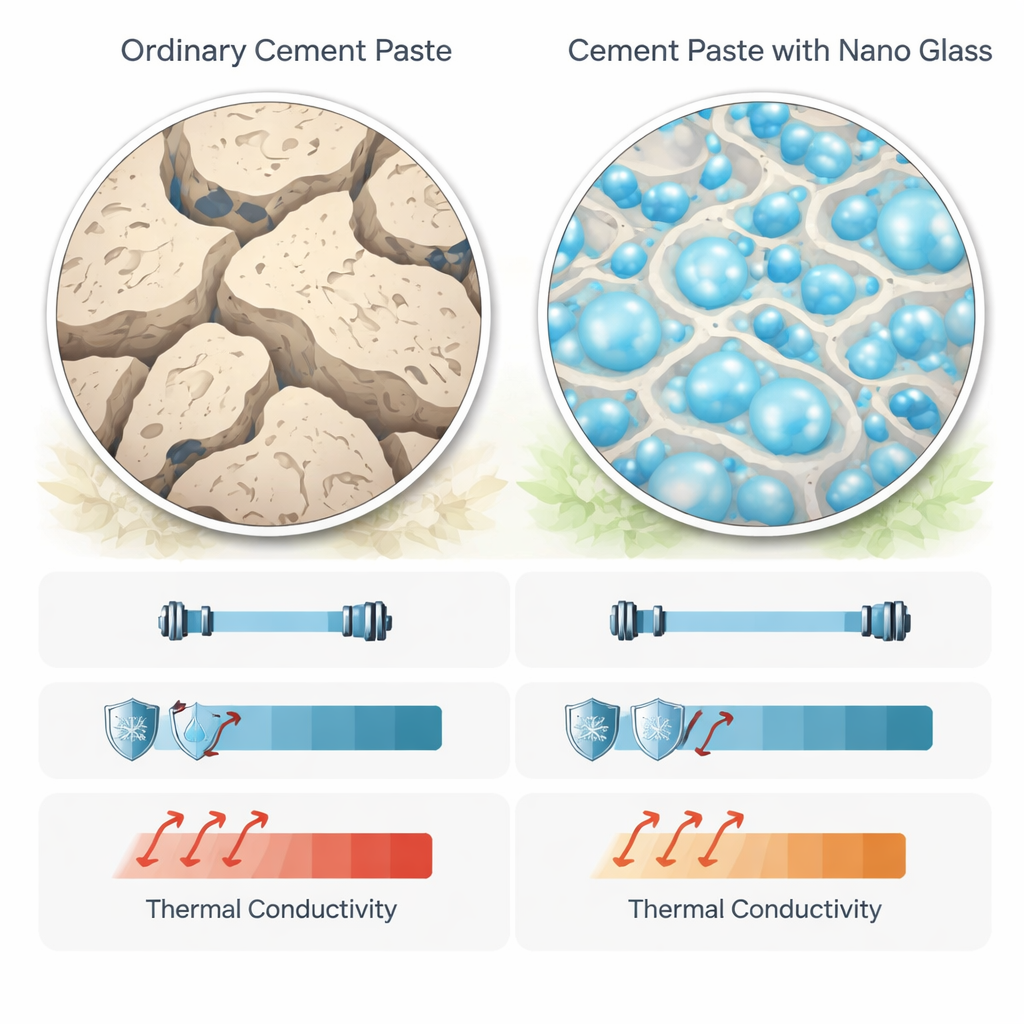
Inside the material, the nano glass worked in two main ways. First, the very fine particles filled in tiny gaps, making the microstructure denser. Second, they reacted with by‑products of cement hydration to form additional binding gel, which further tightened the internal network. Measurements showed that, especially above about 20 percent replacement, the volume of connected pores and the ability of water to soak in dropped sharply, and heat flowed more slowly through the material—an advantage for insulation. However, at very high replacement levels the overall density and strength declined, and the mixes became prone to cracking or breaking during early shrinkage.
What This Means for Greener Construction
For a non‑specialist, the takeaway is straightforward: finely ground waste glass can safely replace a portion of cement and actually improve many properties of the resulting material, as long as it is used in moderation. In this study, using nano glass at about 10–20 percent of the cement content gave the best balance—stronger or comparable strength, better durability, and lower heat flow, while reducing the amount of cement needed. Above that range, benefits fade and problems grow. The work suggests that with proper dosing and mix design, nano glass could help turn a troublesome waste into a useful ingredient for sturdier, more energy‑efficient, and more sustainable buildings.
Citation: Ali, S.M., Mohammed, S.A., Juma, A.A. et al. Evaluation of nano glass as a partial cement replacement on the fresh mechanical durability thermal and microstructural properties of cement paste. Sci Rep 16, 6280 (2026). https://doi.org/10.1038/s41598-026-37244-0
Keywords: waste glass, cement replacement, nano materials, durable concrete, thermal insulation