Clear Sky Science · en
Dissociable age-dependent effects of emotion on scene and location memory
Why feelings shape what we remember
Think about a vivid memory from years ago—perhaps a joyful celebration or a frightening near‑miss. You may recall the people or object at the center of the moment clearly, but struggle to picture the room’s decor or exactly where you were standing. This study asks why our emotions make some parts of an event stick while others fade, how this pattern shifts as we age, and what role mood problems like depression and anxiety might play.
What the researchers set out to test
The scientists wanted to know how emotions influence two different kinds of “where” information in memory: the broader background scene (such as a street or room) and the specific on‑screen location where an image appears. Past work suggests these rely on partly separate brain systems and that older adults often struggle with detailed contextual memory. The team also suspected that emotional events might sharpen memory for where something happened, even as they blur the surrounding details, and that these effects could change with age and with people’s levels of depression and anxiety.
How the memory experiment worked
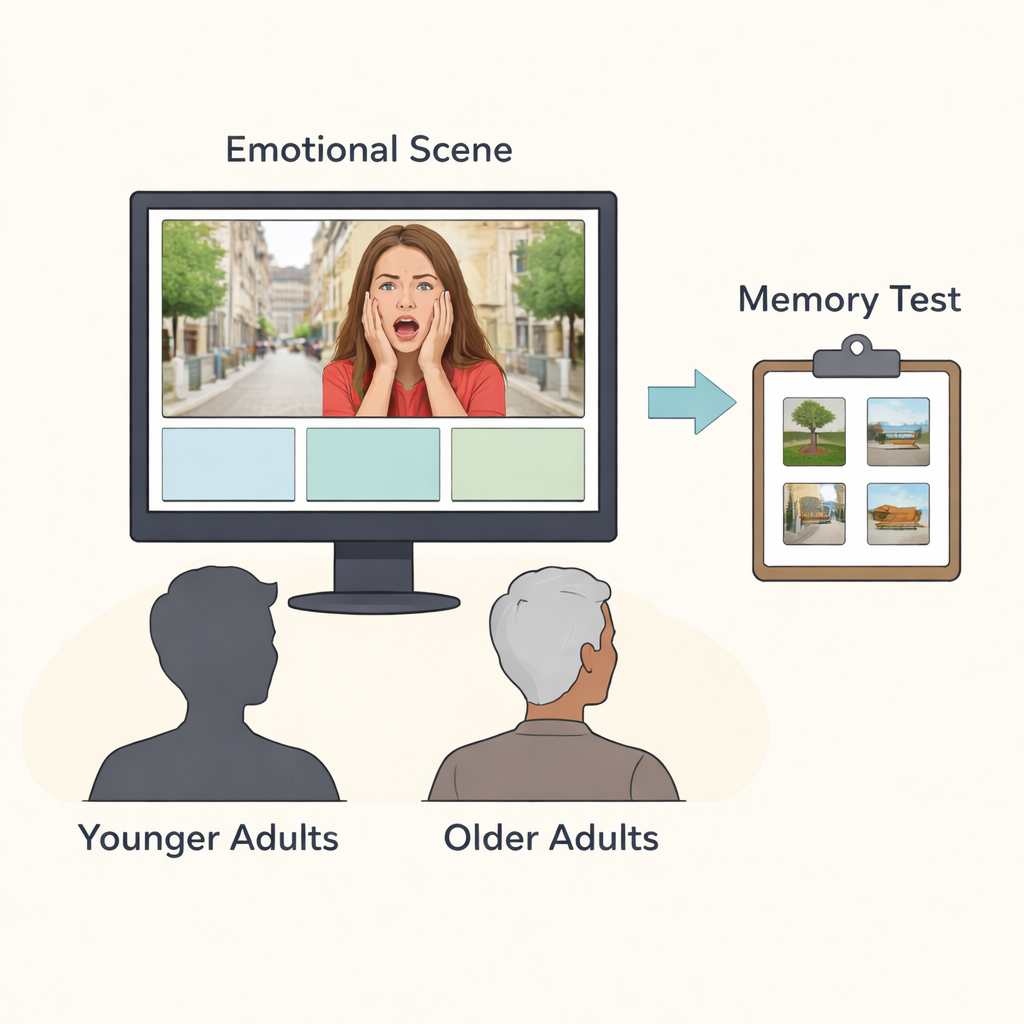
Researchers recruited 165 adults aged 21 to 67 through an online platform. Each person first filled out questionnaires measuring depressive symptoms, anxiety, and general mood. Then, during a computer‑based task, they saw 72 scenes. Each scene combined a neutral background (for example, a building or field) with a foreground picture showing a positive, negative, or neutral emotional event involving people. Every scene appeared for four seconds in one of the four corners of the screen, and participants rated how pleasant and how arousing each scene felt. After a short distraction task, they faced a surprise memory test: for each previously seen foreground object, they chose among four scene options that mixed and matched old and new backgrounds and foregrounds, and then indicated which screen quadrant the original scene had appeared in.
What emotions did to scene details
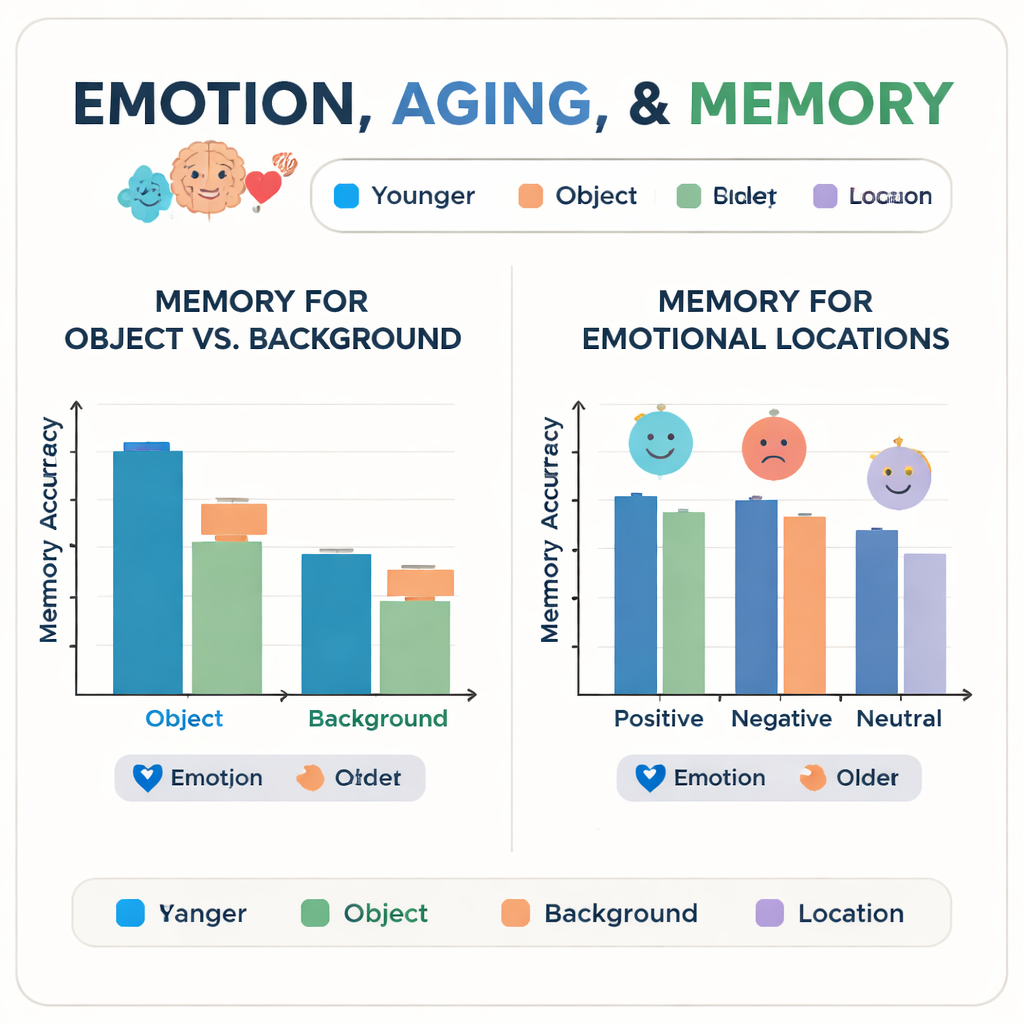
Across all ages, people tended to remember the emotional foreground object better than the background scene. When they made mistakes, they usually picked the correct object paired with the wrong background, rather than the other way around. Emotional—especially negative—objects were more likely to be remembered on their own, even when the surrounding scene was forgotten. With increasing age, accurate memory for fully integrated scenes declined, and people more often remembered just the emotional foreground, particularly for positive images. This suggests that as we get older, our memories become less tied to rich background detail and more centered on the emotionally meaningful core of an event.
Where it happened: locations tell a different story
In contrast to background scenes, memory for the on‑screen location where an emotional scene appeared actually improved with emotion: people more accurately recalled the quadrant for both negative and positive scenes than for neutral ones. Strikingly, this location boost did not depend on remembering the background; knowing the emotional foreground alone was enough. Aging did not cause a broad drop in location memory, but it did weaken the emotional advantage, especially for negative scenes. This pattern fits with evidence that older adults often react less strongly to negative emotions than younger adults, and that emotional “signposts” for where something happened may rely on partially distinct brain circuits from those that store visual scene details.
How mood and anxiety color memory
The study also found that individual emotional health matters. People with higher depression scores tended to show poorer memory for both scenes and locations. Those with higher trait anxiety, in contrast, often had better memory, especially for neutral and positive scenes and for where scenes appeared. These opposite effects of depression and anxiety emerged even in a non‑clinical sample, and they did not fully explain the age‑related memory changes, suggesting that emotional traits and aging shape memory through partly independent routes.
What this means for everyday life
Taken together, the findings show that emotion does not simply make everything more memorable. Instead, it selectively sharpens memory for central emotional objects and their locations, often at the cost of the surrounding context, and this selectivity grows as we age and as our emotional health varies. For everyday life, this means that older adults—and people with depression in particular—may recall the “heart” of an emotional event but not its full setting, whereas anxiety may sometimes heighten attention and memory. Understanding these patterns can inform strategies to support memory across adulthood, for example by deliberately emphasizing important contextual details when we want them to be remembered.
Citation: Koo, M., Lee, S.A. Dissociable age-dependent effects of emotion on scene and location memory. Sci Rep 16, 6672 (2026). https://doi.org/10.1038/s41598-026-37242-2
Keywords: emotional memory, aging, spatial context, depression and anxiety, scene recognition