Clear Sky Science · en
Comprehensive 4E performance assessment of novel porous clay bricks across new climate zones of Türkİye
Smarter walls for comfort and lower bills
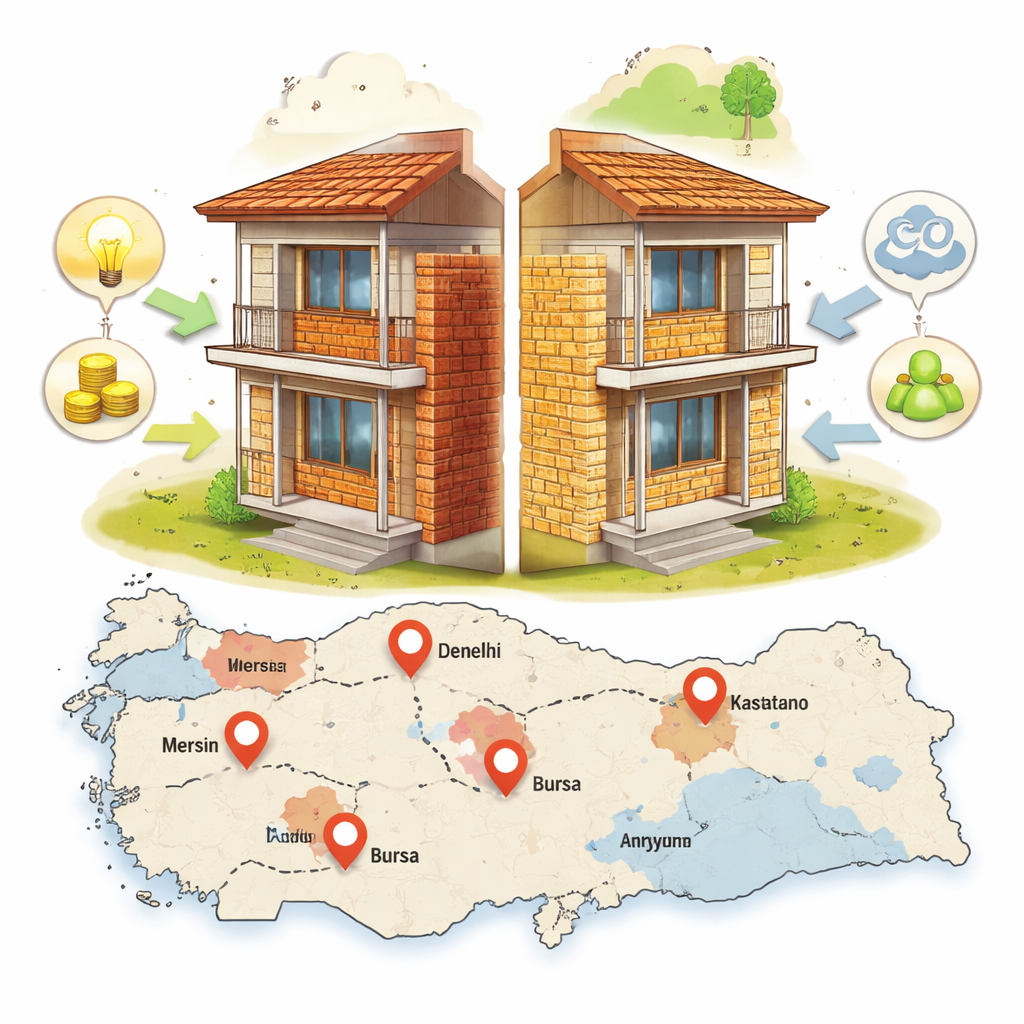
Across Türkiye, people in seaside apartments and snowy mountain towns face the same problem: keeping homes comfortable without exploding energy bills or emissions. This study asks a simple question with big consequences—what if we could redesign the humble brick so that houses use less energy, cost less to run, and pollute less, no matter the climate? By tweaking what goes into a clay brick, the researchers show how wall materials alone can noticeably cut heating and cooling demand across the country.
Why changing bricks can change buildings
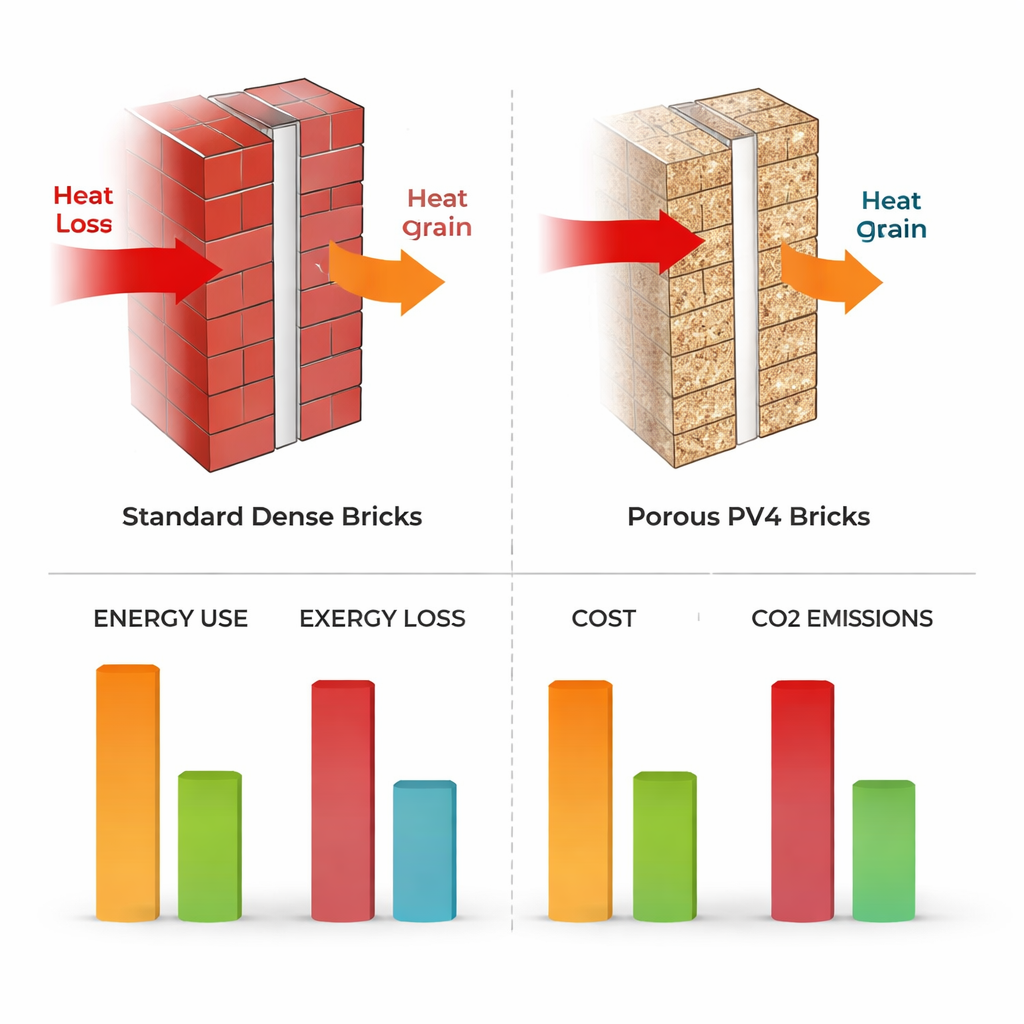
Most of the energy a home uses goes into heating and cooling, and that depends heavily on how easily heat slips through its walls. Standard fired clay bricks are sturdy, but they conduct heat relatively well, which means warmth leaks out in winter and sneaks in during summer. The team examined new “porous” bricks made by mixing clay with lightweight volcanic rocks—pumice and vermiculite. These additives create many tiny air pockets inside the brick, lowering its density and making it harder for heat to pass through. The most advanced mix, called PV4, cuts the wall’s ability to transmit heat by about 41% compared with a normal brick wall, simply by changing the brick recipe rather than adding extra insulation layers.
Testing homes in six very different climates
To see what this means in practice, the researchers did not stop at lab tests. They built a detailed computer model of a typical two-storey, 235 m² family home and ran full-year simulations using EnergyPlus software, which tracks heat flows, sun, ventilation, and indoor comfort hour by hour. They placed the same house in six Turkish cities—from hot, cooling‑dominated Mersin to freezing Erzurum—and swapped only the brick type in the walls. Everything else, from windows to indoor temperature (kept at 22 °C), was held constant. This let them isolate how the different bricks affected energy use, the “quality” of that energy, costs over 10 years, and climate impact.
How better bricks save energy and reduce waste
Across all climates, the porous bricks reduced how much heating and cooling the home needed, with the biggest gains for the most porous PV4 mix (55% clay, 40% pumice, 5% vermiculite). Total annual energy use fell by around 10% in warm Mersin and nearly 13% in cold Erzurum compared with standard bricks. The study also looked at exergy, a thermodynamics measure that captures how much of the energy is truly useful rather than wasted through temperature differences. Here again, PV4 performed best, trimming exergy losses by about 10–14%. In simple terms, the improved bricks didn’t just use less energy—they wasted less of the energy supplied, especially in harsher climates where heat loss through walls normally dominates.
Money, emissions, and payback time
The team then translated these technical gains into everyday terms: money and carbon. Using current fuel and electricity prices, they calculated that PV4 bricks could save roughly $0.50–0.70 per square meter of wall area each year in energy costs, depending on the city. Even though these bricks are more expensive to buy, the extra cost is paid back in about 4.8–6.6 years—well within the life of a building. On the environmental side, the new bricks do carry slightly higher emissions when they are produced, because of added materials and transport. But over time, the lower heating and cooling needs more than compensate. The net result is a cut in annual carbon dioxide emissions of about 3–5 kg per square meter of wall, with the largest savings in the coldest regions.
What this means for future homes
For a non‑specialist, the takeaway is straightforward: by carefully re‑engineering bricks with local volcanic materials, it is possible to build homes in Türkiye that stay more comfortable, use about a tenth less energy, and emit less CO₂—without changing their size, shape, or heating system. The study also shows that no single material is “best” everywhere; performance depends strongly on climate, so choosing wall materials with local weather in mind is crucial. Still, the most advanced porous brick, PV4, emerges as a robust option across all six regions, offering a practical route to more efficient, climate‑aware housing at a modest extra cost.
Citation: Acar, M.Ş., Beyazit, N.İ., Ünal, F. et al. Comprehensive 4E performance assessment of novel porous clay bricks across new climate zones of Türkİye. Sci Rep 16, 6124 (2026). https://doi.org/10.1038/s41598-026-37241-3
Keywords: porous clay bricks, building energy efficiency, thermal insulation, sustainable construction, Turkish climate zones