Clear Sky Science · en
Molecular identification, isolation and functional characterization of a glutathione S-transferase gene CsGST in saffron (Crocus sativus L.)
Why saffron’s colors matter
Saffron is famous for its deep red stigmas that flavor and color foods, but the rest of the flower is also rich in striking purples and yellows. Behind these colors are natural pigments that not only please the eye and palate but also have antioxidant and medicinal properties. This study asks a simple question with far-reaching implications: which gene helps move these pigments inside saffron cells, and could understanding it eventually help us grow plants with more stable color and higher levels of health-promoting compounds?
Two different colors, two different pigment families
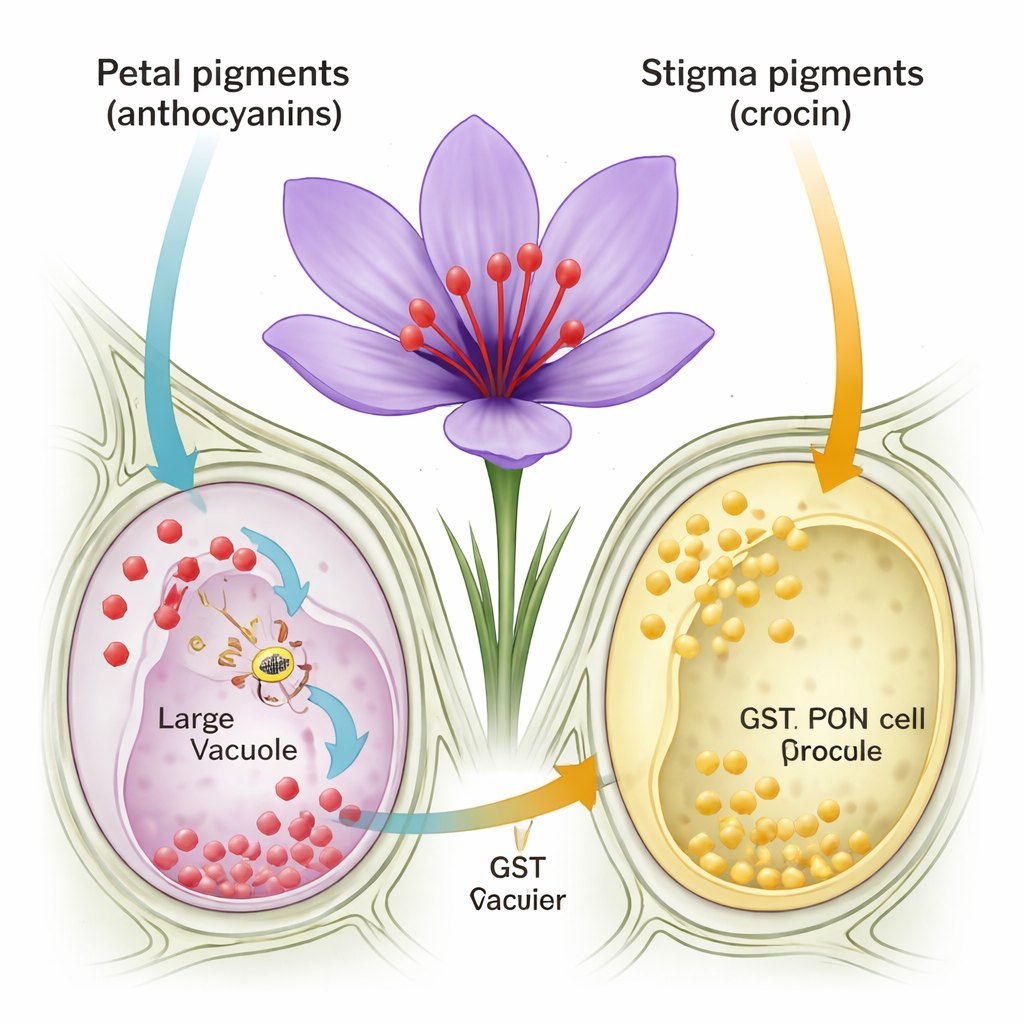
The saffron plant divides its color work between two types of pigments. The bright red stigma, the expensive part sold as spice, is loaded with crocins, a group of saffron-specific carotenoid derivatives that can make up to a tenth of its dry weight. Crocins provide color and may have anti-cancer and other health benefits. In contrast, the purple petals and other floral parts owe their hues mainly to anthocyanins, a widespread class of water-soluble pigments also found in berries and red grapes. Anthocyanins are made in the cell fluid and then must be transported into internal storage sacs called vacuoles, where they become stable, visible color. Proteins from a large family called glutathione S-transferases (GSTs) are known in many plants to act as helpers or “carriers” for this transport step, but until now, no such gene had been pinned down in saffron.
Finding a key pigment helper gene
The researchers searched existing gene expression data from saffron and spotted a candidate GST gene that resembled pigment-related GSTs from other species. They cloned its full-length sequence and named it CsGST. The gene’s structure turned out to be compact, with two coding segments separated by a short intron, matching the pattern seen in other pigment-linked GSTs. Computer analysis showed that the encoded protein belongs to the Tau class of GSTs, a group already implicated in color formation in maize kernels. Evolutionary comparison across many plants placed CsGST firmly within a monocot lineage alongside related species, reinforcing the idea that it could fulfill a conserved role in pigment handling.
Putting the protein to work in the lab
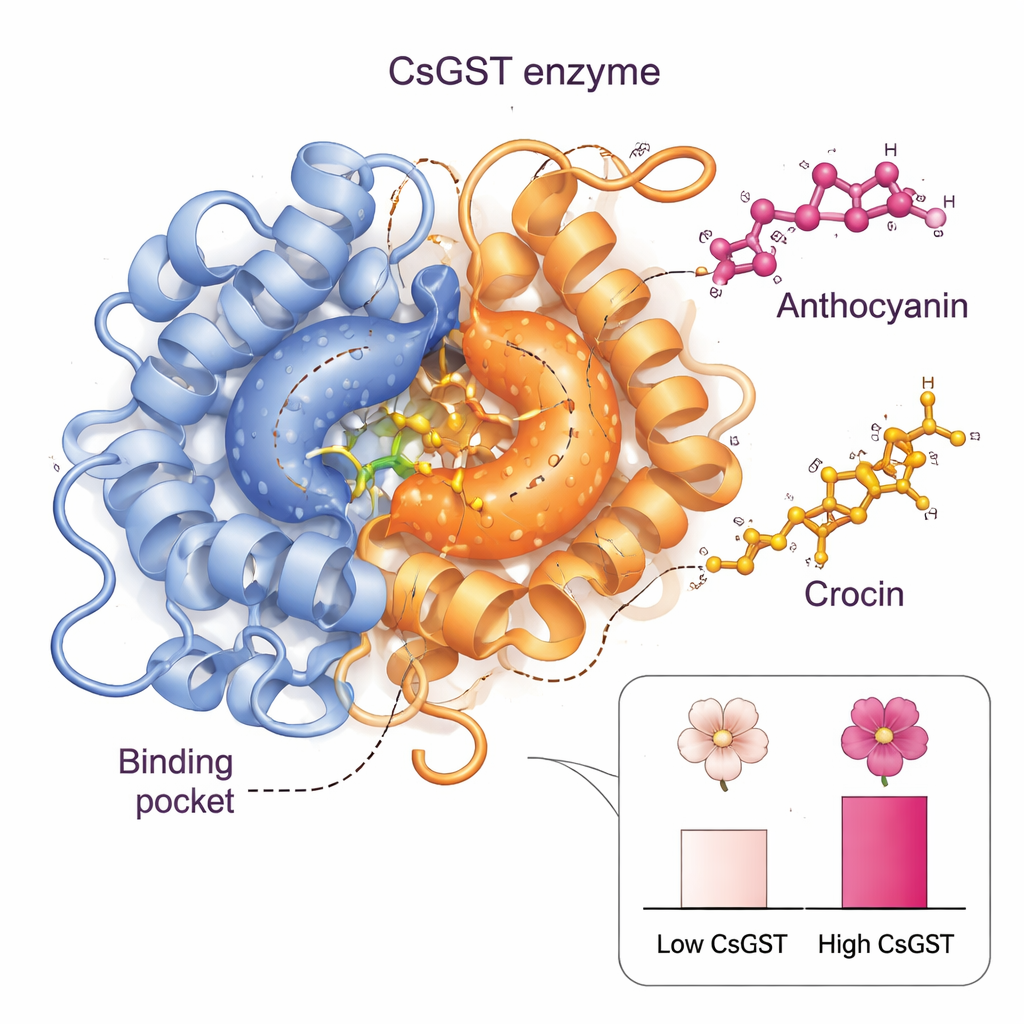
To test whether CsGST is a functional enzyme, the team produced the protein in bacteria, purified it, and measured its activity using a standard artificial test reaction. The purified protein successfully carried out the hallmark GST chemistry, confirming that the cloned gene encodes a working enzyme. The researchers then examined where and when CsGST is active in the saffron plant by measuring its RNA levels in leaves, petals, stamens, and pistils across four flowering stages. They found that CsGST is switched on in all these tissues but follows different patterns: it increases steadily in petals as they mature, while in other organs it rises early and then falls. When they compared these expression patterns to actual anthocyanin levels, only petals showed a strong positive link—higher CsGST went hand in hand with more anthocyanin pigment.
Hints of a connection to saffron’s signature red pigment
Because crocin builds up in the stigma at the same time CsGST is expressed there, the team explored whether the protein could also bind this key saffron pigment. Using computer docking, they modeled the three-dimensional structure of CsGST and tested how crocin might fit into its binding pocket. The simulations suggested that crocin could attach to CsGST with an energy consistent with spontaneous binding, through a network of hydrogen bonds and hydrophobic contacts. While this is not direct proof that CsGST transports crocin in living cells, it raises the intriguing possibility that a single GST could help manage both anthocyanins in petals and crocins in stigmas, linking two different color systems within the same plant.
What this means for saffron and beyond
In everyday terms, this work identifies and characterizes a “pigment handler” gene in saffron for the first time. CsGST behaves like known color-helper proteins from other plants, shows activity as a genuine enzyme, and is tightly associated with the buildup of purple pigments in petals. Early computer evidence also suggests it may interact with crocin, the compound that makes saffron stigmas so valuable. Understanding CsGST lays the groundwork for future experiments—such as switching the gene on or off—that could fine-tune color intensity and possibly enhance useful compounds in saffron and related crops. For growers, breeders, and food and health scientists, that means a clearer path toward plants whose colors are not just beautiful but also more consistent, potent, and beneficial.
Citation: Yan, S., Zhang, X., Li, J. et al. Molecular identification, isolation and functional characterization of a glutathione S-transferase gene CsGST in saffron (Crocus sativus L.). Sci Rep 16, 6498 (2026). https://doi.org/10.1038/s41598-026-37233-3
Keywords: saffron pigments, anthocyanins, crocin, glutathione S-transferase, flower coloration