Clear Sky Science · en
Research on the optimization efficiency of secondary vibrating screening based on EDEM simulation
Why sorting rocks matters for big dams
When engineers build massive rockfill dams or rail beds, they do not just dump rocks in a pile. The size mix of those rocks has to be carefully controlled so the structure is strong, stable, and doesn’t leak. Checking that mix in the field relies on machines that shake stone over metal screens to separate large chunks from smaller pieces. This paper explores how to make those vibrating screens work better, so that engineers can trust their measurements and use less time and energy to get them.
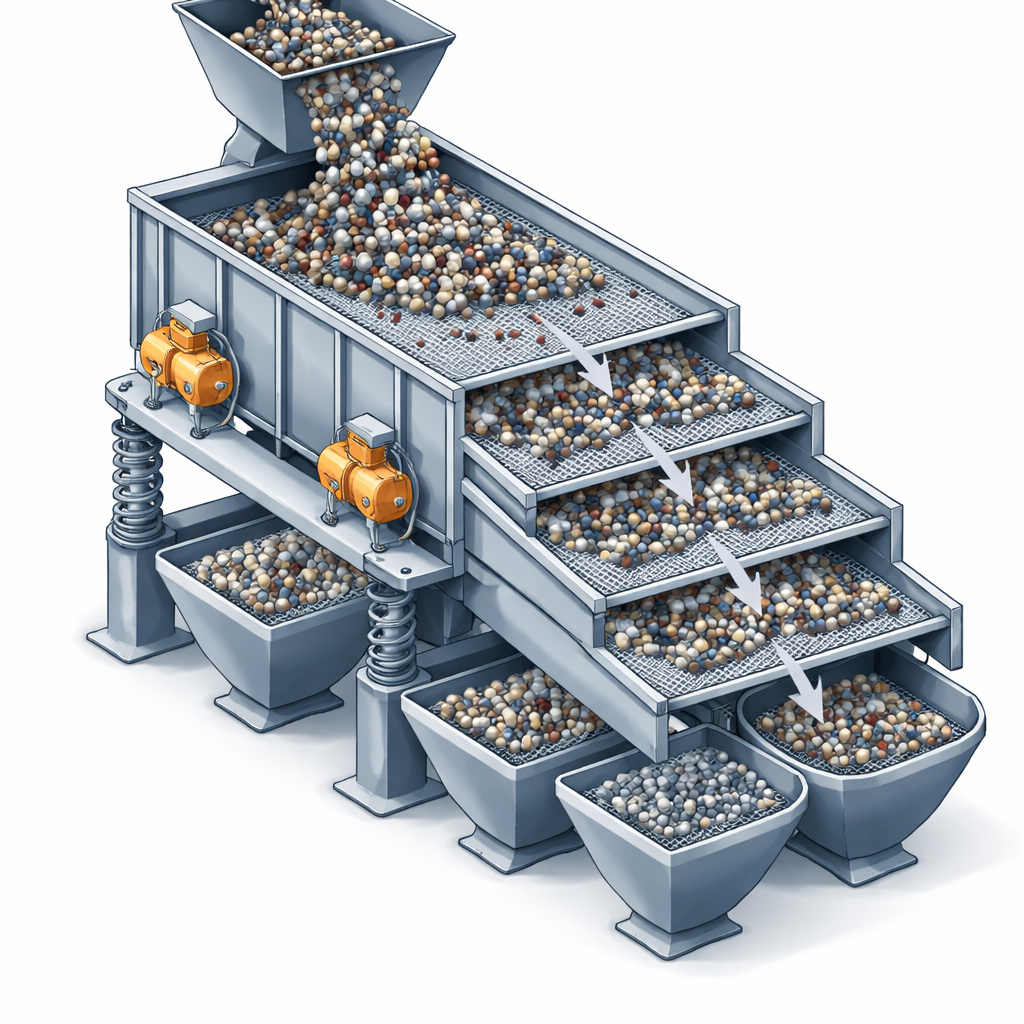
How shaking screens sort piles of stone
Standard vibrating screens look simple: a box with one or more metal grids that are shaken by motors. Rock pours in at one end and travels over the screens. Small pieces fall through the gaps, while larger ones ride over the top. In reality, the process is a complex dance. Particles collide with each other and the metal surface, are tossed into the air, and slide or roll as they search for an opening. Factors such as how steeply the screen is tilted, how big the shaking motion is, and at what angle the vibration is aimed all affect how long each stone spends on the grid and how likely it is to find the right hole.
Using virtual rocks instead of trial and error
Because real rockfill behaves as billions of separate pieces rather than a smooth fluid, the authors used a computer approach called the Discrete Element Method, implemented in the EDEM software. In this virtual setup, every particle is modeled as an individual object that can move, collide, bounce, and roll under gravity and vibration. The researchers built a digital copy of a four-layer screen with opening sizes of 100, 60, 40, and 20 millimeters, matching the needs of rockfill dam projects. They fed in thousands of digital “stones” of different sizes and tracked how many ended up in the correct bin over hundreds of simulated test runs.
Finding the sweet spot for the shake
The team first studied how basic design choices influence performance. Adding more screen layers proved crucial: a single-layer screen left many sizes mixed together, with total efficiency around 81%, while a four-layer design boosted this to nearly 94%. Next they tuned the motion itself. They found that a moderate tilt of about 15 degrees, a vibration amplitude of 10 millimeters, and a frequency around 24 hertz gave the best results. Too little motion and the rocks clump and plug the openings; too much and they are flung so violently that they spend less time in contact with the screen, or fine particles are stirred back into the upper flow. A vibration direction angled about 30 degrees from vertical gave the best balance between bouncing and sliding, raising overall efficiency to roughly 96% under ideal conditions.
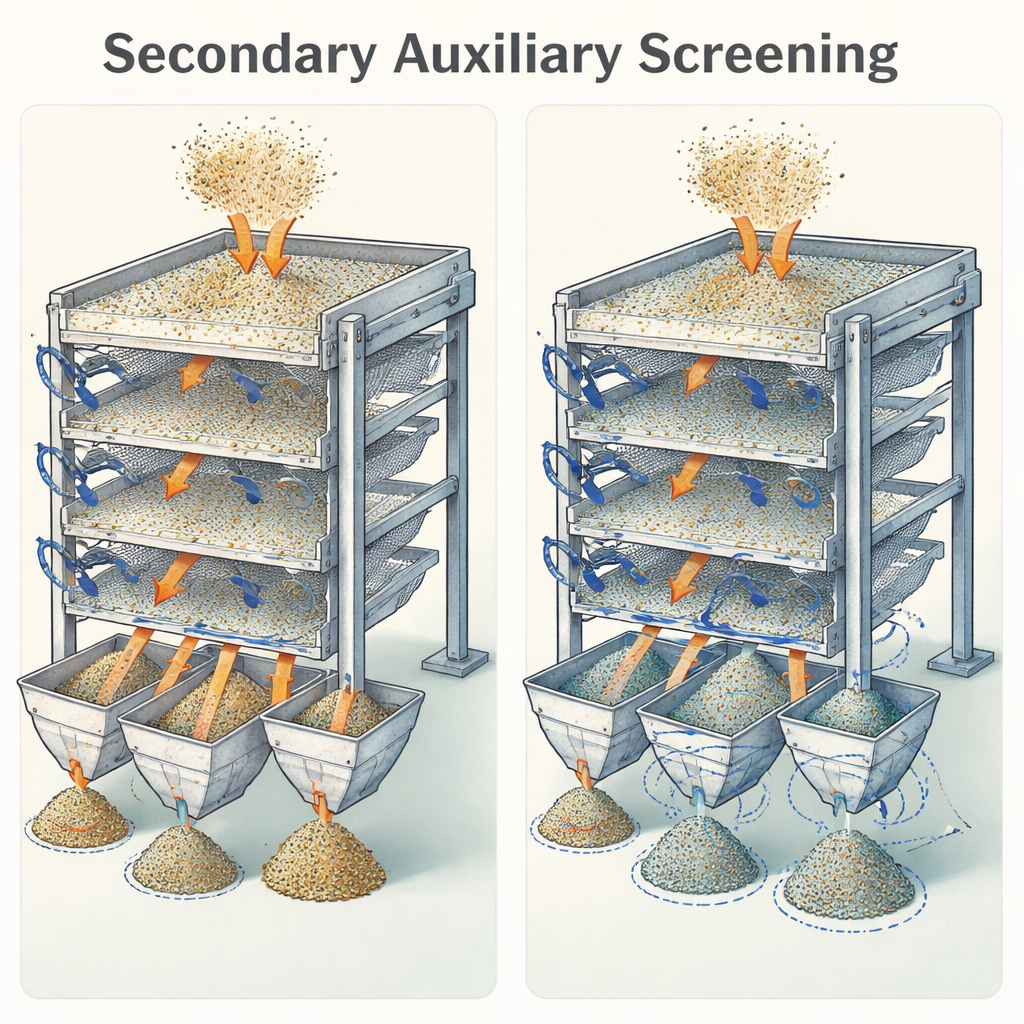
Giving every stone a second chance
Even well-tuned single-pass screens leave some fine particles riding out of the machine with coarser stones. To fix this, the authors proposed a simple but powerful change: place a small “auxiliary” screen inside each collection hopper under the main decks. As material drops off the main screens, it encounters a second layer of mesh with the same opening size. In the virtual tests, this secondary screening step extended the time rocks spent in contact with mesh and gave trapped fines another chance to fall through. For both very small particles and some medium and large sizes, efficiency rose by 3–7 percentage points, and overall performance improved from 92.4% to 96.5%.
What this means for real-world projects
For engineers in charge of dams, mines, and large earthworks, these results suggest that modest design tweaks can deliver cleaner size separation without exotic equipment. By carefully choosing screen tilt, shake strength, and vibration direction—and by adding a simple extra screen inside the collection hoppers—operators can greatly reduce the number of “wrong size” rocks slipping through. While the study is based on detailed simulations rather than full-scale field trials, it points the way toward more reliable, efficient screening systems that help keep critical infrastructure safer and longer lasting.
Citation: Zhu, C., Long, H., Peng, Z. et al. Research on the optimization efficiency of secondary vibrating screening based on EDEM simulation. Sci Rep 16, 6746 (2026). https://doi.org/10.1038/s41598-026-37230-6
Keywords: vibrating screen, rockfill dam, particle simulation, EDEM DEM, secondary screening