Clear Sky Science · en
Three-dimensional bulk reduced graphene oxide coatings with strong metal adhesion via cold plasma and pulsed current
Why a New Kind of Graphene Coating Matters
From faster electronics to tougher tools, many future technologies hinge on finding coatings that are thin, strong, and firmly attached to metal. Graphene, a super-strong, ultra-thin form of carbon, is famous for its exceptional strength, electricity, and heat conduction—but it is hard to apply in a way that is both thick enough for real use and securely bonded to metal parts. This paper describes a practical, low-cost way to create a three-dimensional, bulk-like graphene-based coating that sticks tightly to common metal alloys and can withstand heavy use, bringing graphene a step closer to everyday engineering applications.
Building a Tough Skin on Everyday Metals
The researchers focused on reduced graphene oxide (rGO), a graphene-related material that is easier and cheaper to make in bulk. Instead of trying to spread a single-atom-thick film, they built a micrometer-thick, three-dimensional layer—more like a tough skin than a fragile sheet. Their process has two main steps, both carried out at normal air pressure and mostly at room temperature. First, they treat the metal surface with a beam of “cold” argon plasma. This gentle, low-temperature plasma cleans away organic dirt, increases the surface’s energy, and enriches the natural oxide layer on metals like titanium with oxygen-containing groups, making the surface more welcoming to rGO. Second, they sprinkle or coat the surface with rGO flakes and then press a copper electrode onto the layer while sending short, high-current electrical pulses through it. These pulses heat and deform the contact region very locally, welding the rGO into a dense, three-dimensional coating that bonds strongly to the metal underneath. 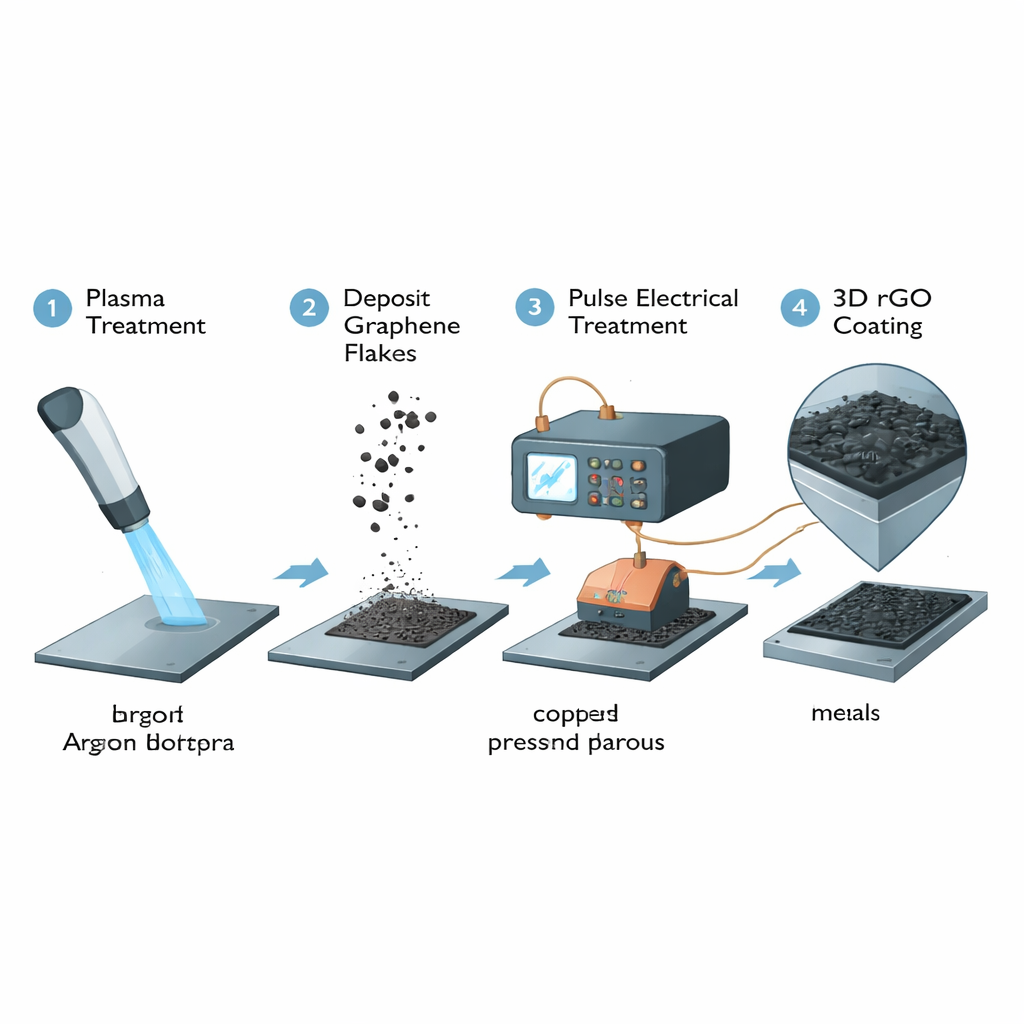
What the Coating Looks Like Up Close
To understand what they had made, the team used powerful microscopes and surface-analysis tools. Transmission electron microscopy revealed that the rGO flakes vary in size and shape, but after processing they form a compact, granular layer with almost no pores and very few gaps at the boundary with the metal. Most flakes stand roughly upright relative to the surface, a consequence of the electric field during pulsed-current treatment. A very thin, disordered carbon-rich interlayer appears where the coating meets the metal’s oxide, likely formed when the flakes partly decompose and rearrange under high temperature and pressure. X‑ray photoelectron spectroscopy confirmed that plasma treatment strips away most contamination carbon and thickens the metal’s oxide layer, while the finished coating retains the characteristic chemical signature of graphene-like carbon. Raman spectroscopy, a laser-based fingerprinting method for carbon materials, showed that the overall structure of the rGO survives the process and remains a multilayer graphene-type network.
How Strong and Durable Is This New Layer?
The mechanical behavior of the coating was tested using nanoindentation—pushing a tiny diamond tip into the surface to measure hardness and stiffness. On tool steel, the three-dimensional rGO layer showed very high local stiffness and hardness, with some regions approaching values reported for high-quality graphene itself. These variations reflect how the flakes are packed: densely aligned, upright stacks resist indentation strongly, while more loosely arranged regions are softer. Scratch tests, in which a diamond tip is dragged across the surface under load, showed that on titanium, stainless steel, and tool steel the coating does not peel or flake off, even after repeated passes. Only samples that skipped the initial plasma treatment showed obvious removal of rGO flakes, underscoring how crucial the plasma step is for strong adhesion. 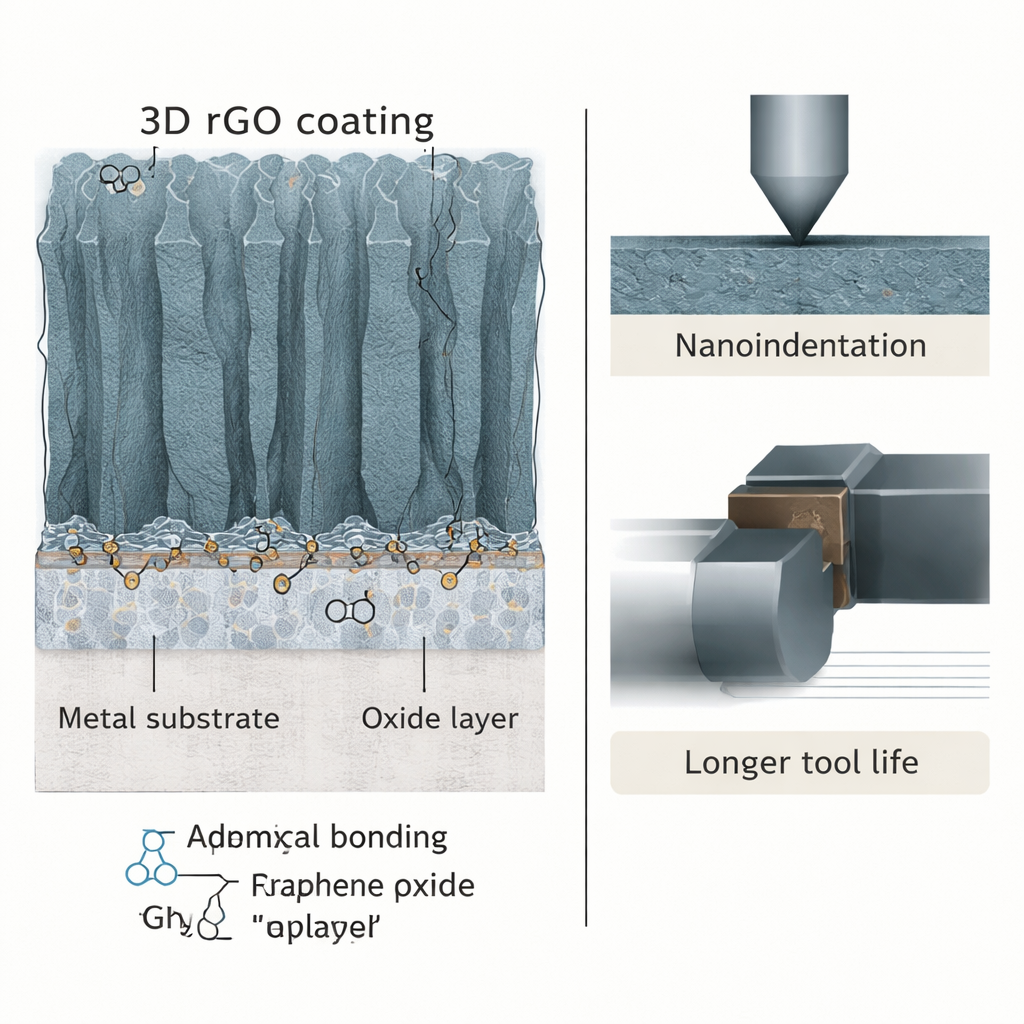
From Laboratory Films to Real-World Use
To probe how well the coating stays attached under stretching and compression, the researchers created rGO bridges between two nickel-chromium wires and used both heating and precise mechanical motion to pull and push on the layer while measuring electrical resistance. As the bridge is strained, the resistance changes in distinct stages, behaving like a network of tiny resistors whose connections break and reform at the metal–rGO interface. The layer can stretch by up to about 30 percent before failing completely, and the resistance is highly sensitive to strain over part of this range. This suggests that beyond serving as a protective coating, such 3D rGO structures could act as sensitive strain or deformation sensors. Finally, the team tested the coating in a demanding industrial task: metal cutting. When applied to carbide cutting inserts used to turn steel on a CNC lathe, the 3D rGO coating survived where a standard hard PVD coating quickly wore off. Tools with the graphene-based layer lasted about 50 percent longer before reaching the same wear limit, hinting at reduced downtime and lower tooling costs in manufacturing.
What This Means in Simple Terms
In plain language, this work shows how to give everyday metals a tough, graphene-based armor that is strongly glued on, mechanically robust, and usable in real machines, not just in the lab. By using cold plasma to activate the metal surface and brief electrical pulses to “lock” a thick forest of graphene-like flakes into place, the authors create a coating that is hard, wear-resistant, and capable of surviving substantial stretching without falling off. The fact that it improves the life of cutting tools and can be applied to several common metals under ambient conditions suggests that such 3D rGO coatings could find widespread use, from more durable machine parts to sensitive strain sensors and energy devices, helping bridge the gap between the exotic properties of graphene and practical engineering solutions.
Citation: Zimniak, Z., Tylus, W., Borak, B. et al. Three-dimensional bulk reduced graphene oxide coatings with strong metal adhesion via cold plasma and pulsed current. Sci Rep 16, 6598 (2026). https://doi.org/10.1038/s41598-026-37227-1
Keywords: graphene coatings, reduced graphene oxide, metal surface engineering, wear-resistant tools, strain-sensitive materials