Clear Sky Science · en
Effects of prosthetic ankle power and foot stiffness category on biomechanical asymmetry and knee moment during walking at different speeds
Why balancing steps matters
For many people who have lost a lower leg, walking with a prosthesis is a daily triumph—but it can also strain the remaining, intact limb. When one leg works harder than the other, the extra forces on the intact knee and hip may raise the risk of joint pain and osteoarthritis over time. This study explores how fine-tuning modern prosthetic feet—by adjusting how stiff they are and how much power they add during each step—can help people walk more evenly and potentially protect their joints.
Two kinds of high-tech feet
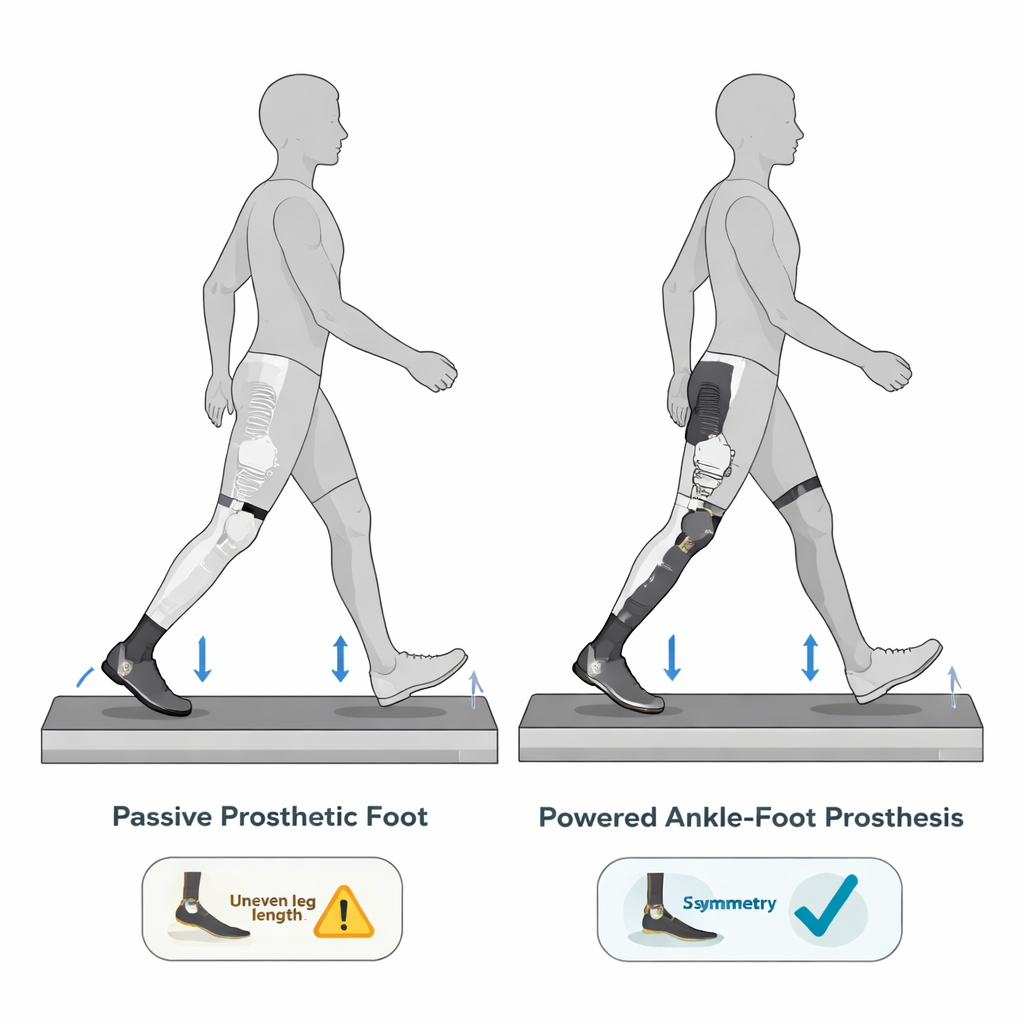
Most people with a below-knee (transtibial) amputation use a passive spring-like foot that stores and releases energy but cannot actively push off the ground. These devices typically return only about half the energy a biological ankle would, so the intact leg must do extra work. A newer option, the BiOM powered ankle-foot prosthesis, includes a built-in motor and spring that can deliver energy during push-off. The BiOM also uses a standard passive foot as its base, which is sold in different stiffness “categories” matched to a user’s weight and activity level. That means clinicians can adjust both how stiff the prosthetic foot is and how much power the motor provides—offering many possible combinations but little guidance on which settings best protect the body.
How the study was done
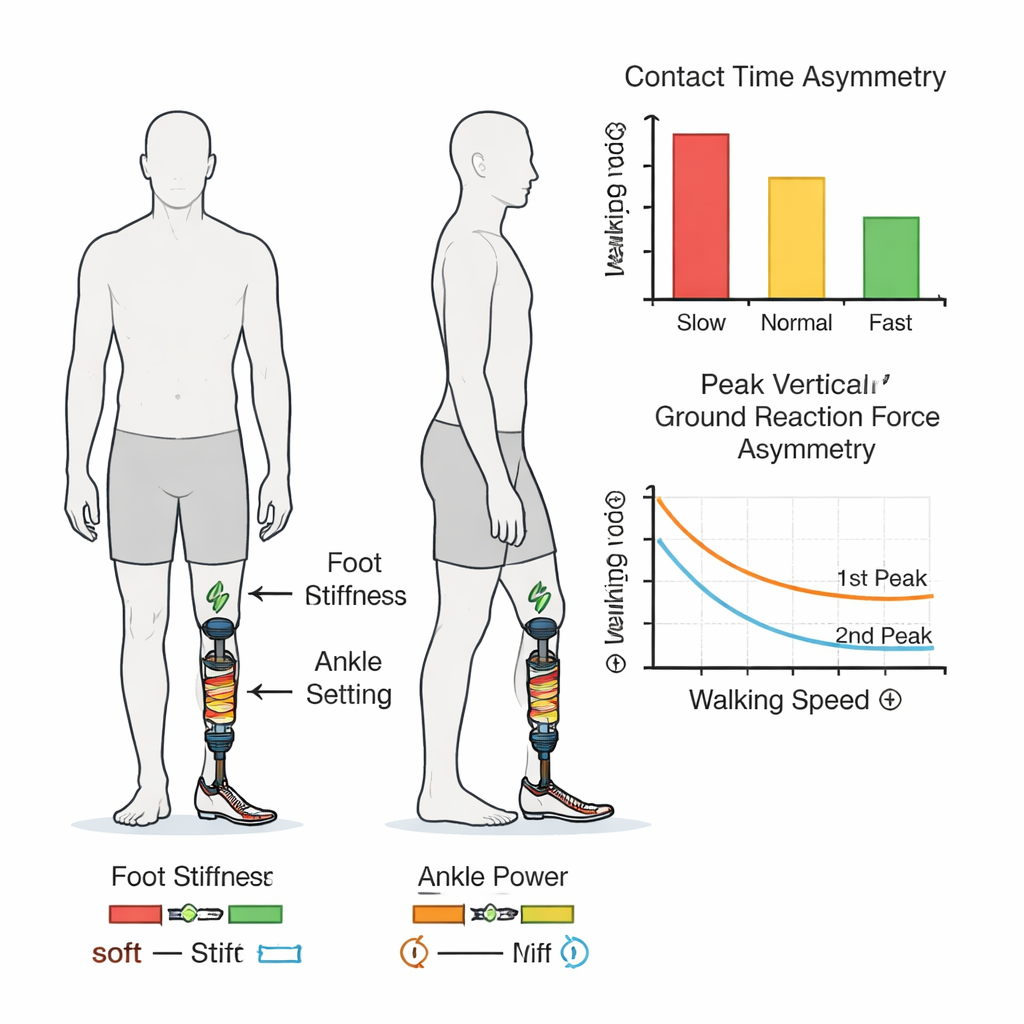
Thirteen experienced prosthesis users with a single below-knee amputation walked on a special treadmill at speeds from slow stroll (0.75 m/s) to brisk walk (1.75 m/s). Each participant tried 16 different prosthetic setups: four foot stiffness categories (from two steps softer than recommended to one step stiffer) and four power conditions (a passive foot with no motor, plus BiOM power tuned to a recommended level, 10% above it, and 20% above it). While they walked, researchers measured how long each foot stayed on the ground, how hard each foot pressed into the treadmill at the first and second peaks of the step, and how much twisting load appeared at the intact knee—an important indicator linked to knee osteoarthritis.
What changed with stiffness alone
Altering the stiffness of the passive foot had surprisingly small effects on walking balance. Across the range of stiffness categories, there was no clear change in how evenly the two legs shared contact time with the ground, nor in the symmetry of the first peak of vertical ground reaction force. Only one pattern stood out: using the stiffest foot reduced the imbalance in the second peak of force compared to using the softest foot, but only by a little over one percentage point. The loads at the intact knee were also largely unaffected by stiffness changes within the tested range. These findings suggest that, for everyday clinic choices among similar commercial feet, modest stiffness adjustments may not dramatically alter joint loading or step balance.
What added power can do—and when
Turning on the BiOM’s motor had more notable effects. Regardless of the underlying foot stiffness, using the powered device reduced differences in contact time between the prosthetic and intact legs compared with using a passive foot. However, the details for force symmetry depended on walking speed and power level. At the tuning speed of 1.25 m/s, running the BiOM 10–20% above its recommended power level produced the most balanced pattern in both first and second peak forces between legs. At slower (0.75 m/s) and faster (1.75 m/s) speeds, though, cranking up the power sometimes made force imbalances worse. Despite these changes in how the legs shared work, the study did not find consistent reductions in the key twisting load at the intact knee when using the powered device at any tested setting.
What this means for everyday walking
For people with a below-knee amputation and their clinicians, these results point to a nuanced picture. A powered ankle-foot prosthesis like the BiOM can help make steps more even, especially near the speed it was tuned for, and slightly stiffer feet may improve one aspect of force balance. Yet within the tested range, neither stiffness changes nor higher power clearly reduced the knee loading thought to contribute to osteoarthritis risk. The authors suggest that prosthetists may want to tailor power settings to a person’s typical walking speed and that future devices might automatically adjust power as speed changes. While fine-tuning today’s prostheses can improve symmetry, fully protecting long-term joint health will likely require further refinements in design and control.
Citation: Tacca, J.R., Colvin, Z.A. & Grabowski, A.M. Effects of prosthetic ankle power and foot stiffness category on biomechanical asymmetry and knee moment during walking at different speeds. Sci Rep 16, 7207 (2026). https://doi.org/10.1038/s41598-026-37225-3
Keywords: prosthetic ankle, transtibial amputation, powered prosthesis, gait symmetry, knee osteoarthritis