Clear Sky Science · en
Study on urban residents’ travel mode choice based on the CART-Apriori method
Why Your Daily Commute Matters
Every trip you take across town—whether on foot, by bike, bus, or car—quietly shapes traffic jams, pollution, and even how your city grows. This study looks closely at how people in a medium-sized Chinese city choose their way of getting around, and tests a new data-driven method to predict those choices. The findings help explain why some people walk a kilometer while others call a ride-hailing car for the same distance, and how smarter planning could cut congestion and carbon emissions.
How People Get Around a Medium-Sized City
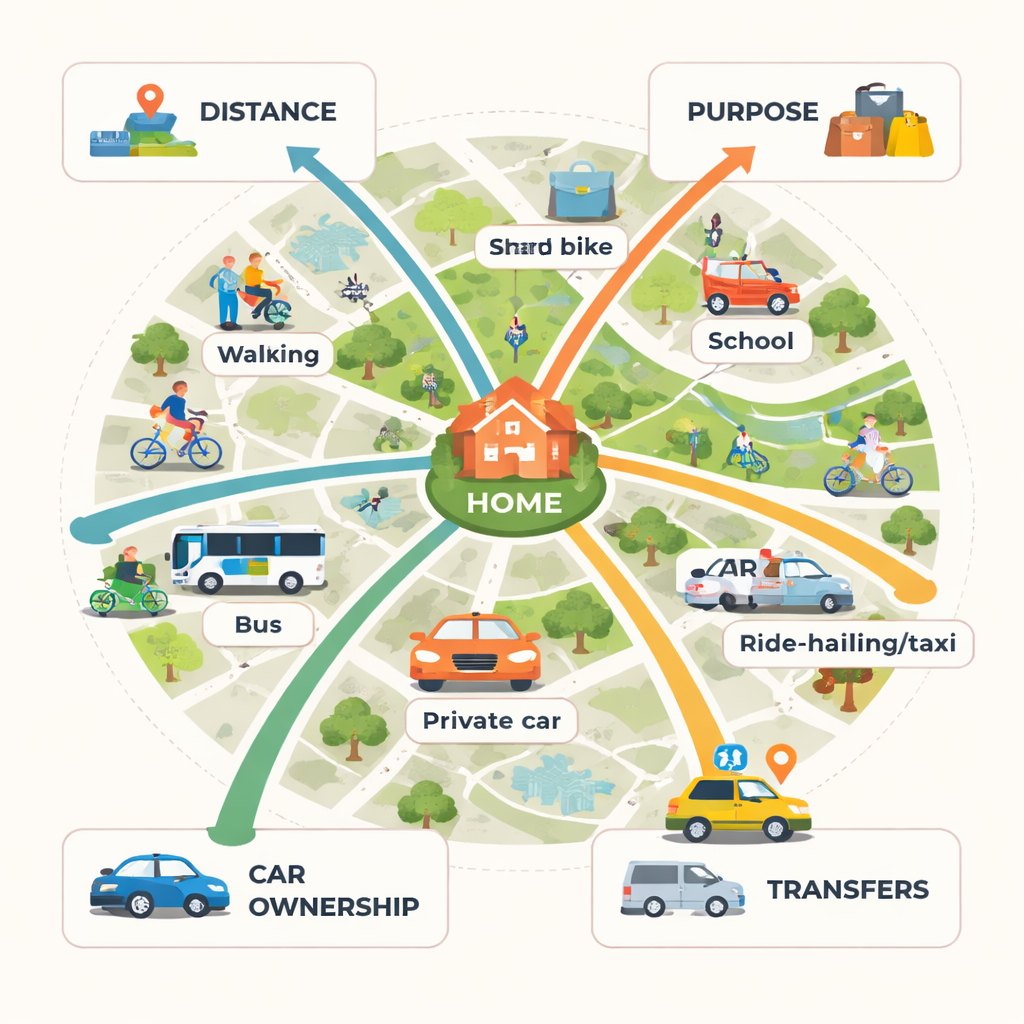
The city examined in this research has about 580,000 urban residents, no subway or rail system, and relatively smooth traffic. Most trips are short, and common options include walking, shared bicycles and e-scooters, buses, taxis or ride-hailing, and private cars. Because bus fares are low and mostly flat, people do not agonize over small price differences for a single trip. Instead, they pay more attention to long-term decisions such as whether to buy a car, and to practical details like how far they need to go and how many times they must transfer between buses. A large survey of 1,500 residents gathered information on who people are, why they travel, how far they go, and which mode they choose.
Blending Old-School Models with New Algorithms
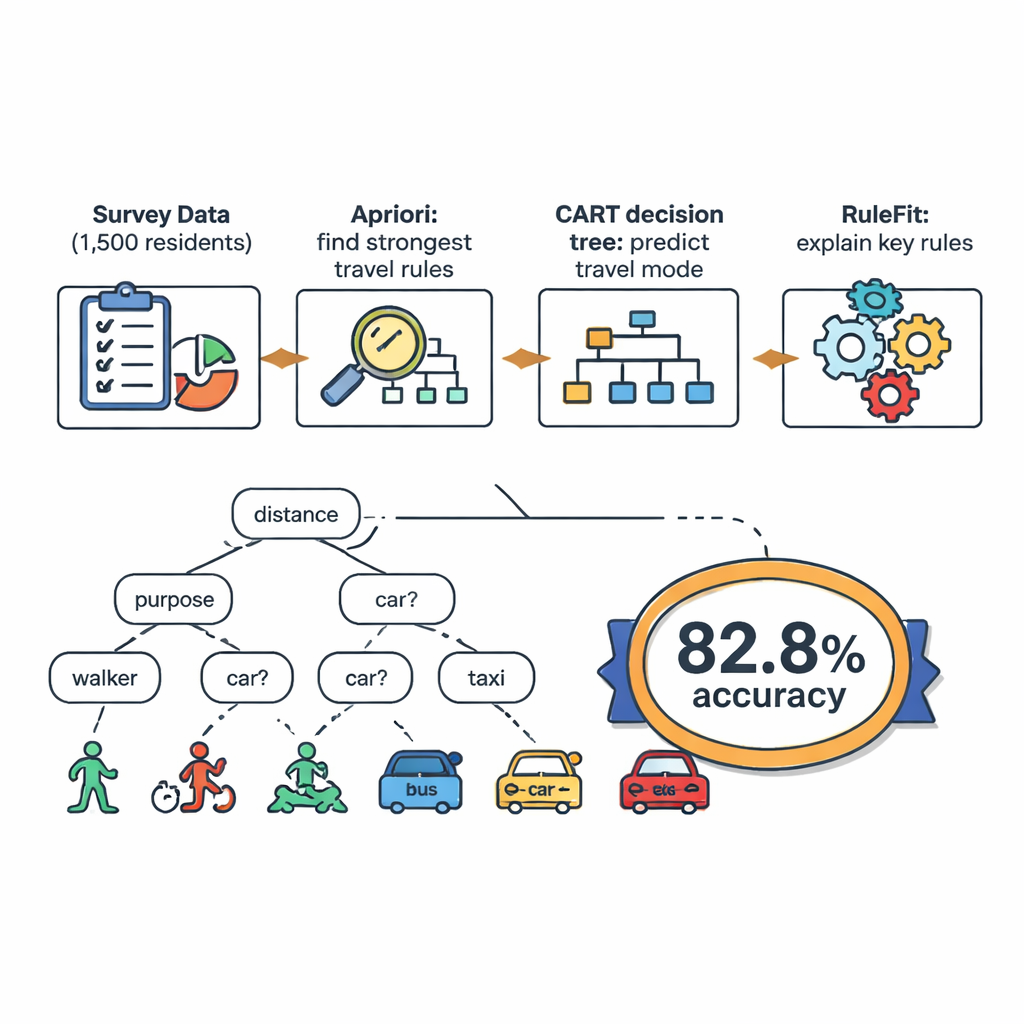
For decades, transport researchers have used traditional mathematical models to predict travel choices, but these often struggle with complex, real-world behavior. Newer machine-learning tools can predict better, but they are often criticized as “black boxes” that are hard to interpret. This study combines several approaches into one framework. First, an algorithm called Apriori scans the survey data to find the strongest “if–then” patterns, such as “if a person travels 3–5 km, owns a car, and must transfer once or twice, then they are very likely to choose ride-hailing.” These patterns are then fed into a decision-tree model known as CART, which repeatedly splits travelers into branches based on factors like distance or car ownership to predict which mode each person will use.
Making the Black Box Understandable
To go beyond raw prediction and actually explain behavior, the researchers add a model called RuleFit. RuleFit takes the branches of the decision tree—the rules that say who ends up choosing which mode—and converts them into simple, human-readable statements with numerical weights. These weights show how strongly each rule nudges a person toward walking, biking, taking the bus, driving, or hailing a ride. By doing this, the study can both forecast what people will do and clearly describe the main patterns, rather than just spitting out a prediction with no explanation.
The Few Factors That Matter Most
Despite starting with many possible influences, the data mining step reveals that just four factors dominate travel decisions: how far people travel, why they are traveling, whether they own a car, and how many transfers they would need to make on public transport. Distance comes out on top. Residents usually walk when the trip is under one kilometer, regardless of whether they own a car. Shared bicycles are especially popular for 1–3 km commutes to work, even among car owners. For medium trips of 3–5 km, shared e-scooters and private cars appeal to those who want a direct ride and wish to avoid multiple transfers. Buses work best for 3–5 km trips that do not require changing routes. Ride-hailing is favored for 1–3 km commutes when the bus alternative would involve several transfers. Overall, the combined CART–Apriori model correctly predicts people’s chosen mode about 83% of the time, outperforming several other widely used methods.
What This Means for Greener Streets
By pinpointing the small set of factors that really drive everyday choices, this study offers clear guidance for city planners. Improving sidewalks and bike lanes within 3 km of homes could shift many short trips to walking and cycling. Redesigning bus routes to reduce transfers, especially for 3–5 km journeys, can make public transport more attractive than driving. Policies such as parking fees or congestion charges for short car trips, combined with convenient shared bikes and e-scooters, could further encourage low-carbon options. To a layperson, the bottom line is simple: when cities make short trips easy to walk or bike, and longer ones simple to complete by bus without multiple transfers, people naturally choose cleaner and more efficient ways to get around.
Citation: Song, H., Wang, X., Tian, W. et al. Study on urban residents’ travel mode choice based on the CART-Apriori method. Sci Rep 16, 6270 (2026). https://doi.org/10.1038/s41598-026-37216-4
Keywords: urban travel behavior, mode choice, machine learning, sustainable transport, public transit