Clear Sky Science · en
Seismic damage evolution and dynamic characteristics of the surrounding rock in tunnel portal anti-dip slopes reinforced with frame beams
Why tunnel entrances matter in big earthquakes
When a major earthquake strikes, we usually picture collapsed buildings and broken bridges. Yet mountain tunnels, which carry highways and railways through rugged terrain, often survive with surprisingly little internal damage. The weak link is the tunnel entrance, where solid underground structures meet steep rock slopes. This study asks a practical question with big implications for infrastructure safety: how and why do earthquakes concentrate damage around tunnel portals carved into unstable, layered rock slopes, and what can engineers do to better protect them?
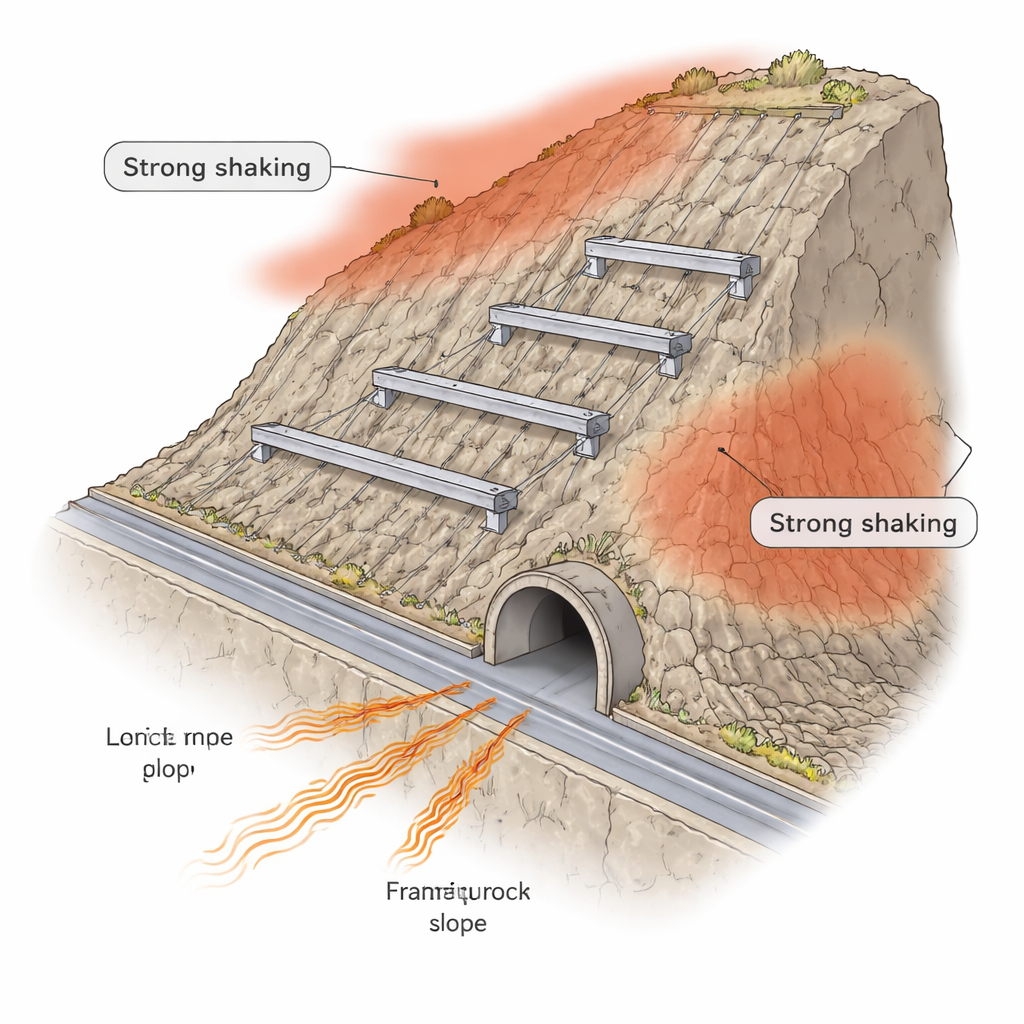
Shaking a miniature mountain in the lab
To explore this, the researchers built a large, scaled-down model of a real tunnel entrance along China’s Nujiang River. The hillside above the tunnel is made of so‑called anti-dip rock layers—tilted rock beds that lean away from the slope face, a geometry known to be prone to toppling during shaking. They reinforced the model slope with frame beams, anchored by steel cables and rods, similar to systems used on real highways and rail lines. The entire model was mounted in a three-directional shaking table facility, where it could be subjected to realistic earthquake motions recorded during past events such as the Kobe, El Centro, and Wenchuan earthquakes.
How the slope and tunnel responded to earthquakes
As the team increased the simulated shaking, they carefully measured acceleration, strain, earth pressure, and displacements throughout the slope and around the tunnel lining. The reinforcing frame beams did their job in one important sense: they prevented the slope from collapsing in a dramatic, full-scale topple. However, the slope surface still suffered heavy spalling, the crest of the slope moved downward, and rock columns leaned strongly toward the open face. Most critically for transportation safety, the tunnel entrance was badly affected. When the shaking level reached about the strength of Earth’s gravity (1.0–1.2 g), cracks formed at the bottom of the tunnel lining and at joints between lining segments, eventually linking into a through‑crack in the invert—the floor of the tunnel ring.
Where shaking is strongest and why the portal suffers
The measurements revealed that shaking does not affect every part of the slope equally. Accelerations were amplified as waves climbed toward the slope crest and were strongest near the surface, a combination of “elevation” and “surface” effects. Under vertical shaking, the tunnel portal became a hotspot where incoming waves were reflected and bent around the lining and the sloping rock layers, creating a complex pattern of reinforced motion. Along the tunnel itself, the shallow-buried section near the entrance shook much more intensely than the deeper section. The difference in motion between the rock above and below the tunnel grew large near the portal, stressing the lining and the surrounding rock and helping explain why damage concentrated there rather than farther inside the mountain.
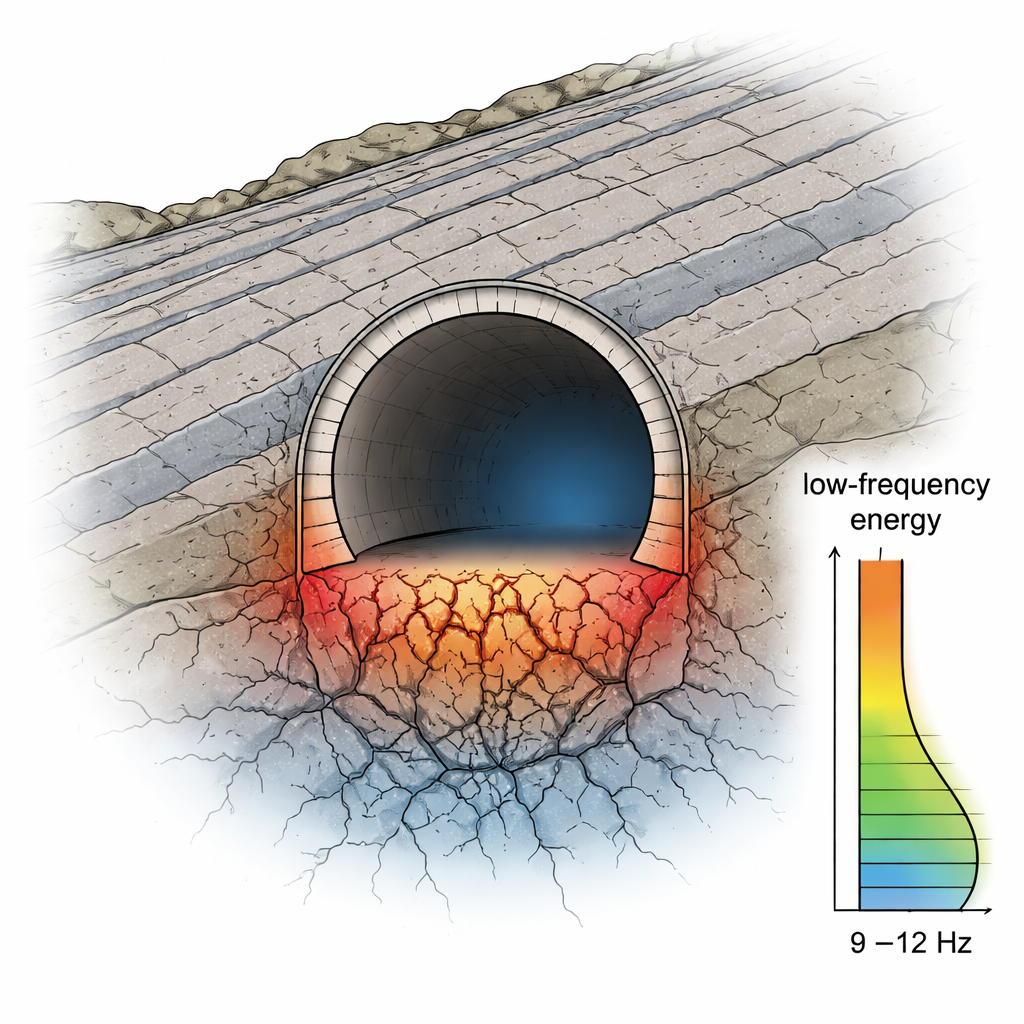
Following hidden damage through rock properties and wave energy
To move beyond surface observations, the researchers tracked how the mechanical properties of the rock mass changed with shaking. They used established relationships between strain and two key dynamic parameters: the shear stiffness of the rock and its ability to dissipate energy (its damping). As shaking intensified, the rock’s stiffness dropped and its damping rose, especially in the rock just below the tunnel lining. Mapping these changes showed damage zones first forming near the lower part of the lining at the entrance, then extending deeper along the tunnel as input motion increased. The team also applied a time–frequency tool called the Hilbert–Huang transform to study how earthquake energy was distributed across different frequencies. They found that, under vertical shaking, low-frequency components in the 9–12 Hz range were particularly important for damaging the rock and lining near the portal. When the lining began to crack, the wave energy in this band noticeably attenuated in the rock beneath the tunnel, offering a potential way to detect damage through careful monitoring of seismic signals.
What this means for safer tunnels
For non-specialists, the takeaway is clear: tunnel portals in steep, layered rock are not simply smaller versions of the underground tunnel—they are special weak spots where hillside motion, wave focusing, and structural details combine to magnify earthquake damage. This study shows that even when visible supports keep the slope from collapsing, hidden damage can build up in the rock and in the tunnel lining, especially at its lower arc. The authors conclude that engineers should strengthen the inverted arch (the bottom of the lining) and the rock beneath it, and pay particular attention to vertical, low-frequency shaking when designing and assessing tunnel entrances. Better understanding of where and how energy concentrates during earthquakes can guide smarter reinforcement and monitoring, helping keep lifeline tunnels open when they are needed most.
Citation: Wen, H., Yang, C., Hou, B. et al. Seismic damage evolution and dynamic characteristics of the surrounding rock in tunnel portal anti-dip slopes reinforced with frame beams. Sci Rep 16, 6480 (2026). https://doi.org/10.1038/s41598-026-37208-4
Keywords: tunnel portal, earthquake damage, rock slope, seismic shaking, underground infrastructure