Clear Sky Science · en
Study on the dynamic tensile properties and damage mechanisms of thermally treated granite under acid cooling
Why breaking hot rock matters for clean energy
Deep beneath our feet lie vast stores of heat locked in hard, crystalline rock such as granite. Tapping this heat could provide round-the-clock, low‑carbon energy, but drilling and cracking these rocks is difficult and expensive. This study explores a surprising helper: acid. By heating granite to the high temperatures found in geothermal reservoirs and then cooling it with water or acid, the researchers show how carefully chosen fluids can weaken rock, making it easier to fracture and potentially cheaper to turn underground heat into useful power. 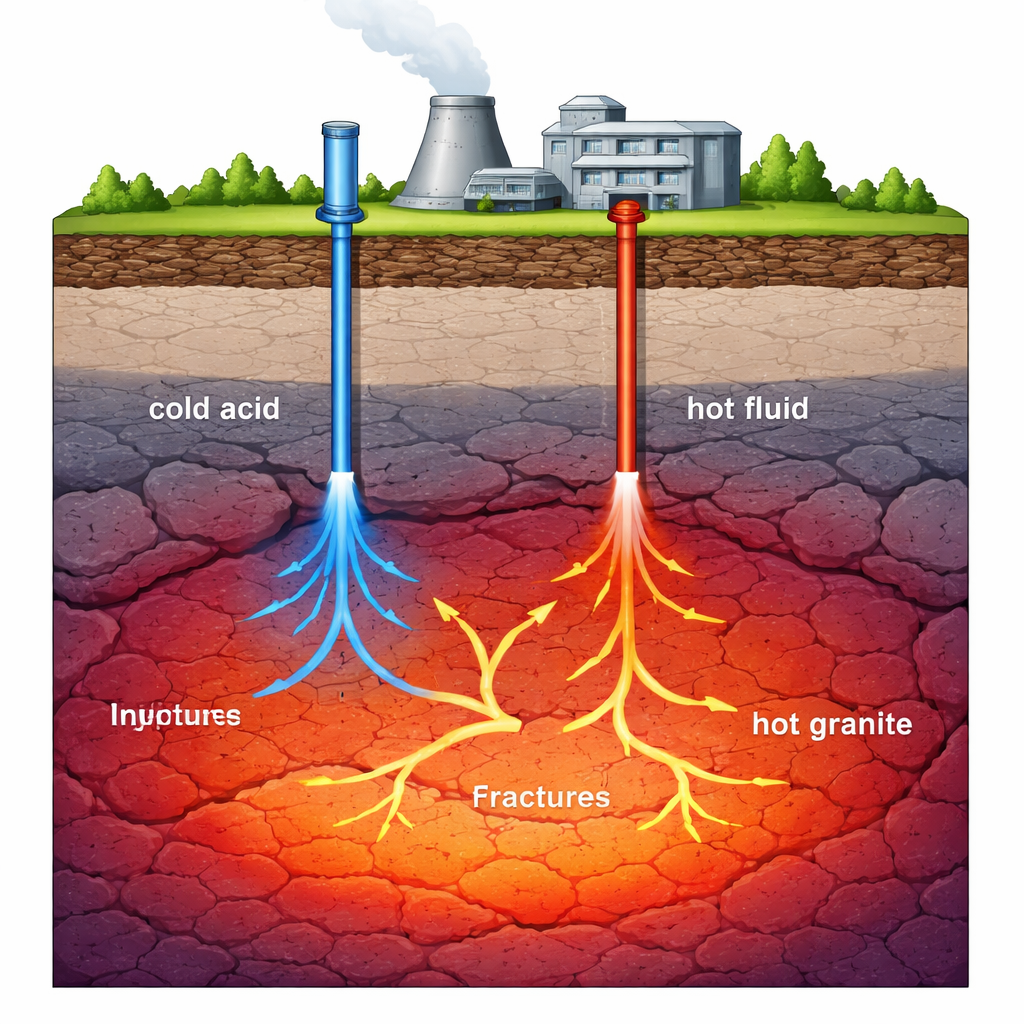
From quarry to lab: recreating deep underground conditions
The team began with granite from a region of China that resembles the hot dry rock found several kilometers below ground in many geothermal projects. They cut the stone into small, uniform cylinders to ensure that each sample behaved consistently under stress. These samples were heated to temperatures from room temperature up to 600 °C, covering the range expected in real geothermal reservoirs. After heating, each group of samples was cooled in one of three ways: left to cool naturally in air, plunged into room‑temperature water, or plunged into a strong acid mixture similar to what engineers already use to clean and stimulate geothermal wells.
Listening to rocks and smashing them apart
To see how much damage heating and cooling caused, the researchers first measured how quickly sound waves traveled through the granite. Slower waves signal more internal cracks and voids. They then used a device that fires a fast stress pulse through each disk‑shaped sample, pulling it apart in a fraction of a millisecond. This method, known as a dynamic tensile test, mimics the rapid loading that rocks experience near a drill bit or during fluid injection. High‑speed cameras and digital image techniques captured how cracks formed and spread, turning each test into a frame‑by‑frame movie of rock failure.
Acid cools, cracks, and corrodes
The measurements painted a clear picture: heating alone weakens granite, but the way it is cooled matters greatly. As temperature rose from 100 to 600 °C, all samples showed slower sound speeds and lower tensile strength, meaning they became easier to break. Yet acid‑cooled samples were consistently the most damaged. At 600 °C their sound speed dropped by about 71 percent, and their resistance to being pulled apart fell by more than 60 percent compared with room‑temperature rock. After impact, acid‑cooled pieces crumbled into smaller fragments than those cooled in water or air. X‑ray tests of the mineral makeup and surface‑chemistry scans revealed why: the hot acid was not just cooling the rock but actively dissolving key minerals such as quartz and reshuffling others, opening pores and enlarging microcracks throughout the material. 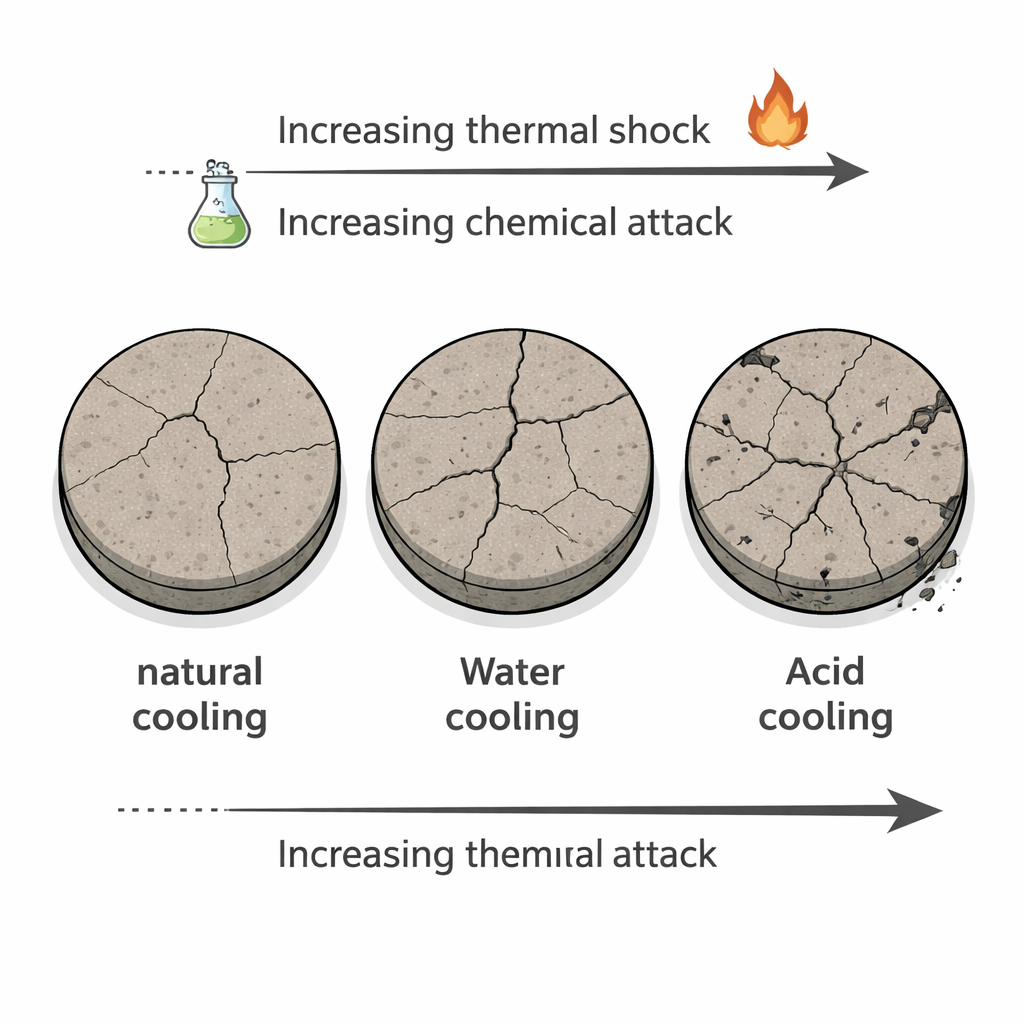
How cracks grow under different cooling paths
Fast imaging showed that the path to failure also changed with cooling method. In naturally cooled granite, the first visible cracks tended to start near the center of the disk and then spread outward. In water‑ and acid‑cooled samples, initial cracks often appeared at the loaded edge, where thermal shock and pre‑existing damage were greatest, then shot toward the middle. As loading continued, secondary cracks branched off, forming X‑shaped patterns. At the highest temperatures, the region near the loading point broke into many small wedges, especially in acid‑cooled samples, highlighting just how much extra damage thermal shock and chemical attack can produce together.
What it means for future geothermal energy
For a non‑specialist, the key message is that heat plus acid can turn tough granite into a much more breakable material. By pre‑heating rock in the Earth and then injecting cool acidic fluid, engineers may be able to open more fractures with less force, improving drilling efficiency and boosting the flow of hot water or steam from a geothermal reservoir. The authors caution, however, that using acid underground raises questions about environmental safety, long‑term rock stability, and how different rock types respond. Even so, their results offer a roadmap for tuning fluid chemistry and temperature to unlock clean geothermal energy more effectively, using the rock’s own weaknesses against it.
Citation: Yin, T., Song, J., Liu, F. et al. Study on the dynamic tensile properties and damage mechanisms of thermally treated granite under acid cooling. Sci Rep 16, 6112 (2026). https://doi.org/10.1038/s41598-026-37207-5
Keywords: geothermal energy, hot dry rock, granite, acid stimulation, thermal damage