Clear Sky Science · en
A Novel Hybrid Approach To Drought Forecasting: Leveraging Feature Engineering And Ensemble Methods
Why predicting dry spells matters
Droughts creep up slowly but can devastate crops, drinking water supplies, and entire local economies. As climate change makes weather more erratic, communities need early warnings that go beyond simple guesses about rainfall. This paper presents a new way to forecast how severe droughts will become, using smart combinations of math and machine learning to give farmers and planners a clearer picture of what lies ahead.
From shifting skies to usable signals
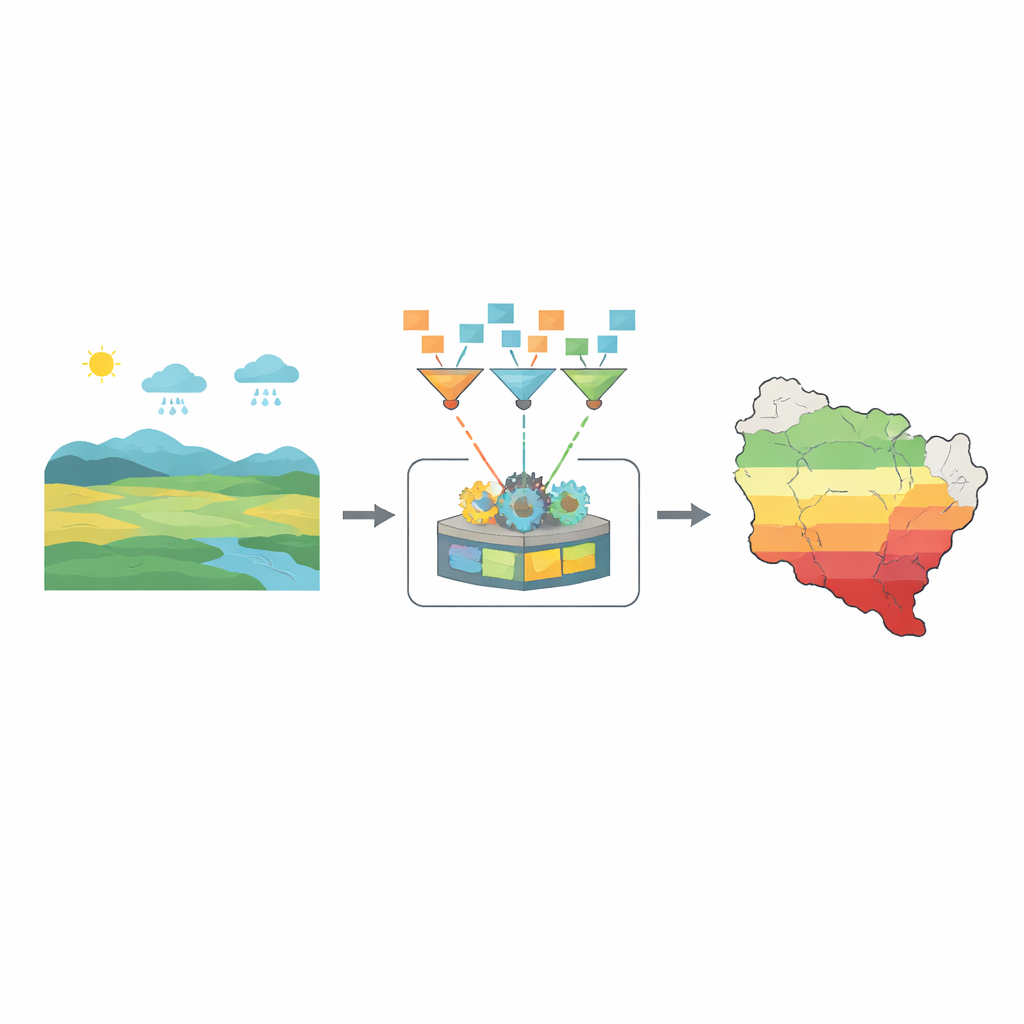
The study starts from a simple reality: today’s climate is messy. Temperature swings, shifting winds, and uneven rainfall no longer follow neat statistical patterns. Traditional forecasting tools struggle with this complexity. The authors turn instead to large collections of weather and landscape data, including rainfall, temperature, humidity, wind, ground height, slope, soil quality, and a vegetation health score. Their goal is to turn these raw numbers into a smaller set of powerful signals that describe how close a region is to different levels of drought, ranging from healthy conditions to extreme water shortage.
Choosing the few numbers that matter most
Not every measurement is equally helpful. Country names or administrative codes, for example, do little to explain why plants are drying out. The team first cleans the data and then uses a correlation analysis to see which factors move together and which actually help distinguish wet from dry periods. They find that certain features stand out: a vegetation score, the steepness of the land in one direction, and three moisture-related air temperatures near the ground. These carefully chosen ingredients become the backbone of the forecasting system.
Turning raw data into drought fingerprints
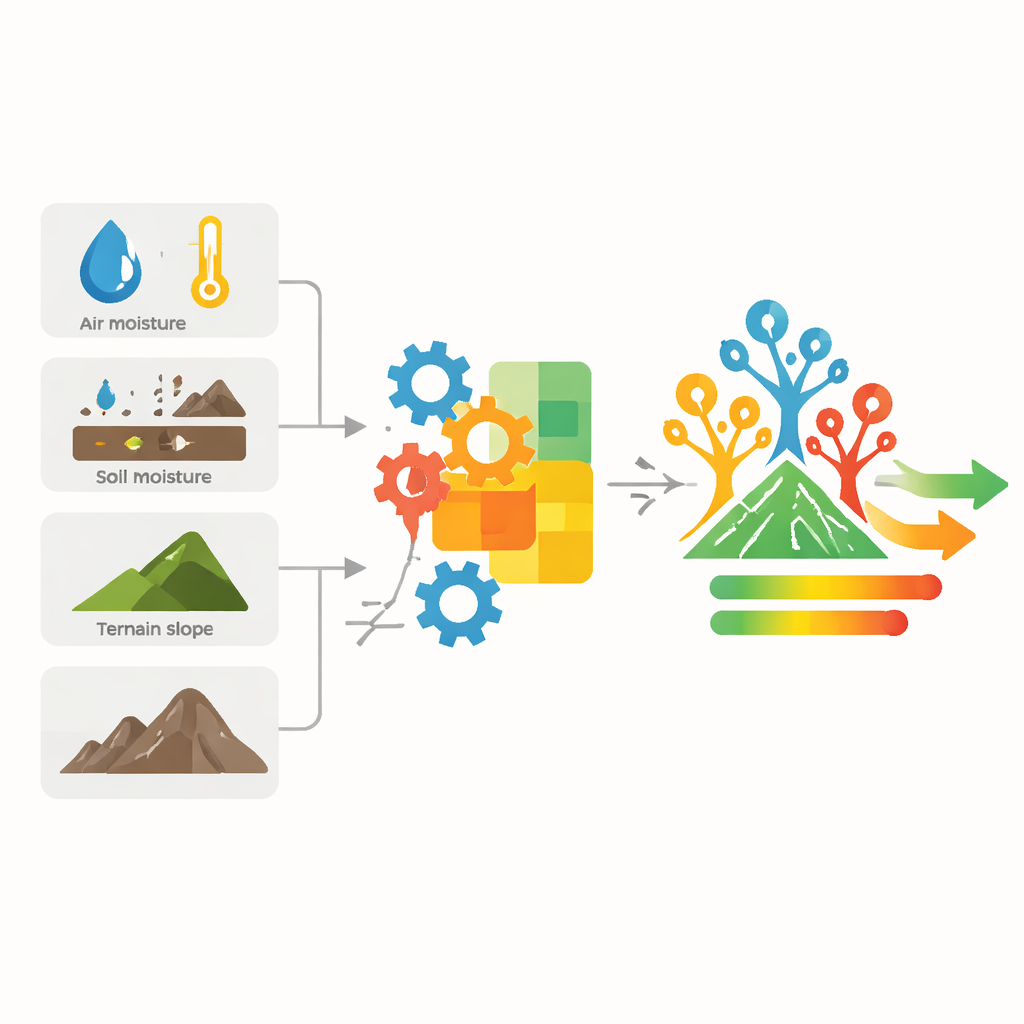
Instead of simply feeding these five ingredients into an algorithm, the authors design new combined measures that reflect how drought really behaves in nature. They build simple but meaningful formulas—using only familiar operations such as addition, multiplication, square roots, and logarithms—to capture ideas like overall dryness, the helpful effect of recent rain, how quickly heat pushes conditions toward drought, how much water remains in the soil, and the balance between moisture gained and moisture lost to evaporation. Each formula produces a new index that acts like a fingerprint of current drought pressure for each place and week in the record.
Letting a forest of decisions vote on the outcome
These engineered indices are then handed to a machine learning method called a random forest. Rather than one big decision rule, this approach grows many simple decision trees, each seeing a slightly different slice of the data. Every tree gives its own opinion on which drought level a situation belongs to, and the forest’s final answer is based on majority vote. By tuning how many trees are grown and how deep each tree can split the data, the authors find a sweet spot where the model is both accurate and resistant to overfitting. On held-out test data, their hybrid system correctly classifies the drought level in almost every case and shows far fewer errors than more standard tools such as k-nearest neighbors, support vector machines, or basic logistic regression.
What this means for life on the ground
For non-specialists, the key message is that a small set of well-designed indicators, grounded in how heat and moisture actually behave, can power a highly reliable early warning system. By blending straightforward equations with a voting-based learning method, the model reaches very high accuracy while remaining relatively light to run and easier to interpret than many deep learning black boxes. If adopted and adapted to local data, this hybrid approach could help farmers adjust planting schedules, water managers plan storage and releases, and disaster agencies prepare for escalating dry spells before they become full-blown crises.
Citation: Charjan, O., Gajbhiye, K., Warhade, J. et al. A Novel Hybrid Approach To Drought Forecasting: Leveraging Feature Engineering And Ensemble Methods. Sci Rep 16, 7972 (2026). https://doi.org/10.1038/s41598-026-37206-6
Keywords: drought forecasting, climate risk, machine learning, agriculture, early warning systems