Clear Sky Science · en
Time stability of Intensive Care Infection Score (ICIS) as a cellular hematology biomarker for infection in critically ill patients
Why timing matters when fighting infection
For people in intensive care, every hour counts when doctors are trying to tell whether a patient is battling a serious infection like sepsis or simply recovering from surgery or trauma. A newer blood-based score, the Intensive Care Infection Score (ICIS), promises faster answers using the same routine blood sample already taken from most patients. This study asks a practical but crucial question: if that blood sample sits for several hours before being analyzed, can clinicians still trust the ICIS result?
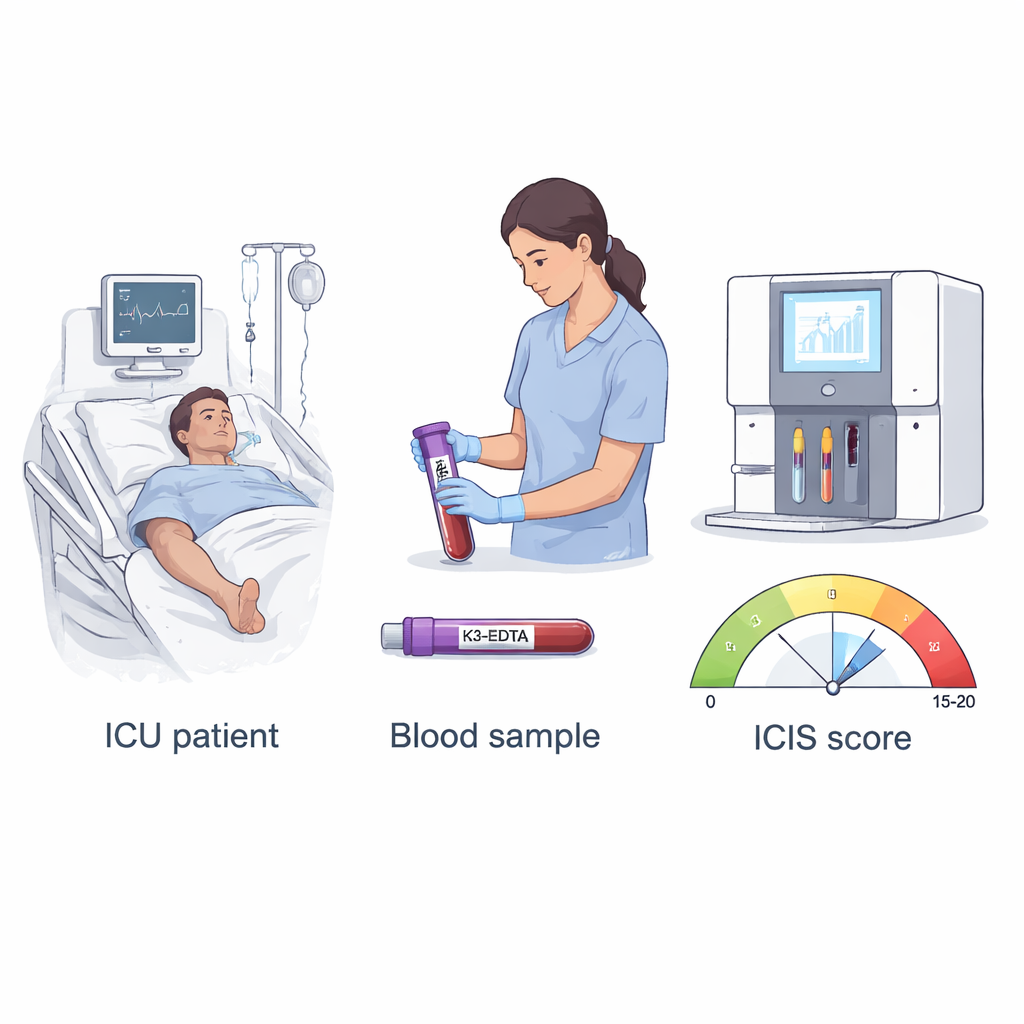
A smart score hiding in a routine blood test
ICIS is built from five detailed measurements of white and red blood cells that are already captured by modern blood-count machines. These measurements track how many mature and immature infection-fighting cells are present, how “activated” they look, whether specialized antibody-producing cells are appearing, and subtle changes in hemoglobin inside red cells. Together, they are combined into a score from 0 to 20. Low values suggest that infection is unlikely, very high values raise suspicion of infection or sepsis, and the middle range invites a closer look at the patient.
Testing what happens during a real hospital shift
The researchers studied 53 critically ill patients in an intensive care unit, including people without infection, with confirmed infections, and with sepsis. For each person, they drew a standard blood sample into commonly used K3‑EDTA tubes and ran it on a high-end hematology analyzer right away. Then they stored the same sample upright at normal room temperature, similar to how tubes often wait in a hospital lab, and re-ran the test about eight hours later—roughly the length of a typical ICU shift. This design mirrored real-world practice, where a clinician might decide later in the day to check ICIS on blood that was drawn that morning.
Stable score, small shifts where it doesn’t matter
Overall, the ICIS values hardly changed between the first and second measurements. The typical score was 2 at the first test and 3 at the second, a difference that was not statistically or clinically meaningful. Some underlying blood-count numbers, like the size of red blood cells or the number of platelets, drifted slightly over eight hours, which is known to happen as cells age outside the body. One component of ICIS—the count of very young white cells called immature granulocytes—showed a noticeable drop on paper, but because it is only one part of the score and is weighted modestly, the overall ICIS classification stayed remarkably stable.
Did these changes affect patient classification?
To judge real-world impact, the team grouped each ICIS result into three simple categories: “no infection indicated” (very low scores), “intermediate,” and “infection indicated” (higher scores). Between the first and the eight-hour measurement, a few patients moved between “no infection” and “intermediate,” or between “infection” and “intermediate.” Importantly, not a single patient jumped directly from “no infection” to “infection” or the other way around. In practice, this means delayed testing might nudge a score from “clearly low” to “borderline,” prompting another check, but it did not create dangerous false reassurance or false alarm.
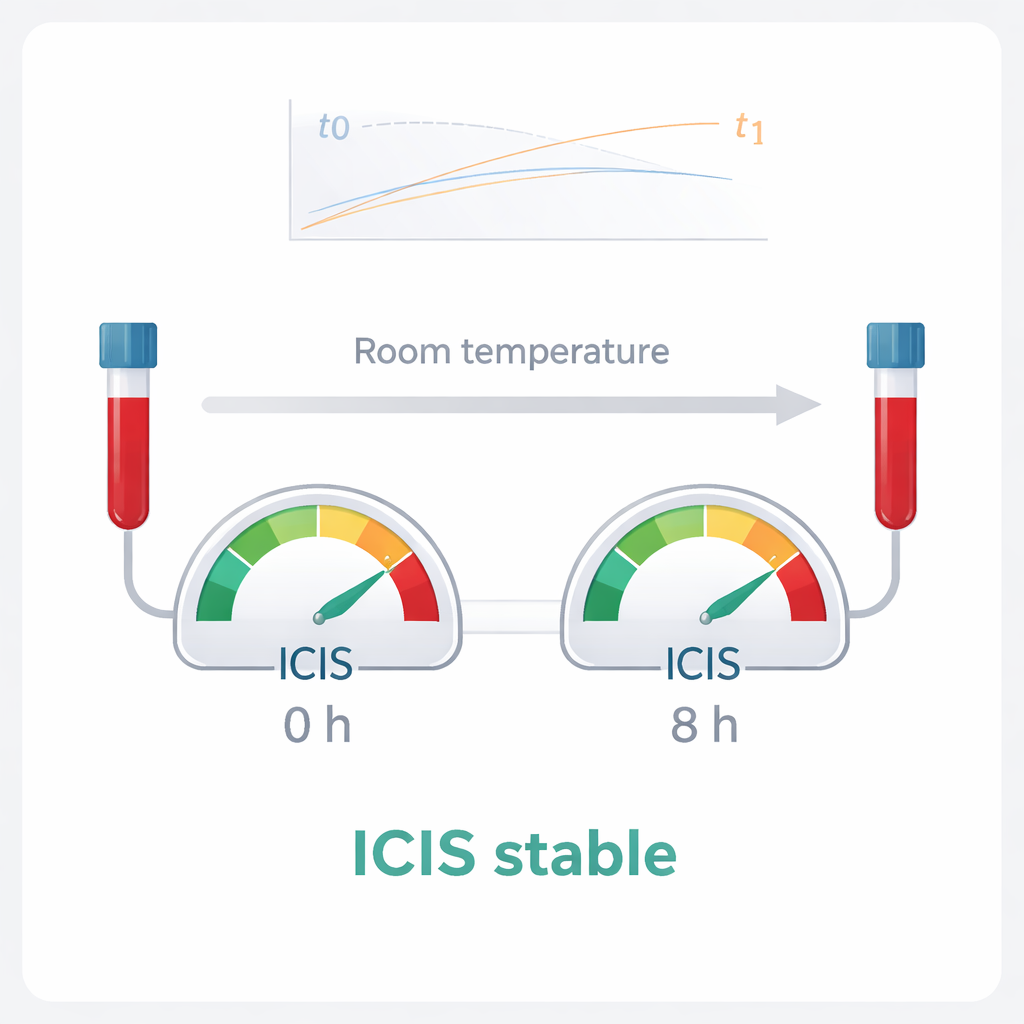
Why this matters for patients and hospitals
Because ICIS can be calculated from a blood sample that is already taken for routine testing, it avoids extra needle sticks and helps reduce unnecessary blood loss in fragile patients. Showing that the score is reliable for up to eight hours at room temperature means laboratories do not have to rush to run it immediately and can even re-use earlier samples if a doctor becomes concerned later in the day. That flexibility can speed up decisions about whether a patient might be developing an infection, while saving staff time and resources.
Take‑home message in simple terms
For patients in intensive care, this study shows that a smart infection score hidden inside the standard blood count remains trustworthy for at least eight hours after the blood is drawn, as long as the sample is stored properly at room temperature. Even though some fine details in the blood slowly change, they do not mislead the ICIS score into wrongly labeling a patient as infected or infection‑free. In short, if the blood was taken this morning and analyzed this afternoon, ICIS still gives doctors a dependable snapshot of the body’s fight against infection.
Citation: Nacke, N., Zuther, M., Hönemann, C. et al. Time stability of Intensive Care Infection Score (ICIS) as a cellular hematology biomarker for infection in critically ill patients. Sci Rep 16, 5620 (2026). https://doi.org/10.1038/s41598-026-37204-8
Keywords: sepsis, intensive care, infection biomarker, blood test, ICIS score