Clear Sky Science · en
Categorization of household drinking water and sanitation service levels and associated determinants in Uganda
Why Clean Water and Toilets Still Matter
Clean drinking water and safe toilets are things many people take for granted, yet in Uganda millions of families still lack them. This study looks across the entire country to ask a simple but crucial question: who gets good water and sanitation services, and who is left behind? By combing through a large national survey, the researchers show how where you live, how much money you have, and even who heads your household can strongly shape your chances of drinking safe water and using a decent toilet.
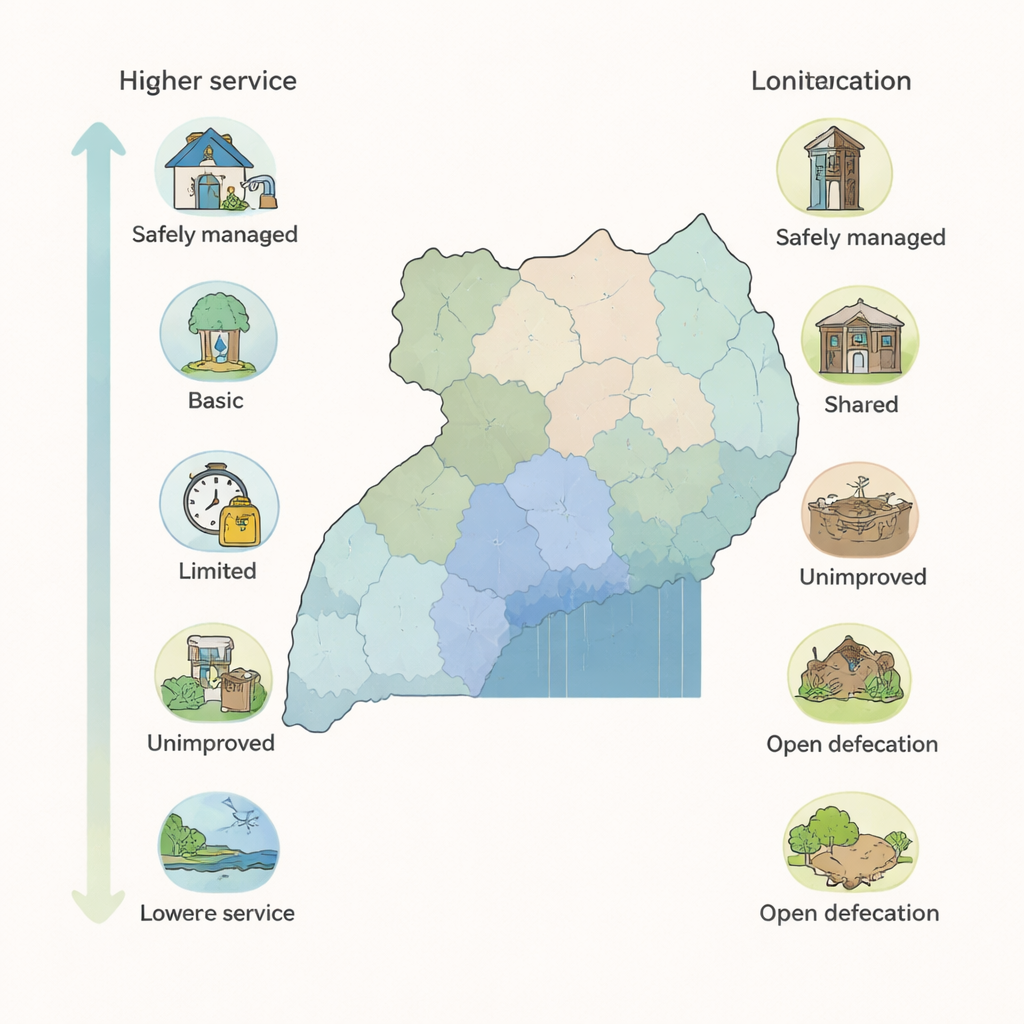
Different Steps on the Water and Toilet Ladder
The researchers use a simple “service ladder” created by the World Health Organization and UNICEF. At the top of the ladder is “safely managed” service—water that is treated, available at home, and free from contamination, and toilets that are private and safely handle waste. Lower rungs include basic services, shared or distant facilities, unimproved options such as crude pits, and finally no service at all, meaning surface water or open defecation. Instead of just asking whether a household has a borehole or pit latrine, the ladder captures how safe, convenient, and private those services really are.
What the National Picture Shows
The team analyzed data from nearly 9,000 households in the 2018–2019 Uganda Malaria Indicator Survey, which for the first time included refugee settlements as well as regular communities. They found that most Ugandan households—about two thirds—depend on “basic” drinking water. This usually means an improved source such as a borehole or protected spring that is within a 30-minute round trip. Only about one in eleven households has safely managed water on their premises, and some regions, such as Karamoja, have virtually none. For toilets, almost half of households rely on improved facilities that are shared with other families, while a little under half have safely managed toilets of their own. Open defecation has declined overall but remains common in a few regions.
Cities, Countryside, and Refugee Settlements
Where a family lives makes a major difference. Urban households are far more likely to have water and toilets that qualify as safely managed, reflecting the concentration of piped networks and better infrastructure in cities. Rural households typically use basic services and often walk long distances for water; many still depend on unimproved sources or surface water. Refugee settlements stand out as some of the most disadvantaged places. Very few refugee households have safely managed water or sanitation, and they are more likely to rely on unsafe sources and to practice open defecation, underlining the limits of short-term emergency systems for long-term living.
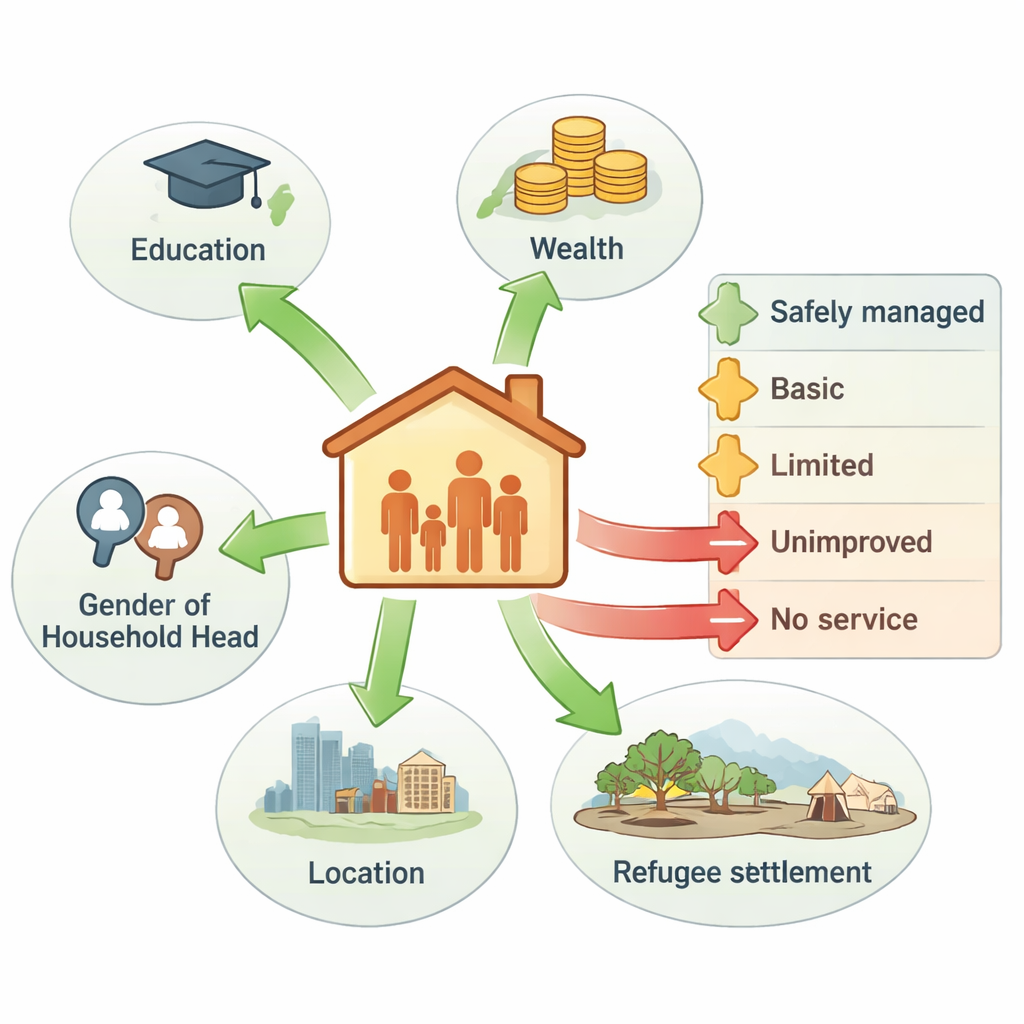
Who Benefits Most from Better Services
The study goes beyond description to explore which household traits line up with better or worse service levels. Using statistical models, the authors show that households headed by someone with more education, especially beyond secondary school, are much more likely to reach the top rungs of the ladder. Wealth strongly matters: richer families can afford safer connections, private toilets, and fees for upkeep, while poorer families are often stuck with crowded or unsafe options. Male-headed households are more likely than female-headed ones to have higher service levels, reflecting wider gender inequalities in income, land, and decision-making power. Geography is crucial as well: regions in central and western Uganda generally fare better, while places such as Bukedi, Teso, Karamoja, and many refugee-hosting areas lag behind.
What Needs to Change
For a layperson, the message is clear: Uganda has made progress in spreading basic water points and latrines, but the safest and most convenient services still reach mainly the educated, the better-off, and those in favored regions. The study concludes that meeting global goals for water and sanitation will require more than building a few wells or toilets. Targeted investment is needed in rural areas, remote regions, and refugee settlements, along with policies that reduce costs for poor and female-headed households and support local, long-lasting solutions. In everyday terms, this means making sure that a child’s chances of drinking safe water and using a decent toilet do not depend on where they were born or how much money their parents have.
Citation: Nakibuule, B., Semakula, H.M., Nseka, D. et al. Categorization of household drinking water and sanitation service levels and associated determinants in Uganda. Sci Rep 16, 6089 (2026). https://doi.org/10.1038/s41598-026-37203-9
Keywords: Uganda water access, sanitation services, SDG 6, rural and urban disparities, refugee settlements WASH