Clear Sky Science · en
Machine learning-based estimation and optimization of phoenix Dactylifera Seed Powder reinforced vinyl ester bio-composites
Turning waste seeds into useful materials
Every year, tons of date palm seeds are discarded as agricultural waste. This study explores how that waste can be transformed into strong, heat-resistant plastic parts, and how artificial intelligence can help engineers design these new materials faster and with far fewer lab tests. The work combines “green” fillers made from ground date seeds with a common engineering resin, then uses machine learning to predict how tough and durable the resulting composites will be.
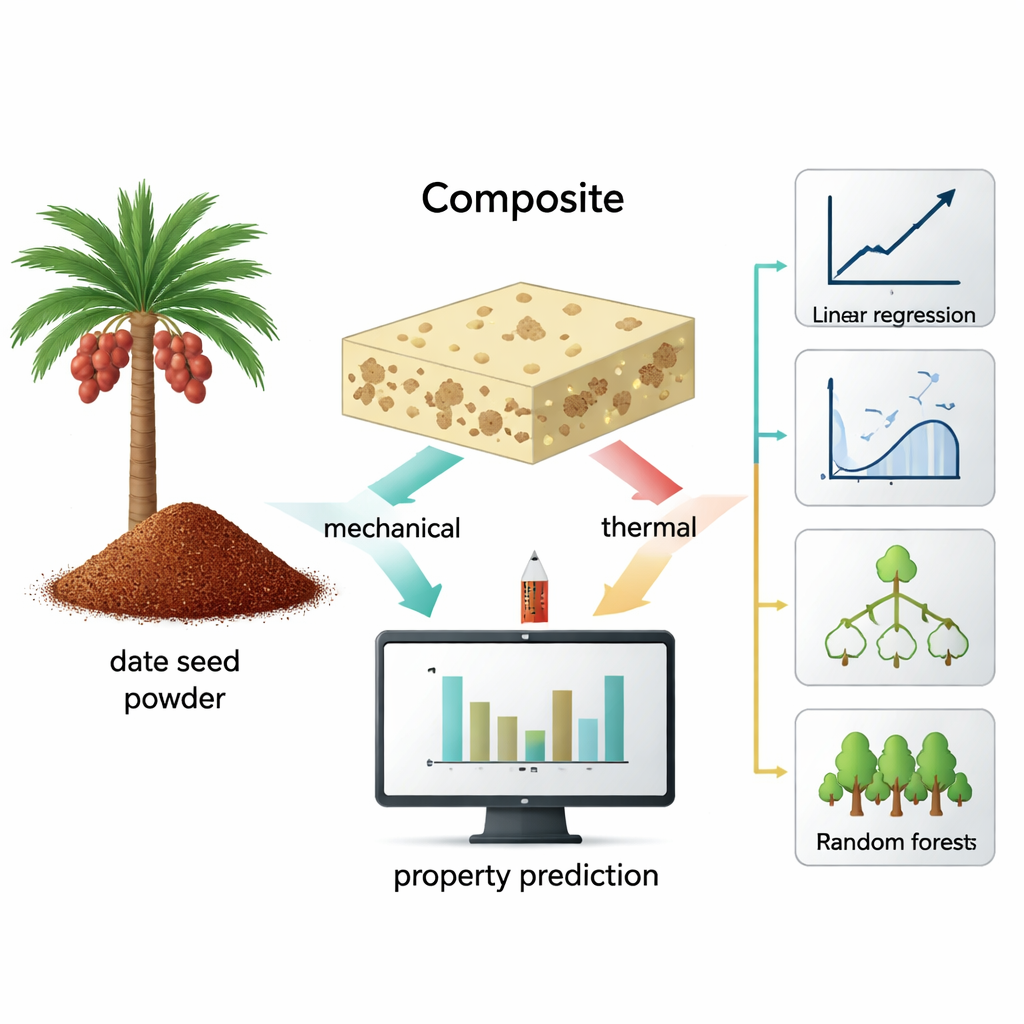
From date seeds to strong plastic parts
The researchers focused on vinyl ester, a resin widely used in automotive and construction components, and reinforced it with finely ground Phoenix dactylifera (date palm) seed powder. By mixing different amounts of seed powder (from 0 to 50% by weight) into the resin and molding flat panels, they created a family of bio-composites. Standard tests were then used to measure how these materials behave: how much force they can withstand in tension and bending, how well they resist sudden impact, how hard their surface is, and how much heat they can tolerate before they begin to soften under load (the heat deflection temperature).
Why trial-and-error is not enough
Traditionally, optimizing such composites is slow and expensive. Each new formulation requires mixing, curing, machining, and destructive testing, and it is especially difficult to predict long-term behavior under real-world conditions. Simple formulas often fail because many factors interact in complex, non-linear ways. In this study, the authors deliberately worked with a limited experimental dataset—only 11 data points per property—and asked whether modern machine learning could still capture the key trends well enough to guide design. To protect against overfitting, they used data cleaning, cross-validation, and even created carefully interpolated “virtual” points within verified ranges.
Teaching machines to read materials
Four types of prediction models were compared: basic linear regression, support vector machines (SVM), decision trees, and random forests (an ensemble of many trees). Each model learned to relate a small set of inputs—especially the percentage of seed powder—to the measured properties. Their performance was checked using standard statistics that quantify accuracy and stability. Overall, SVM emerged as the most balanced and reliable model, with strong scores across tensile strength, bending strength, hardness, and heat resistance, while random forests were particularly good at predicting impact strength. Decision trees, though easy to interpret, tended to “memorize” the training data and performed less consistently.
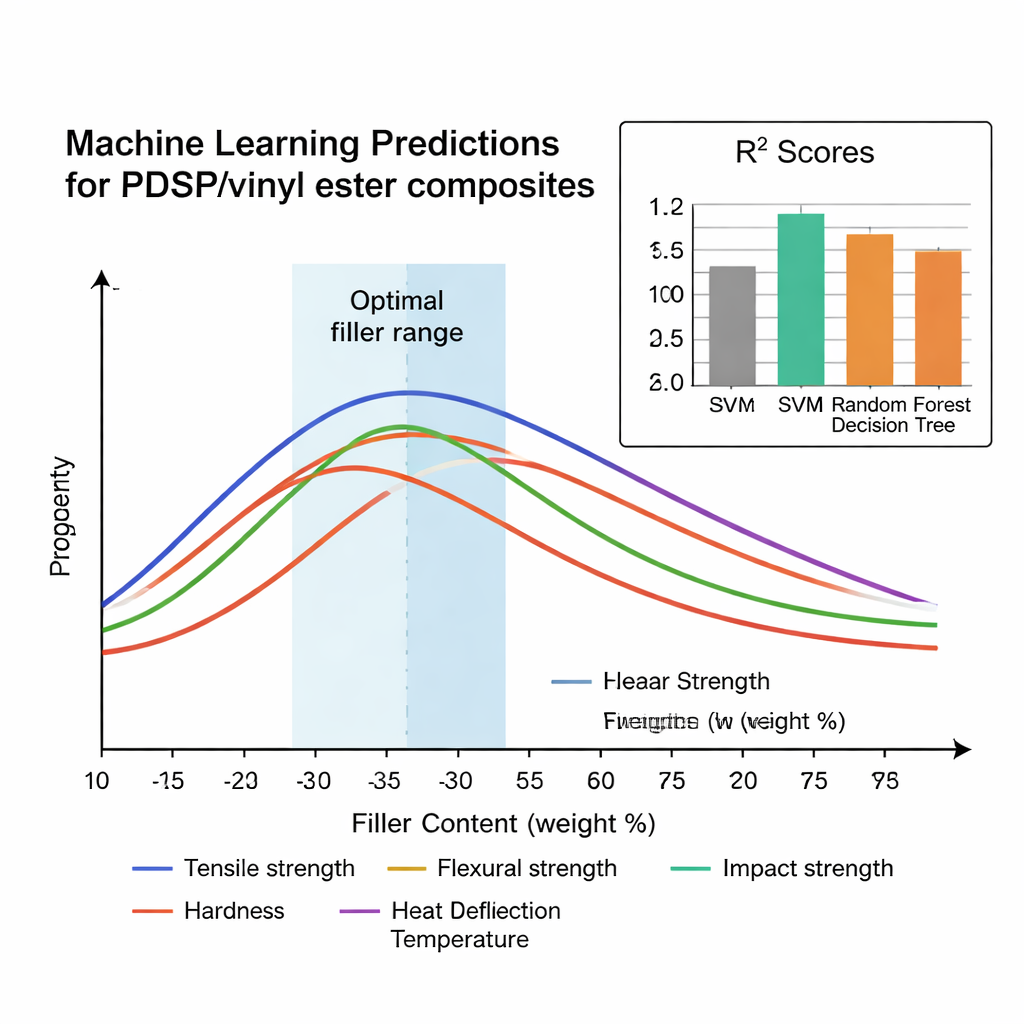
Finding the sweet spot in filler content
Using the best-performing models and an interpretability method called SHAP (which shows how each input pushes predictions up or down), the team identified how much seed powder gives the best performance. They found a clear sweet spot between about 25 and 32.5% filler by weight. In this window, multiple properties peak together: bending and tensile strength rise, the surface becomes harder, impact resistance stays high, and the heat deflection temperature reaches about 84 °C. Above roughly one-third filler, the models predict a sharp drop in performance, consistent with what is known physically: too many particles cluster together, the resin can no longer bind them well, microscopic voids form, and the material becomes weaker and more brittle.
What this means for everyday technology
To a non-specialist, the key message is that waste materials like date seeds can replace some of the fossil-based content in engineering plastics without sacrificing performance—if they are used in the right amount. By combining a modest set of carefully measured experiments with machine learning, the researchers show that it is possible to “map out” the best formulations virtually, cutting down on time, cost, and material consumption. Their framework points to practical uses in car interiors, building panels, and other components where light weight, strength, and heat resistance are important, and it illustrates how data-driven tools can speed up the shift toward more sustainable, bio-based materials.
Citation: Vignesh, V., Kumar, S.S., Mohan, A.M.A. et al. Machine learning-based estimation and optimization of phoenix Dactylifera Seed Powder reinforced vinyl ester bio-composites. Sci Rep 16, 6663 (2026). https://doi.org/10.1038/s41598-026-37202-w
Keywords: sustainable composites, date seed powder, vinyl ester, machine learning materials, bio-based fillers