Clear Sky Science · en
Characteristics of motor polyneuropathy in Fabry disease: a case-control study
Why this rare disease matters
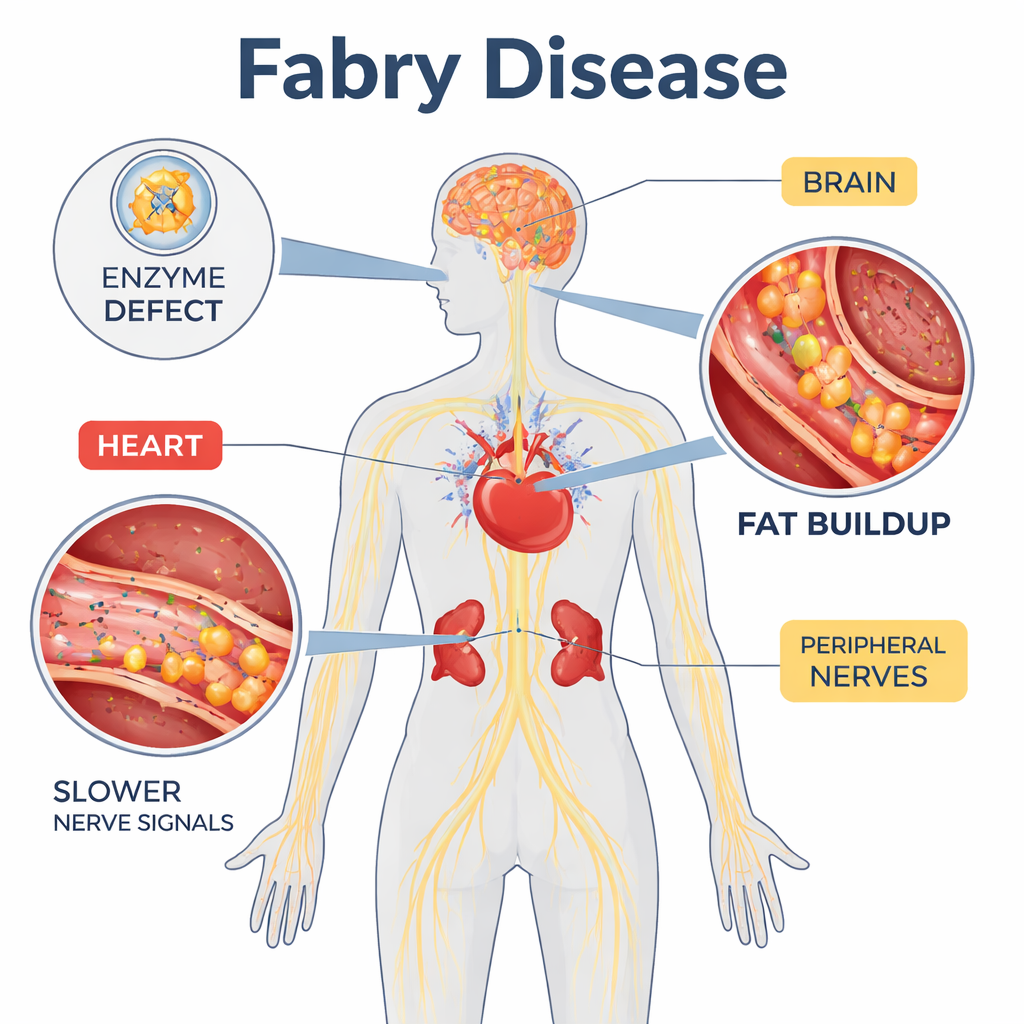
Fabry disease is a rare inherited condition, but it offers a window into how tiny changes inside our cells can echo through the whole body. People with Fabry often struggle with burning pain in their hands and feet from an early age, and later may develop heart, kidney, or brain problems. This study takes a closer look at the body’s wiring—the motor nerves that control movement—to see when and how they are affected, and why some patients, especially men and those with kidney disease, may be at higher risk of movement problems.
The hidden wiring problem
Doctors have long known that Fabry disease damages small sensory nerve fibers that carry signals about pain and temperature. These injuries help explain the early symptoms of painful crises and abnormal sweating. Much less was known about the larger motor fibers that tell our muscles when to contract. The authors set out to clarify whether these movement-carrying fibers are also harmed, and if so, whether this damage appears early or mainly in more advanced stages of the disease.
How the study was done
The research team examined 20 adults with genetically confirmed Fabry disease and compared them with 32 healthy volunteers of similar age and sex. They focused on two major nerves: the ulnar nerve in the arm and the peroneal nerve in the leg. Using standard nerve conduction tests, they measured how fast electrical signals traveled and how strong the responses were. They also used a more refined method called conduction velocity distribution, which can separate the performance of slower, thinner fibers from faster, thicker ones within the same nerve. Medical records were carefully reviewed to note other health problems such as heart disease, stroke, and especially chronic kidney disease.
What the tests revealed
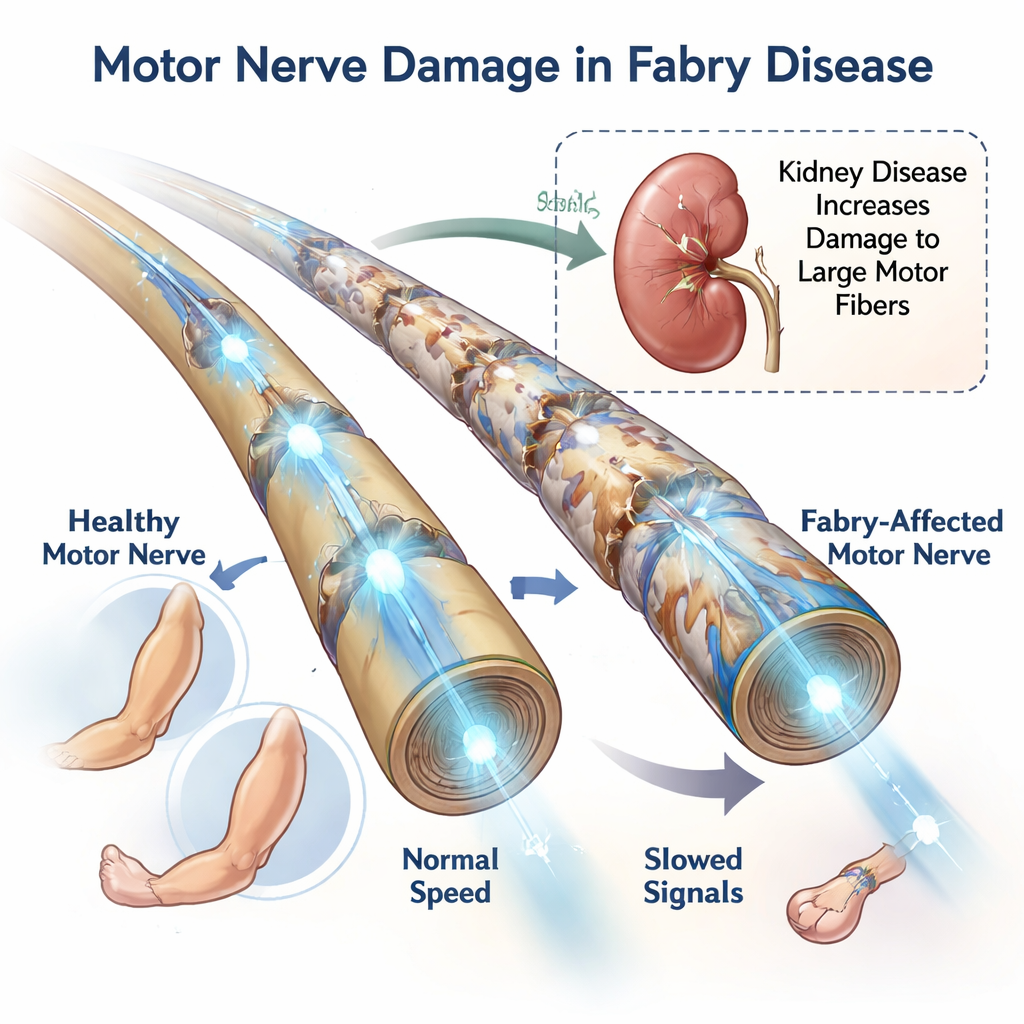
Even though none of the patients showed clear muscle weakness or wasting on examination, the electrical tests told a different story. On average, signals in the motor fibers of both the arm and leg nerves traveled more slowly in Fabry patients than in healthy controls. In the leg nerve, the strength of the motor response was also reduced, suggesting that some fibers were not working properly or were lost. When the team separated results by sex, men with Fabry had slower motor conduction and more abnormal distributions of conduction speeds than women, even though their ages and age at first symptoms were similar. Men also carried a heavier burden of other complications: more heart enlargement, rhythm problems, strokes, and kidney failure.
The added weight of kidney disease
Chronic kidney disease emerged as a key amplifier of nerve damage. Patients with Fabry and kidney failure had weaker and slower motor responses than Fabry patients whose kidneys were still functioning relatively well. In these individuals, not only were nerve signals slower overall, but the faster, thicker fibers—those most important for powerful, precise muscle actions—appeared to be especially affected. This pattern points toward damage to the insulating myelin coating of the nerve fibers, a demyelinating process, layered on top of the more typical metabolic and toxic effects seen in kidney disease.
What it means for people living with Fabry
For non-specialists, the take-home message is that Fabry disease does not just cause pain in small sensory nerves; it can also quietly erode the larger motor nerves that control movement, particularly in men and in people whose kidneys are failing. The study suggests that nerve damage to movement fibers tends to appear later in the course of Fabry, when organ complications are more advanced, and that loss of the nerves’ insulating sheath plays a major role. Regular nerve testing and aggressive protection of kidney function may help doctors spot and possibly slow this hidden damage before it translates into noticeable weakness or disability.
Citation: Koszewicz, M., Dziadkowiak, E., Szydlo, M. et al. Characteristics of motor polyneuropathy in Fabry disease: a case-control study. Sci Rep 16, 6267 (2026). https://doi.org/10.1038/s41598-026-37198-3
Keywords: Fabry disease, peripheral neuropathy, motor nerves, chronic kidney disease, nerve conduction