Clear Sky Science · en
A time-coupled multi-objective distributionally robust chance-constrained framework for grid resilience enhancement using mobile emergency generators
Why keeping the lights on after disasters matters
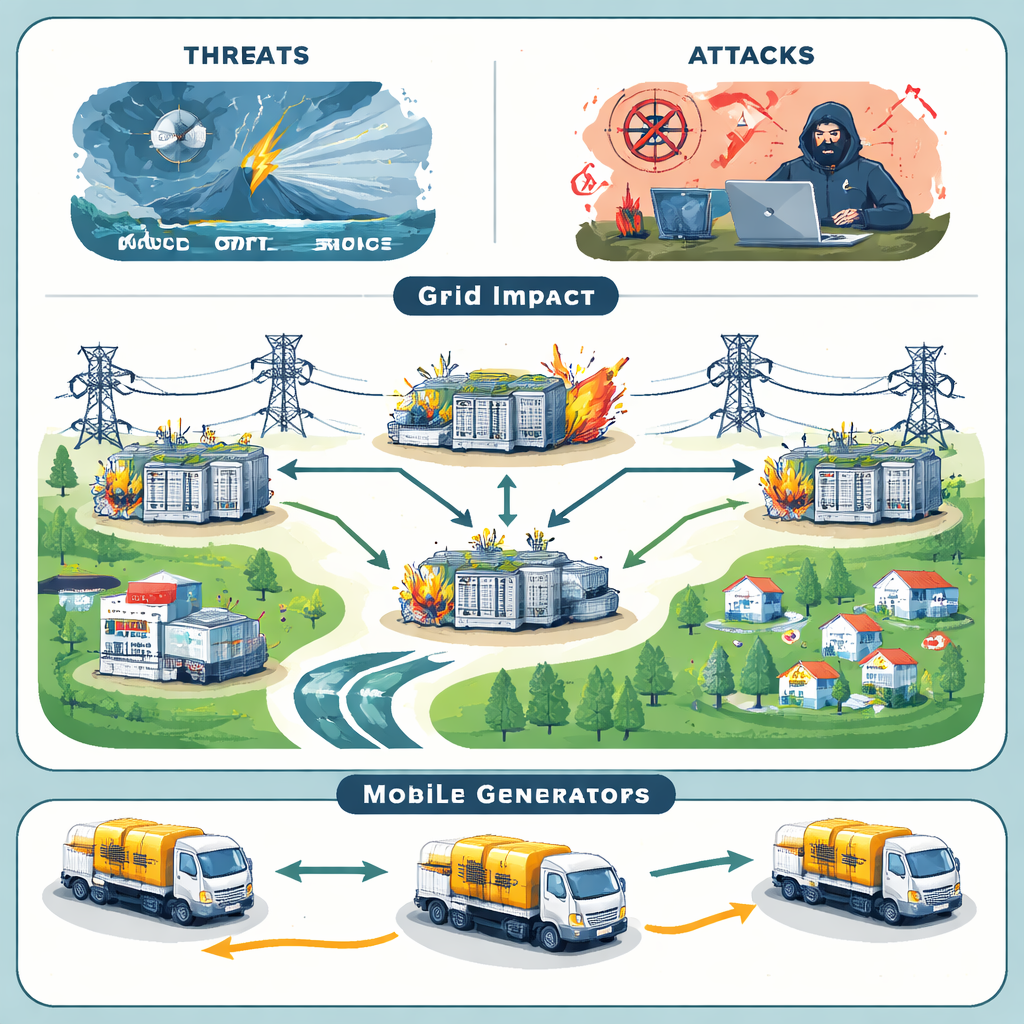
When a major storm or coordinated attack knocks out a country’s power grid, whole regions can go dark for hours or even days. Hospitals switch to backup power, traffic signals fail, and businesses grind to a halt. This paper explores a smarter way to use mobile emergency generators—power plants on wheels—to bring electricity back faster and more reliably, even when roads are blocked and damage is uncertain. The work focuses on conditions similar to disaster‑prone parts of India but is relevant to any region facing extreme weather and other large‑scale threats.
Bringing power plants to where they’re needed
Instead of relying only on fixed backup generators, utilities can dispatch Mobile Emergency Generators (MEGs) mounted on trucks. These units can be driven to damaged substations or critical buildings and connected to restore power in local pockets. The challenge is that MEGs are limited in number, need fuel, and require trained crews to move and operate them. After a cyclone or flood, roads may be blocked, travel times uncertain, and new damage may appear as the situation evolves. The authors argue that treating MEG use as a simple one‑time placement problem ignores this reality and can lead to plans that look good on paper but fail in the field.
Planning ahead under deep uncertainty
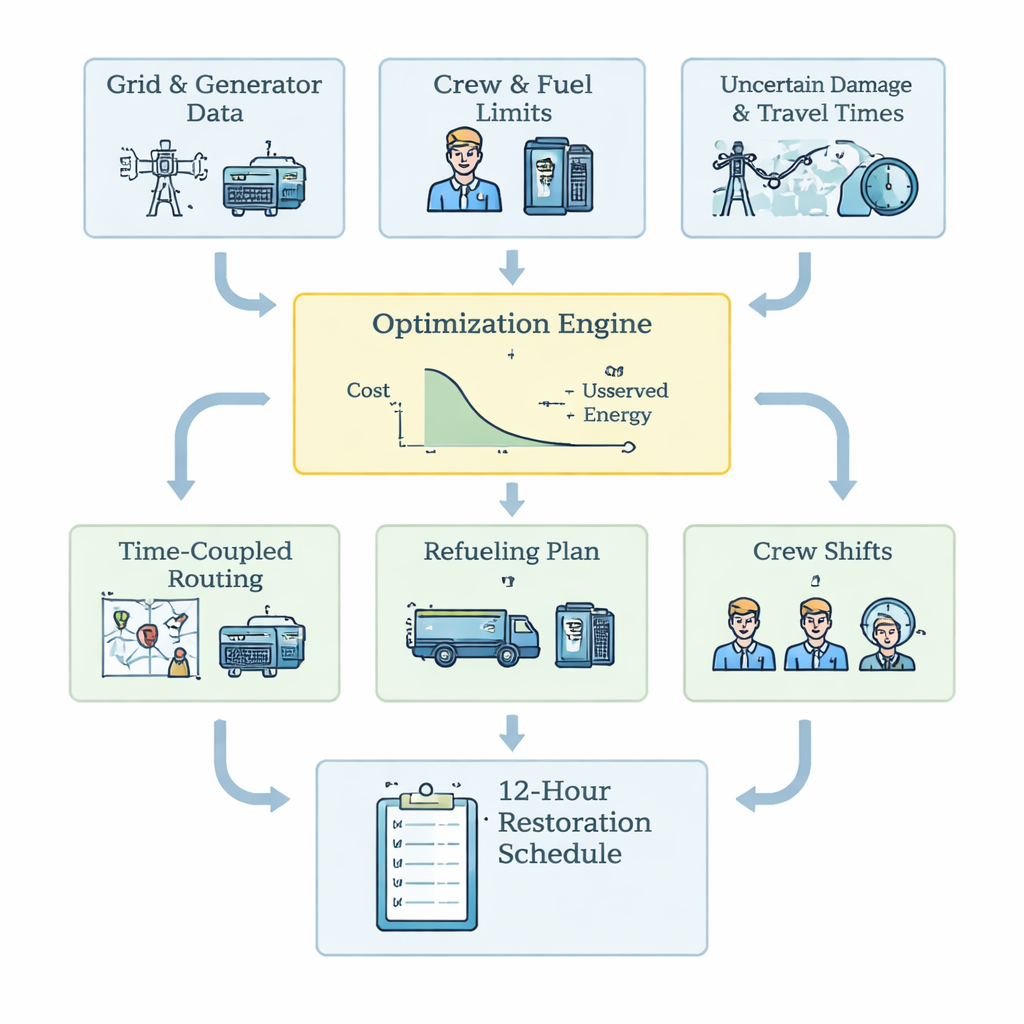
The study introduces a planning framework that looks at the entire 12‑hour recovery window in half‑hour steps. It decides where each MEG should start, when it should move, how much power it should produce, when it must refuel, and which crew should handle it. At the same time, it respects the physics of how electricity flows through the damaged grid so that every proposed schedule is actually workable. A key feature is how the model handles uncertainty: instead of assuming one set of likely damage scenarios, it builds a protective “bubble” around what past data suggest, making sure that the plan will work for a whole family of plausible futures, not just the ones explicitly simulated.
Balancing cost and resilience, not just one or the other
Any realistic utility must weigh the cost of fuel, crew time, and generator use against the social and economic cost of leaving customers without power. The authors therefore treat planning as a two‑goal problem: minimize operating cost and minimize “unserved energy,” the amount of electricity demand that remains unmet over time. Using an evolutionary search algorithm, the framework generates a smooth “menu” of options—called a Pareto front—that shows, for example, how much extra resilience can be gained for each additional rupee spent. In one large test system with 118 buses and 16 MEGs, moving from a purely cost‑focused plan to a more resilience‑oriented one raised cost by about 10% but cut expected unserved energy by roughly half, from 92 to 42 megawatt‑hours.
What the simulations reveal about smart mobility
Tests on standard benchmark networks show that explicitly modeling MEG movement, crew shifts, and refueling across time pays off. Compared with more rigid approaches that either fix MEGs in place or ignore uncertainty in road conditions and attack severity, the new method reduces expected unserved energy by 14–20% for similar budgets. In the simulated disasters, MEGs are first sent to isolated pockets to restore islands of power, then gradually re‑routed toward central substations that help reconnect larger areas. Average travel delays of about half an hour per MEG are more than compensated by faster overall restoration, because the plan anticipates where generators will be most valuable several hours ahead.
Implications for disaster‑ready power grids
For non‑specialists, the main message is that mobility plus intelligent risk‑aware planning can make grids bounce back faster after major shocks without dramatically raising costs. Instead of parking backup generators in fixed locations and hoping for the best, utilities can use tools like this to pre‑compute playbooks: detailed 12‑hour schedules that say where to send each mobile generator, when to refuel it, and which neighborhoods to prioritize. Because the method is designed to cope with imperfect information about damage and travel conditions, it offers a practical blueprint for countries seeking to harden their power systems against an era of stronger storms, heatwaves, and potential cyber‑physical attacks.
Citation: Ashokaraju, D., Ramamoorthy, M.L., Simon, D. et al. A time-coupled multi-objective distributionally robust chance-constrained framework for grid resilience enhancement using mobile emergency generators. Sci Rep 16, 6204 (2026). https://doi.org/10.1038/s41598-026-37197-4
Keywords: grid resilience, mobile emergency generators, disaster recovery, power system planning, optimization