Clear Sky Science · en
Minimizing frictional irreversibility in a rough-walled tapered bearing with a nanoparticle-enhanced Sutterby lubricant
Why smoother-running machines matter
From car wheel hubs to jet engines and wind turbines, many machines rely on bearings: carefully shaped metal surfaces separated by a thin film of oil. When that oil film wastes energy as heat, the machine runs hotter, less efficiently, and wears out faster. This study explores how to design and lubricate tapered bearings so they lose as little energy as possible, using advanced "nano" lubricants and smart geometry to tame friction and heat.
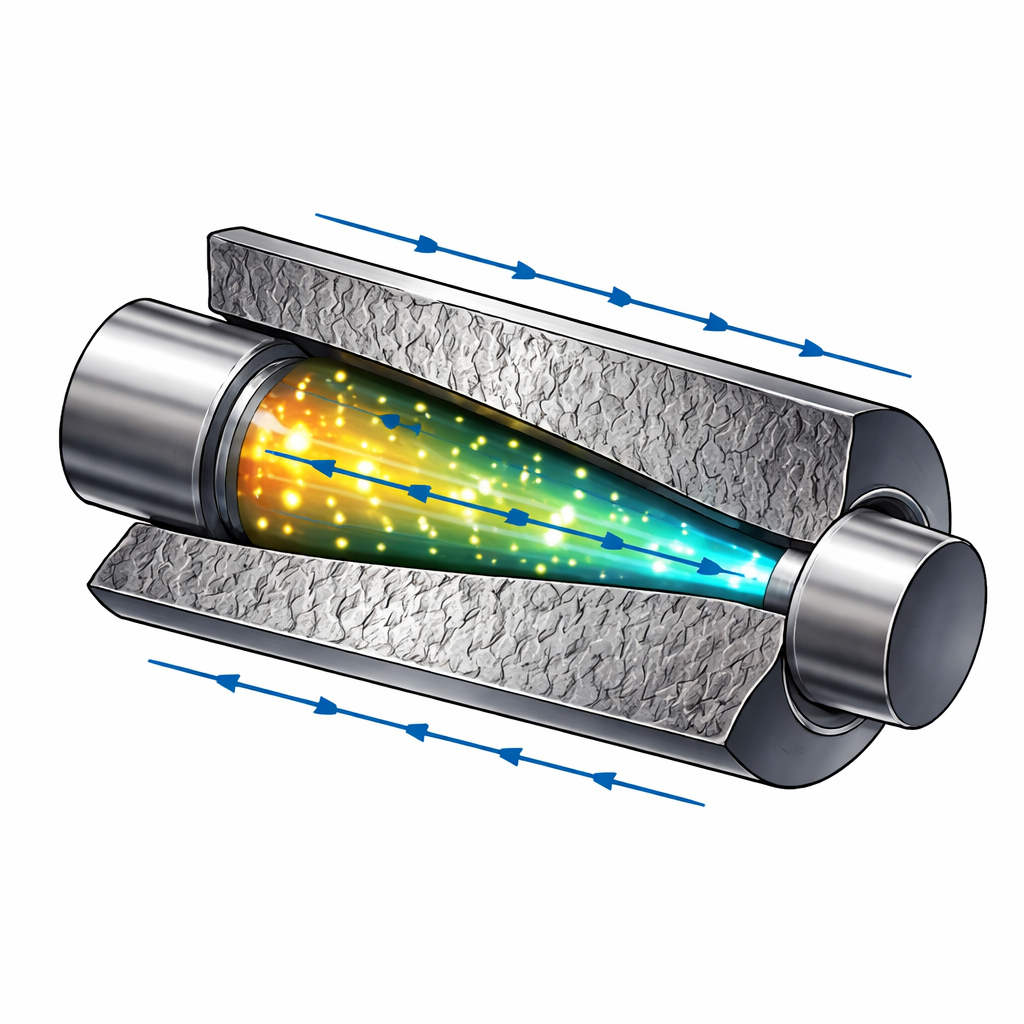
A closer look inside a tapered bearing
The authors focus on a common industrial design where two walls form a wedge-shaped channel around a rotating shaft. As the shaft turns, lubricant is drawn into this converging–diverging gap, creating a pressurized film that keeps metal surfaces from touching. Real bearings are not perfectly smooth: their walls have roughness from manufacturing and wear. The study treats this roughness explicitly and also includes the effect of an applied magnetic field, which can influence the motion of an electrically conducting lubricant. All of these features—shape, roughness, and magnetism—change how the fluid flows and how much energy is lost.
A smart fluid boosted with nanoparticles
Instead of using an ordinary oil, the work considers a special non-Newtonian fluid described by the Sutterby model. In simple terms, this lubricant becomes "thinner" (less viscous) when it is sheared strongly, as happens in narrow gaps under high load. On top of that, tiny solid particles—nanoparticles—are suspended in the fluid. These particles greatly improve the ability of the lubricant to carry heat away from hot spots. The authors use a well-established framework for nanofluids that accounts for two key microscopic effects: Brownian motion, where particles jiggle randomly, and thermophoresis, where they drift along temperature gradients. Together, these mechanisms increase heat transport compared with conventional oils.
Simulating how and where energy is wasted
To understand the trade-offs, the team builds a detailed mathematical model of fluid flow, heat transfer, and nanoparticle transport in the tapered channel. They add an equation that tracks entropy generation, a thermodynamic measure of how much useful energy is irreversibly degraded into waste heat. Entropy is produced by four main mechanisms: temperature differences, fluid friction, particle diffusion, and magnetic effects. Using similarity transformations, the equations are reduced to a set of coupled ordinary differential equations, which are then solved numerically with a high-accuracy Runge–Kutta shooting method. This allows the researchers to systematically vary dimensionless groups such as the Reynolds number (measuring flow inertia), the Weissenberg number (measuring how strongly the fluid thins under shear), a magnetic strength parameter, and a roughness factor that represents how "grippy" the walls are.
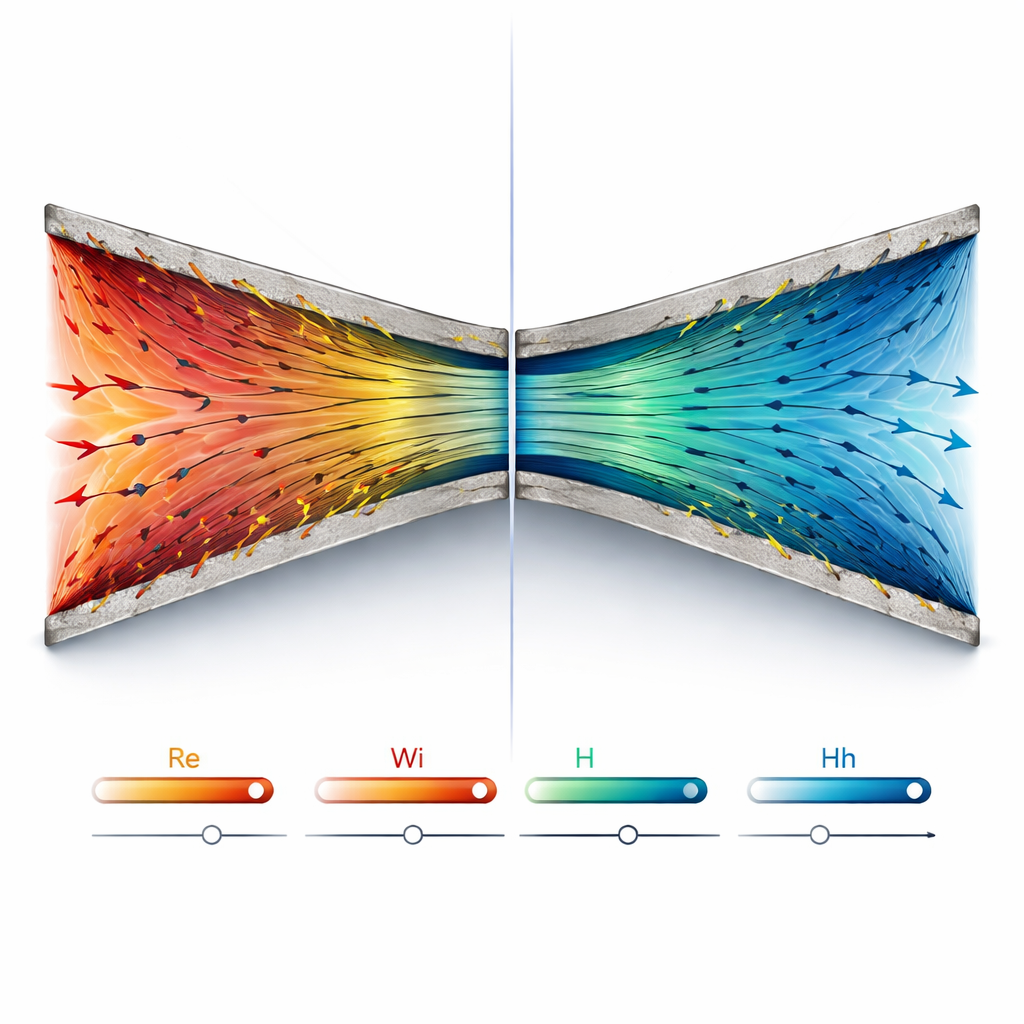
What controls friction, heating, and mixing
The simulations show that the shape of the channel strongly governs how the lubricant behaves. In converging regions, higher flow rates tend to speed up the fluid and can lower the drag on the walls, while in diverging regions the same increase causes flow deceleration and higher drag. A stronger magnetic field generally slows the fluid and cools it, but can raise entropy by concentrating shear near the walls. Increasing wall roughness predictably boosts friction and both heat and mass transfer at the surfaces. Crucially, when the Sutterby fluid is strongly shear-thinning (higher Weissenberg number), the nature of irreversibility shifts: losses caused by temperature gradients decrease, while losses due to viscous friction become more important. Adding more nanoparticles improves heat removal, shrinking temperature-driven entropy production and changing how efficiently the bearing can shed heat.
Designing bearings for less waste
From a practical standpoint, the study identifies combinations of flow rate, fluid rheology, magnetic field, and surface roughness that minimize the total entropy generation inside the bearing. In plain terms, this means finding operating conditions and lubricant formulations that waste the least amount of energy while still carrying load and removing heat. The results suggest that carefully chosen shear-thinning nano-lubricants, matched to a particular tapered geometry and wall finish, can significantly reduce frictional irreversibility and overheating. For engineers, this provides a roadmap for designing next-generation bearings and lubrication systems that run cooler, last longer, and consume less energy.
Citation: Jazza, Y., Hashim, Saqib, M. et al. Minimizing frictional irreversibility in a rough-walled tapered bearing with a nanoparticle-enhanced Sutterby lubricant. Sci Rep 16, 6477 (2026). https://doi.org/10.1038/s41598-026-37196-5
Keywords: nanofluid lubrication, tapered bearings, entropy generation, non-Newtonian fluids, magnetohydrodynamics