Clear Sky Science · en
Reducing label dependence in vibration-based drill-bit condition monitoring with masked feature pretraining
Why smarter drills matter on the factory floor
In modern factories, tiny drill bits quietly cut thousands of precise holes in metal parts. When these tools wear out or chip, the consequences can be big: parts go out of tolerance, surfaces turn rough, and machines sit idle while operators hunt for the problem. This study explores a new way to “listen” to drills through their vibrations and use artificial intelligence to judge their health, all while drastically cutting down the amount of human-labelled data usually needed to train such systems.
Listening to the hidden story in vibrations
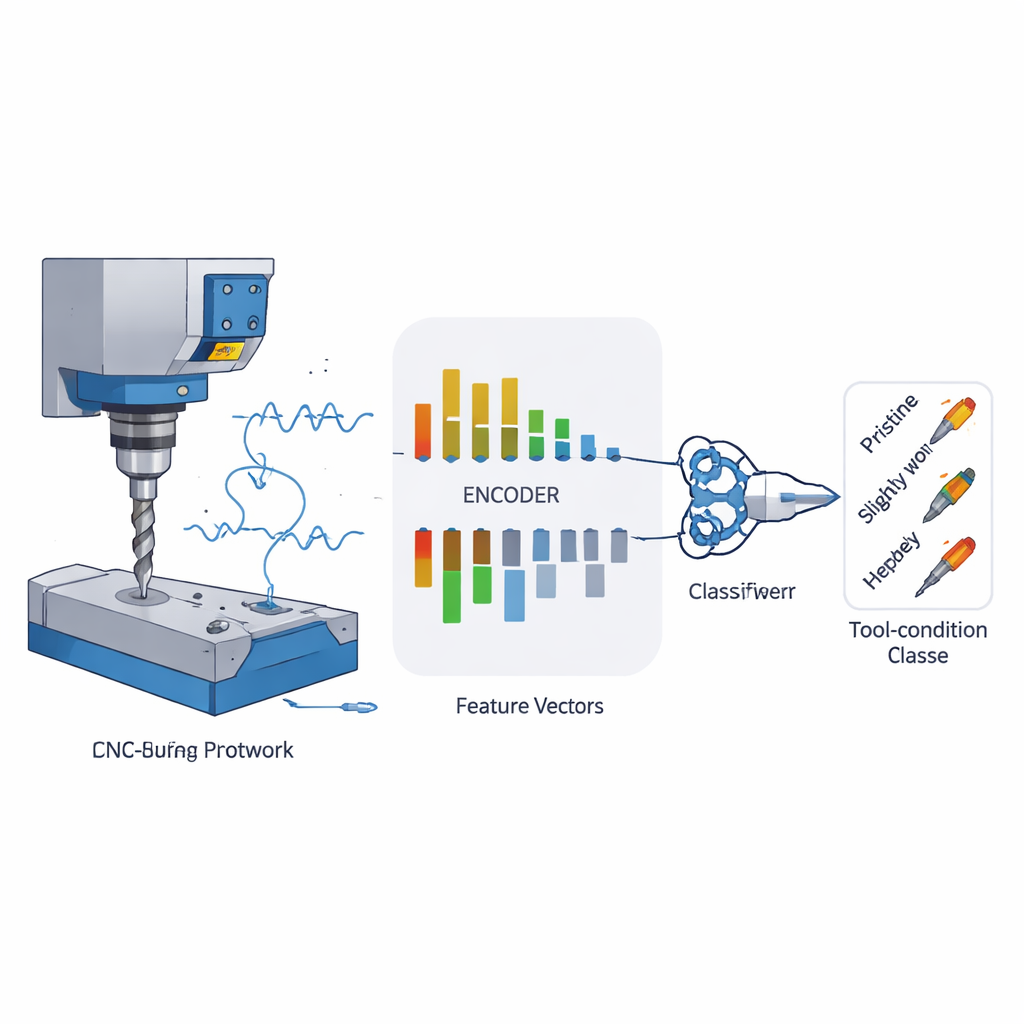
As a drill spins and cuts, it creates complex vibrations that change as the tool moves from brand‑new to worn or damaged. The researchers mounted a sensitive accelerometer on the spindle housing of a vertical machining center and recorded vibration signals while the drill produced holes. They focused on the steady part of the drilling process, chopped the signals into short time windows, and cleaned them using wavelet-based denoising so that wear-related patterns stood out more clearly. From each window, they extracted 20 simple numerical descriptors that describe how strong, spiky, and spread-out the vibrations are in both time and frequency—such as average level, variability, shock-like peaks, and how the energy is distributed across low and high pitches.
Teaching a model without telling it the answers
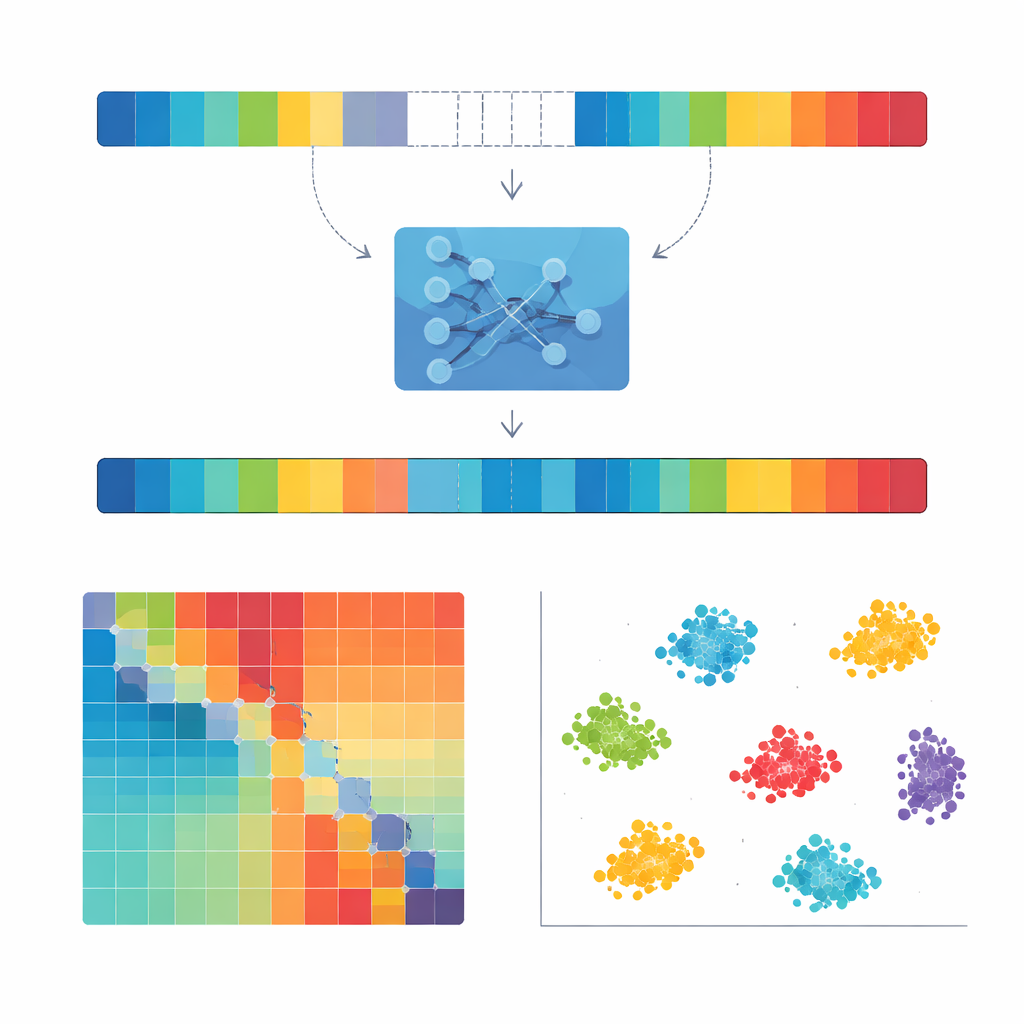
A major hurdle in industry is that every vibration sample must usually be labelled by an expert as “healthy” or a particular type of wear, which is slow and expensive. To get around this, the authors used a strategy called self-supervised learning. Instead of feeding the model labelled examples from the start, they built a system that learns by trying to fill in missing pieces. For each vibration feature vector, they randomly hid a quarter of the values and told a neural network to reconstruct only those missing parts from the remaining ones. The input combined the actual features with a simple indicator showing which entries were hidden. By repeatedly solving this puzzle, the network discovered how different vibration features depend on each other, forming a compact internal representation of drill behavior without ever seeing wear labels.
From hidden patterns to clear tool-health decisions
Once this pretraining phase was complete, the reconstruction head was removed and a lightweight classifier was attached to the learned representation. Only then did the team introduce a modest amount of labelled data covering seven conditions: healthy, edge chipping, outer corner wear, flank wear, chisel edge wear, crater wear, and margin wear. The classifier learned to map the internal vibration “fingerprints” to these classes. On a separate test set, the system correctly identified the tool state more than 99% of the time, with almost perfect balance across all wear types. Some confusion appeared between edge chipping and crater wear—two modes that naturally produce very similar high‑frequency shock patterns—but overall the predictions lined up closely with expert labels, as shown by strong summary statistics and a clean confusion matrix.
Doing more with far fewer labelled examples
The real strength of this approach appears when labelled data are scarce. The authors gradually restricted how many labelled samples the classifier could see—down to just 10% of the usual training labels—while keeping the same self-supervised pretraining on unlabelled vibrations. Even in this tough setting, the system kept accuracy above 94%, while conventional machine-learning and deep-learning models that relied purely on labels lost 15–25 percentage points or more. Additional analyses showed that the features the model found most important, such as low‑frequency energy and measures of spectral “disorder” and impulsiveness, line up well with known physical signatures of wear. Visualizing the learned feature space revealed tight, well-separated clusters for most wear states, indicating that the model’s internal view of the data is both structured and physically meaningful.
What this means for real factories
For manufacturers, this work points to a practical path toward intelligent, vibration-based drill monitoring that does not demand huge, carefully labelled datasets. By first teaching a model to predict missing pieces of engineered vibration features, the system builds a rich understanding of normal and faulty cutting behavior that can then be refined with a relatively small number of expert labels. The result is a label-efficient, interpretable tool-health monitor that can spot subtle wear and damage before it leads to scrap or downtime, and that can be retrained or adapted as conditions change on the shop floor.
Citation: Chandan, M.N., Badadhe, A., Kebede, A.W. et al. Reducing label dependence in vibration-based drill-bit condition monitoring with masked feature pretraining. Sci Rep 16, 6555 (2026). https://doi.org/10.1038/s41598-026-37192-9
Keywords: tool wear monitoring, vibration analysis, self-supervised learning, drilling, condition monitoring