Clear Sky Science · en
A Citrus medica stem cutting-based platform for rapid screening of therapeutic compounds against Candidatus Liberibacter asiaticus
Why Sick Citrus Trees Matter To Everyone
Oranges, lemons, and limes are staples on breakfast tables and in global trade, but a disease called citrus greening, or huanglongbing (HLB), is pushing this industry to the brink. The culprit is a tiny, hard-to-study bacterium that clogs the plant’s food-transport system, leading to bitter, misshapen fruit and dying trees. Because this microbe cannot be grown in the lab, testing new treatments has been slow, costly, and often inconclusive. This study describes a simple, faster way to test potential therapies using infected cuttings of a citrus relative called citron, offering hope for finding better tools to protect citrus groves worldwide.
A Fast-Growing Citrus Stand-In
The researchers first needed a plant that could act as a reliable stand-in for full citrus trees. They compared stem cuttings from seven citrus types, including sweet oranges, mandarins, limes, and citron, to see which would root and grow most quickly and consistently. Citron stood out: most of its cuttings survived, formed roots within two weeks, and produced new leafy shoots within the study period. Other genotypes rooted later, grew more slowly, or failed to produce new growth at all. Because treatments move through water-conducting tissues and new roots are critical entry points, this vigorous and uniform rooting made citron the ideal candidate for a rapid testing platform.
Building a Mini-Grove In The Lab
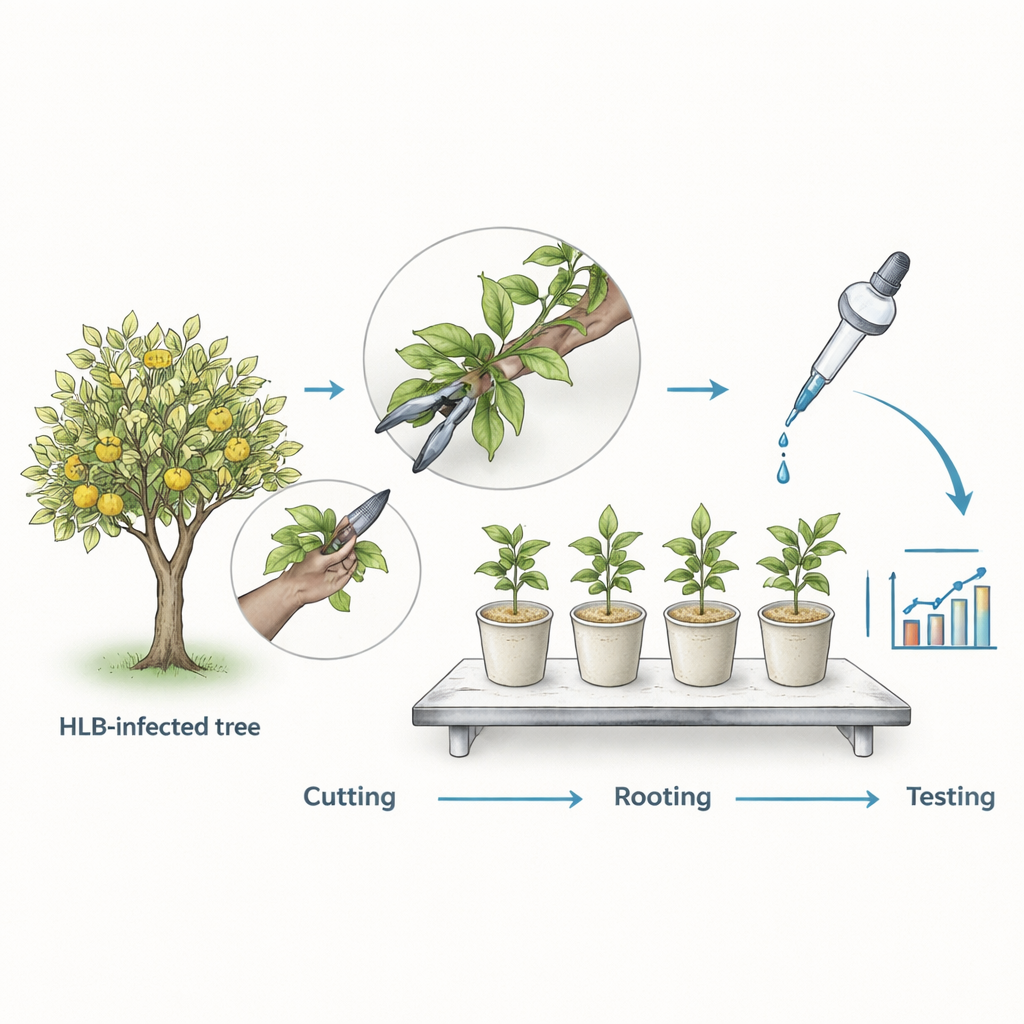
To mimic what happens in real orchards, the team produced mother citron plants infected with the HLB-associated bacterium, Candidatus Liberibacter asiaticus (CLas). From these plants, they cut small stem pieces, each with three leaves trimmed to limit water loss, dipped them in a rooting hormone, and planted them in cups filled with clean sand. Under controlled light, temperature, and watering, these cuttings grew roots and shoots much like young trees would. Because the bacterium naturally spreads through the plant’s internal plumbing, these living stem cuttings allowed CLas to move from old tissues into newly formed roots and leaves, closely reflecting the way infection develops in orchard trees.
Four Ways To Time A Treatment
The core of the study was to test when and where to apply a known antibiotic, oxytetracycline (OTC), in order to best reveal its ability to hold CLas in check. The researchers designed four step-by-step “mini-trials” that differed mainly in timing and in whether roots or new leaves were sampled. In all cases, infected cuttings received a single drench of OTC solution poured into the sand, while others received only water. Later, the entire root system or young leaves were harvested and analyzed with a sensitive DNA-based test to measure bacterial levels. Importantly, OTC did not significantly reduce the survival of the cuttings in any protocol, meaning the platform can also flag treatments that might be toxic to the plant.
Delaying The Bacterium’s Takeover
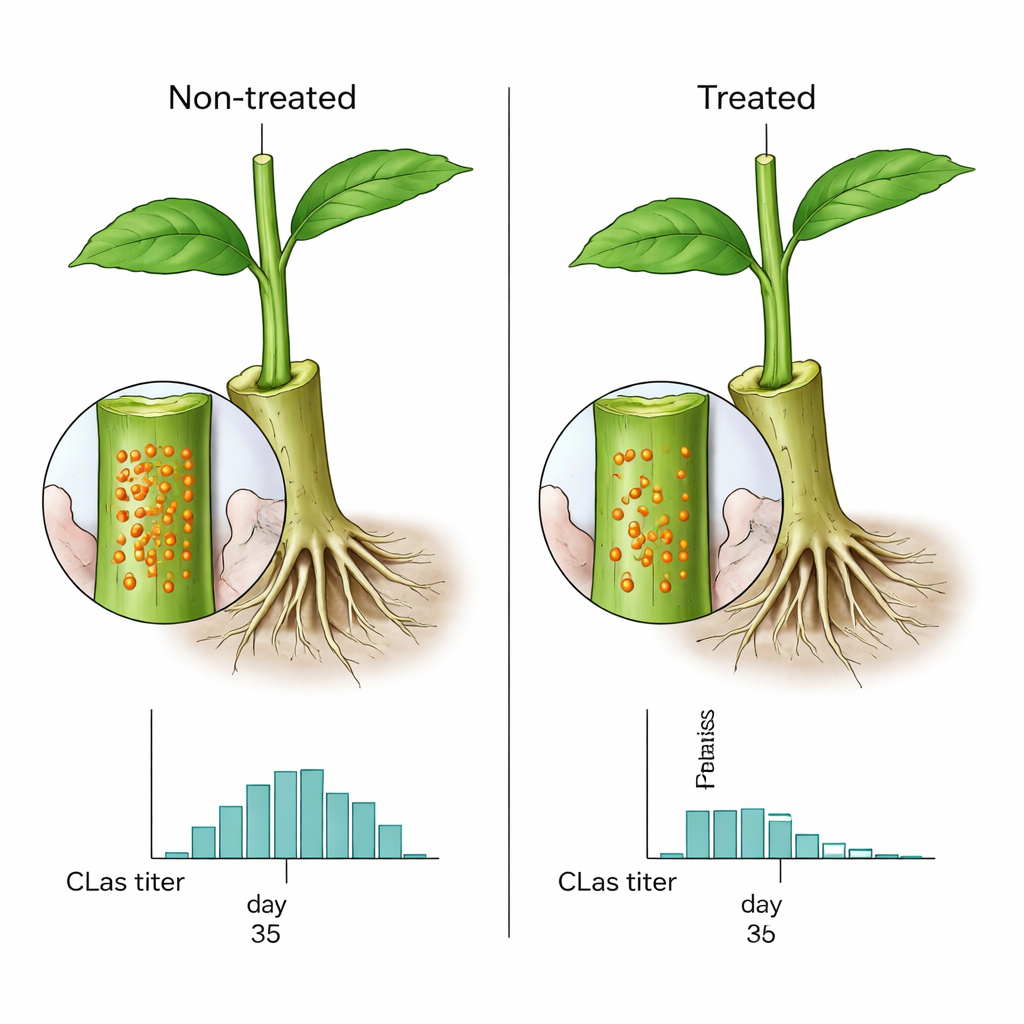
The clearest results came from the protocol in which cuttings were allowed to begin forming a callus and early roots for two weeks before receiving OTC, and roots were sampled three weeks after that. In this setup, treated roots had both a much lower share of CLas-positive cuttings and sharply reduced bacterial levels compared with untreated roots. A time-course experiment tracking roots over 77 days showed that in untreated plants, CLas surged in new roots by about four weeks after planting and then stabilized. In treated plants, that surge was delayed and blunted, with the strongest suppression around day 35. Over longer periods, bacterial numbers in treated and untreated roots gradually converged, mirroring field observations that OTC can suppress but not fully eliminate CLas.
A New Early Filter For Promising Cures
By using fast-rooting citron stem cuttings instead of whole nursery trees, this platform shrinks the time needed for an initial test of a new compound from roughly a year to just over a month. It lets researchers see how candidate treatments move through living citrus tissues, how strongly they hold back CLas in roots or shoots, and whether they harm the plant, all under repeatable conditions. While orchard-scale trials and trunk injection studies are still essential before any product reaches growers, this cutting-based system acts as a powerful first filter. It should help scientists more quickly identify the most promising antimicrobial molecules and strategies, speeding progress toward better, more diverse tools to manage citrus greening disease.
Citation: Pecoraro Sanches, B.C., dos Santos, T.A., Gorayeb, E.S. et al. A Citrus medica stem cutting-based platform for rapid screening of therapeutic compounds against Candidatus Liberibacter asiaticus. Sci Rep 16, 6864 (2026). https://doi.org/10.1038/s41598-026-37186-7
Keywords: citrus greening, huanglongbing, Candidatus Liberibacter asiaticus, citrus antibiotics, plant disease management