Clear Sky Science · en
Ameliorative effects of gum Arabic–coated selenium nanoparticles on Cisplatin-induced cerebellar neurotoxicity in rats
Why protecting the brain during cancer treatment matters
Chemotherapy drugs like cisplatin save lives by killing cancer cells, but they can also harm healthy brain tissue. That damage may show up as problems with balance, coordination, memory, or mood, and there are currently no reliable medicines that shield the brain from these side effects. This study explores an intriguing idea from the worlds of nutrition and nanotechnology: using tiny particles of the essential nutrient selenium, wrapped in a natural plant gum, to protect a key brain region—the cerebellum—from cisplatin-induced injury.
A natural coating for a tiny protector
The researchers focused on selenium, a trace element needed for the body’s own antioxidant defenses. In ordinary supplement form, selenium can be difficult for tissues to use efficiently and may be toxic at higher doses. By shrinking selenium into nanoparticles and coating them with gum Arabic—a safe, edible fiber obtained from Acacia trees and already used in foods and medicines—the team created a more stable, water-dispersible form. Gum Arabic itself contains plant compounds with antioxidant and anti-inflammatory properties, so the coating not only helps the particles travel in the body but may also add its own protective effects. 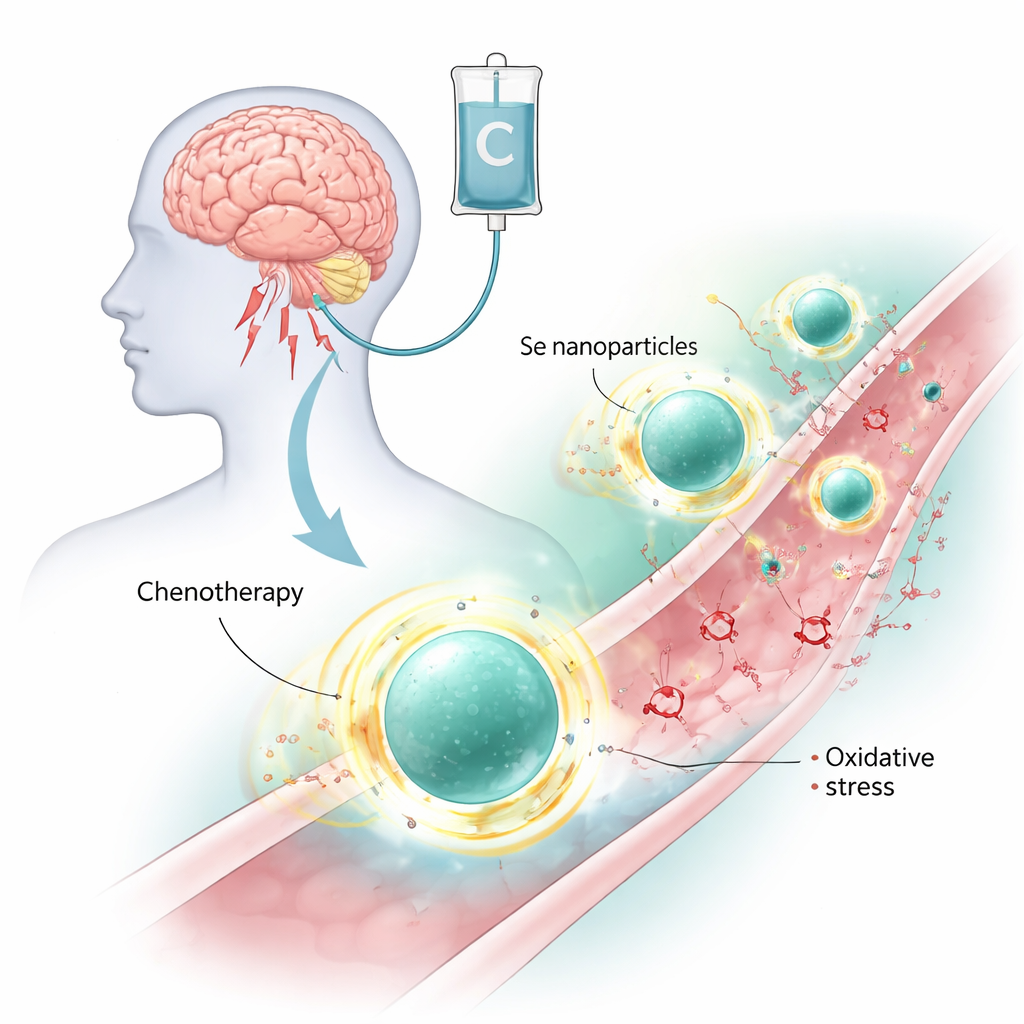
Testing brain protection in a rat model
To see whether these coated selenium nanoparticles could shield the brain from chemotherapy damage, the scientists worked with adult male rats divided into four groups. One group received only saline (control), another got gum Arabic–coated selenium nanoparticles by mouth, a third received a single dose of cisplatin, and a fourth received cisplatin plus daily oral nanoparticles for 30 days. The researchers then examined the animals’ cerebella—the brain region crucial for balance and fine movement—looking at chemical markers of oxidative stress, inflammation, and cell death, as well as levels of key brain signaling molecules like dopamine and serotonin. They also inspected brain tissue under the microscope and with high-resolution electron imaging.
Less oxidative damage, calmer inflammation, healthier cells
In rats treated with cisplatin alone, the cerebellum showed a clear pattern of injury. Natural antioxidant defenses dropped, while markers of oxidative damage to fats and DNA rose sharply. Inflammatory substances, including the signaling proteins TNF-α, IL-6, and IL-10, were elevated, and proteins linked to programmed cell death (such as caspase-3 and p53) increased. Under the microscope, the researchers saw loss and distortion of Purkinje cells—the large neurons that form the output of the cerebellar cortex—as well as swelling, vacuoles, and signs of scarring support cells. In contrast, rats that received cisplatin plus the gum Arabic–coated selenium nanoparticles had antioxidant levels much closer to normal, far fewer signs of oxidative and inflammatory damage, and reduced activation of cell-death pathways. Their brain tissue architecture was largely preserved, with more intact Purkinje cells and less swelling and scarring.
Supporting brain chemistry and structural repair
Beyond simply preventing damage, the nanoparticles also appeared to help restore normal brain chemistry. Cisplatin alone reduced levels of dopamine and serotonin—messenger molecules involved in mood, motivation, and motor control. Co-treatment with gum Arabic–coated selenium nanoparticles significantly raised these neurotransmitter levels toward those of healthy controls. Detailed staining for specific proteins showed that cisplatin increased markers of astrocyte activation (GFAP) and decreased structural nerve-fiber proteins (neurofilament light), consistent with injury and degeneration. Nanoparticle treatment reversed these trends, suggesting better preservation of nerve fibers. Computer modeling of the plant-derived compounds found in gum Arabic further supported a plausible mechanism: many of these molecules can bind, in theory, to inflammatory and cell-death proteins, reinforcing the biochemical protection seen in the animals. 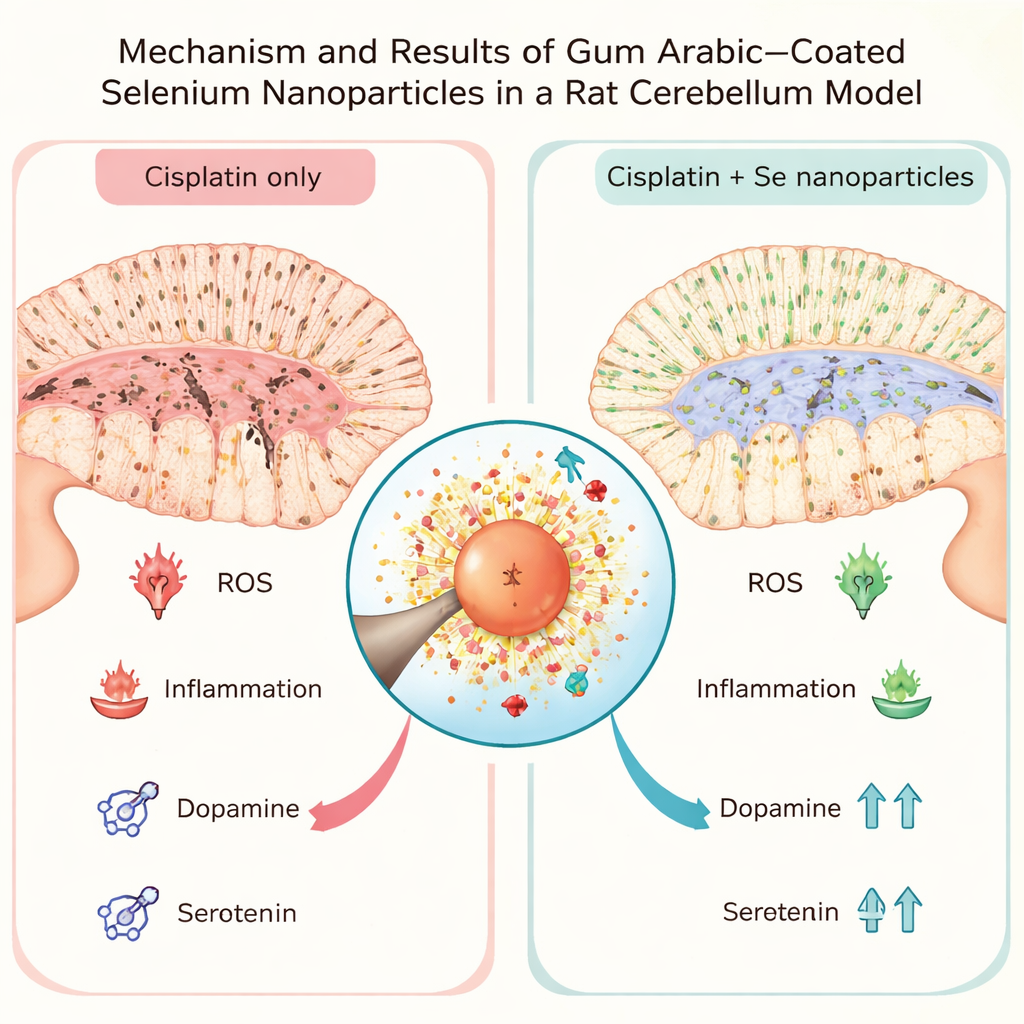
What this could mean for people receiving chemotherapy
Overall, the study concludes that gum Arabic–coated selenium nanoparticles can blunt multiple aspects of cisplatin-induced cerebellar damage in rats: they boost antioxidant defenses, dampen inflammation, reduce cell death, and help maintain both brain structure and neurochemical balance. While this work is still at the animal-research stage and used a single cisplatin dose under controlled conditions, it points toward a potential future in which carefully designed, food-derived nanoparticles might be added alongside chemotherapy to better protect the brain. Before any human use, scientists will need to refine the particle formulation, confirm long-term safety, and test whether similar protection occurs in more complex treatment regimens, but the results offer a promising proof of concept.
Citation: El-Dein, M.A., Marawan, M.A., Hamouda, S. et al. Ameliorative effects of gum Arabic–coated selenium nanoparticles on Cisplatin-induced cerebellar neurotoxicity in rats. Sci Rep 16, 6354 (2026). https://doi.org/10.1038/s41598-026-37185-8
Keywords: cisplatin neurotoxicity, selenium nanoparticles, gum arabic, cerebellum, nanomedicine