Clear Sky Science · en
Integrated analytical framework for identifying factors related to the ecological degradation of lakes
Why the fate of one shallow lake matters
Lakes around the world are under pressure from pollution, climate change, and dams, but their decline is often hard to predict. This study focuses on Baiyangdian Lake, the largest shallow lake in North China, to ask a simple but urgent question: what, exactly, is driving the loss of aquatic life? By combining several advanced statistical tools, the authors build an integrated framework that not only diagnoses what went wrong over the past 35 years, but also helps forecast how lake health will respond to future management choices.
A lake under growing human and climate pressure
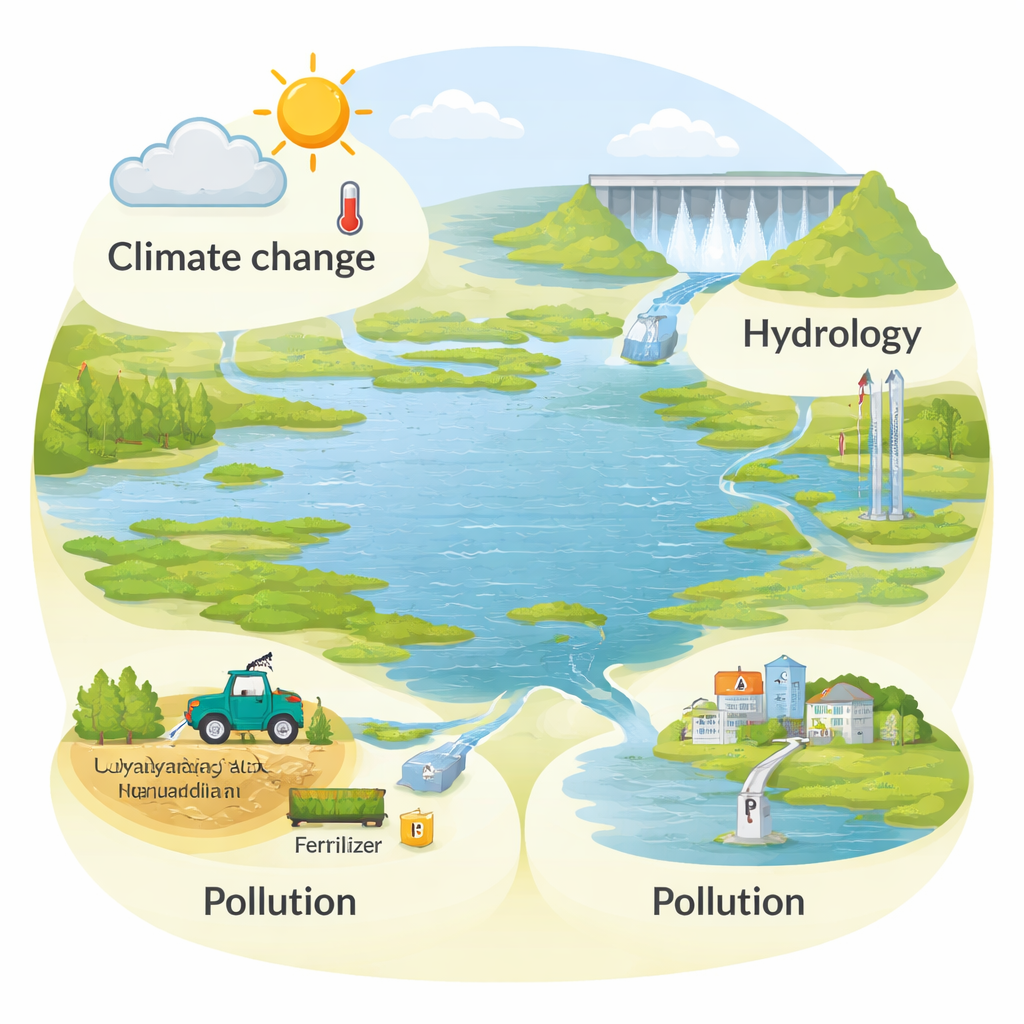
Baiyangdian Lake is a shallow, plant-rich lake that supports drinking water, farming, fishing, tourism, and wildlife habitat. Since the 1960s, upstream reservoirs, heavy water use, and rapid urbanization have sharply reduced inflows and lowered water levels. At the same time, growing amounts of nitrogen and phosphorus from farms, sewage, and other human activities have pushed the lake into a nutrient-rich, or eutrophic, state. Warmer air temperatures and shifting rainfall patterns linked to climate change have further altered water quality and favored algal growth. Together, these pressures have coincided with long-term declines in submerged plants, plankton, bottom-dwelling animals, and fish.
Following the long-term story of lake life
To understand how the lake’s ecology has changed, the authors assembled a rare 35‑year record (1986–2020) of climate, water levels, inflows, and water chemistry, together with data on key groups of organisms. They tracked the richness (number of species, or area for submerged plants) of phytoplankton, zooplankton, benthic animals, fish, and aquatic vegetation, and combined these into an overall index of ecosystem state. This long view revealed three distinct phases: a sharp drop in species richness from the late 1980s to the late 1990s, a long period of degraded but relatively stable conditions until about 2015, and then a modest recovery coinciding with large water diversions and nutrient reduction efforts.
Untangling the main culprits behind degradation
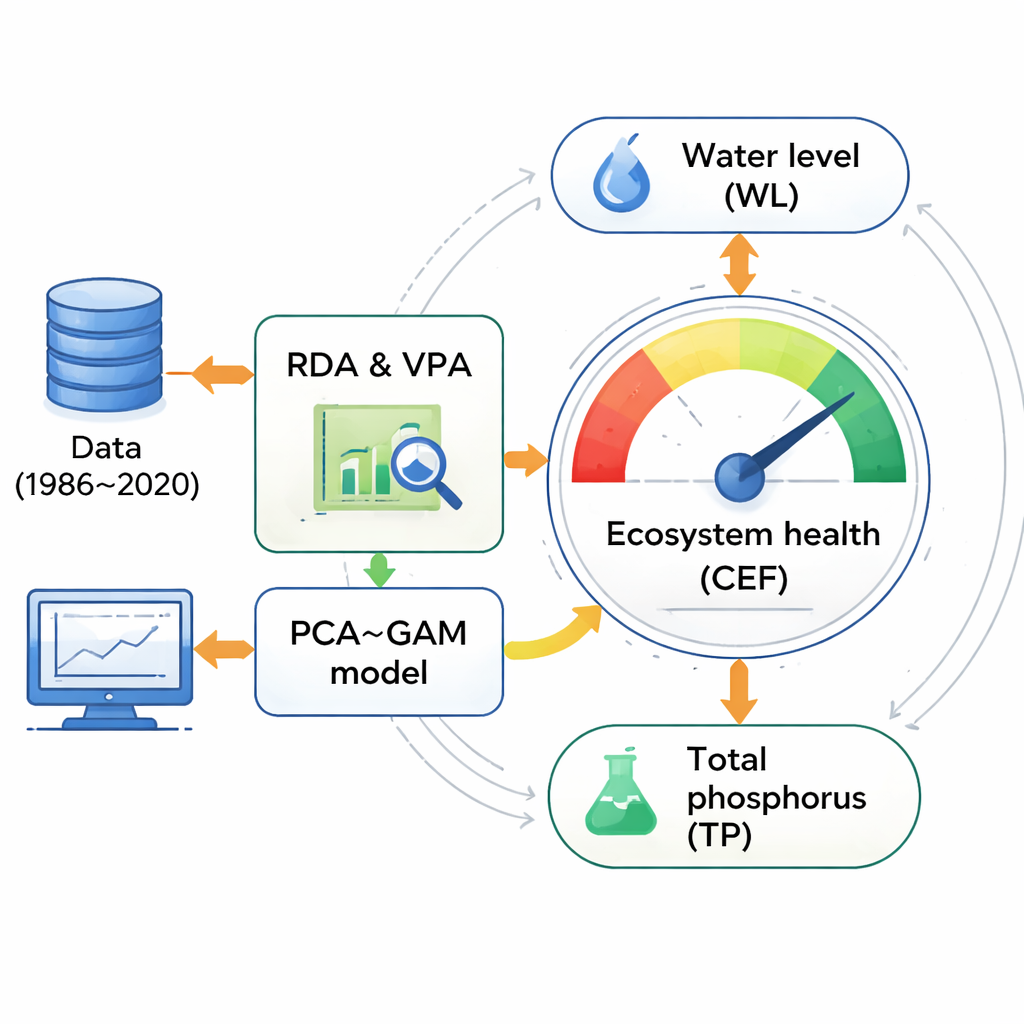
The heart of the study is an integrated analytical framework that links multiple data sources and methods. Redundancy analysis (RDA) is used to highlight which environmental factors best track changes in species richness, while variance partitioning analysis (VPA) separates their individual and combined contributions. These tools show that three broad forces dominate: human pollution, climate change, and hydrological conditions. Human‑driven nutrient and water quality problems alone explain about 41% of the variation in ecosystem state, climate factors such as air temperature account for 18%, and water level and inflow add another 13%. Interactions between these groups of drivers—especially between pollution and hydrology—contribute an additional 27%, underscoring that stresses rarely act in isolation.
Nonlinear tipping points and an early-warning health index
To capture how the whole ecosystem responds, the authors compress all biological indicators into a single “comprehensive evaluation function,” or CEF, using principal component analysis. They then relate this health index to environmental drivers with a flexible modeling approach known as a generalized additive model. This reveals strongly nonlinear behavior and thresholds. When the lake is very shallow, small drops in water level are linked to sharp ecological decline, but once levels are maintained in a moderate to high range, further increases are beneficial. In contrast, higher air temperatures and higher phosphorus concentrations show steadily harmful effects. A model that includes water level, temperature, phosphorus, and the interaction between water level and phosphorus explains more than 98% of the observed variation in the ecosystem health index, and performs well in prediction tests.
What this means for saving lakes
For non-specialists, the study’s message is both sobering and practical. Baiyangdian’s decline is not caused by a single problem, but by the combined weight of nutrient pollution, falling water levels, and a warming climate. Yet the results also show that management matters: raising water levels into an ecologically safe range and cutting phosphorus inputs can markedly improve the lake’s condition, even under climate stress. The CEF index and the integrated analysis framework provide managers with a way to monitor lake health in near real time, detect early warning signs of degradation, and test how different policy choices might play out. Because many lakes worldwide face similar mixes of pollution, altered hydrology, and climate change, this approach could help guide restoration strategies far beyond Baiyangdian.
Citation: Zeng, Y., Zhao, Y. & Yang, W. Integrated analytical framework for identifying factors related to the ecological degradation of lakes. Sci Rep 16, 3259 (2026). https://doi.org/10.1038/s41598-026-37179-6
Keywords: lake degradation, eutrophication, Baiyangdian Lake, aquatic biodiversity, water management