Clear Sky Science · en
Nighttime warming enhances photosynthetic activity and induces changes in chloroplast membrane structure and antioxidant profile in Platycerium ferns
Why warmer nights matter for ferns and cities
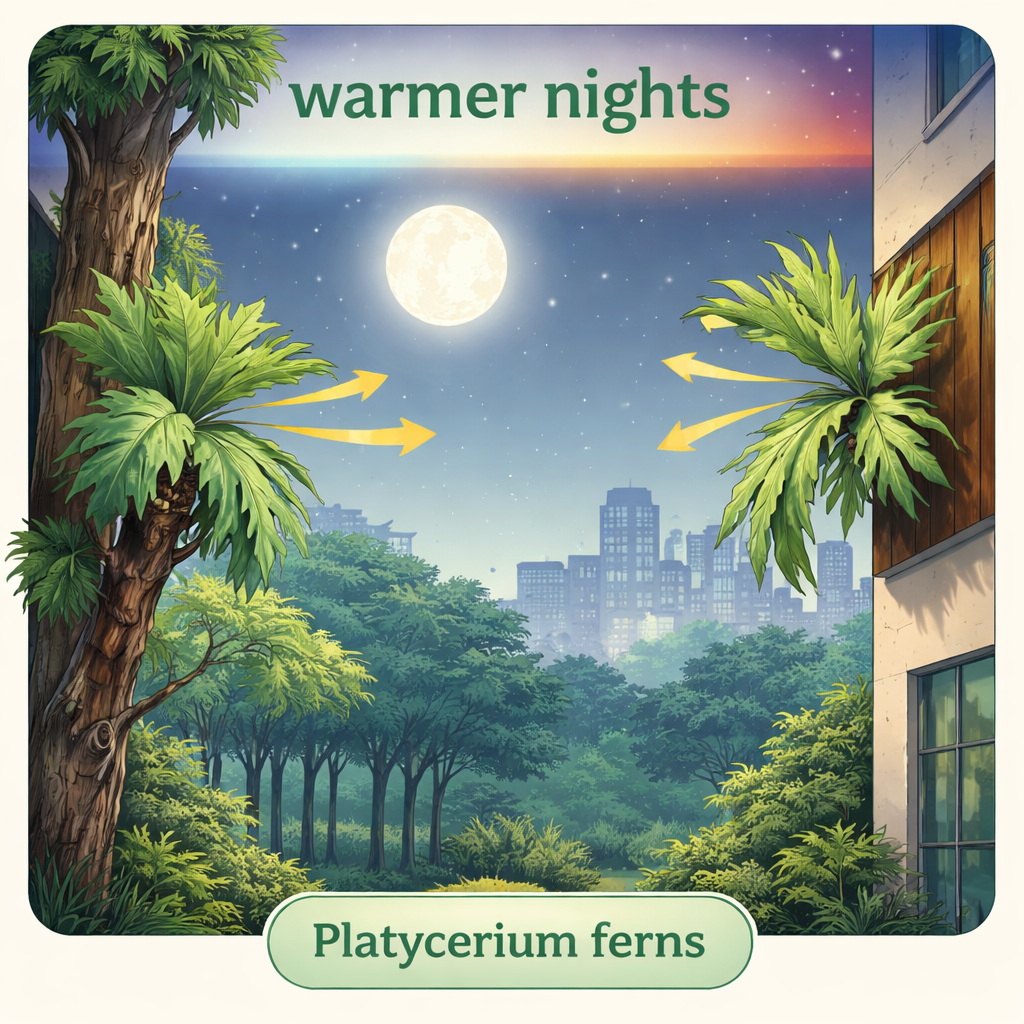
Nighttime temperatures are rising faster than daytime temperatures around the world, especially in cities. That shift may sound subtle, but it can reshape how plants grow, cope with stress, and even which species take over urban trees and walls. This study asks a simple question with big ecological consequences: when nights get warmer, do popular staghorn ferns (Platycerium), widely used as ornamental and sometimes invasive plants, struggle—or do they actually perform better?
A closer look at two hanging fern celebrities
The researchers focused on two epiphytic staghorn ferns, Platycerium bifurcatum and Platycerium alcicorne, which naturally grow attached to trees in tropical and subtropical regions but are now common ornamentals in gardens and on city walls. For a month, young plants were grown under two regimes: a “normal” one with cooler nights (24 °C during the day and 17 °C at night) and a “warmed” one where the night temperature was raised to match the daytime 24 °C. This modest 2.3 °C increase in the daily average temperature mimics the kind of nocturnal warming already observed in many regions. The team then examined how the ferns’ leaves handled light, exchanged gases, managed chemical defenses, and adjusted the structure of their chloroplast membranes.
Night warmth that boosts plant breath and light use
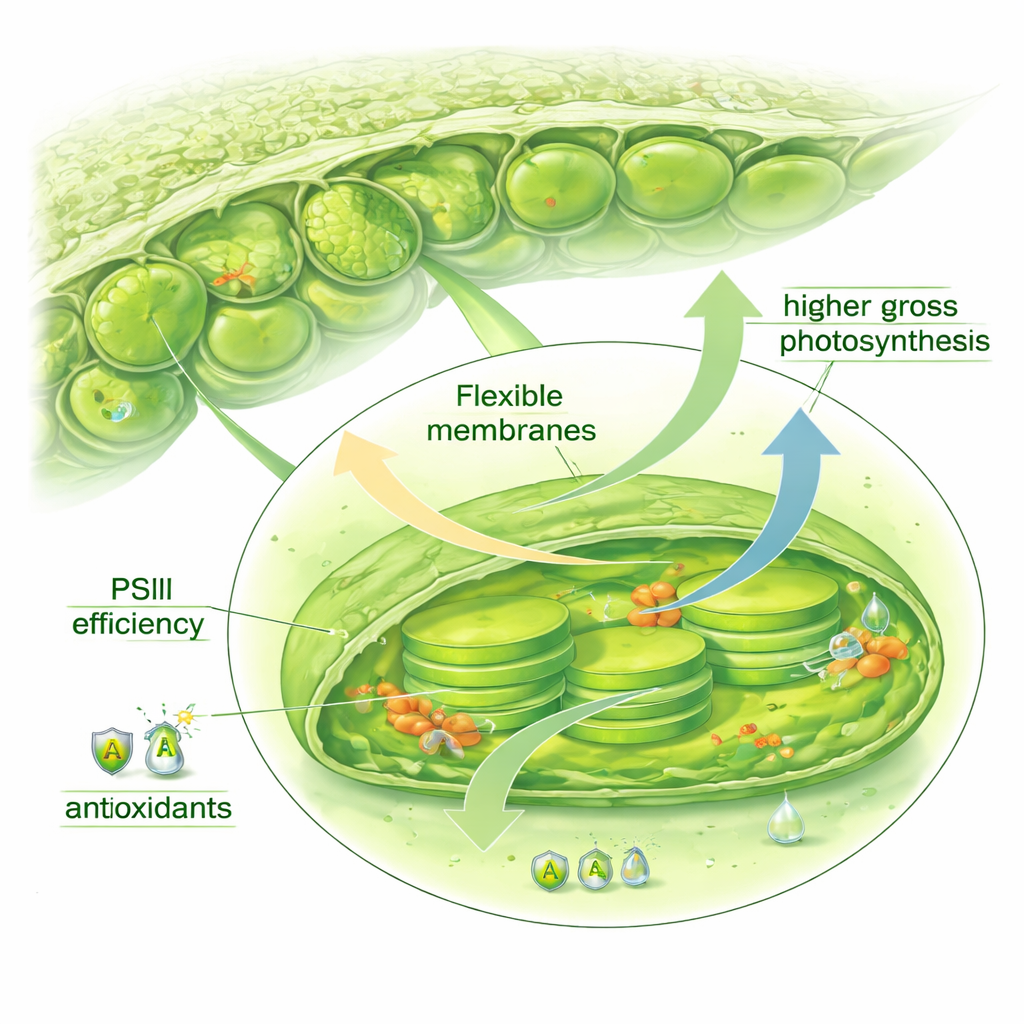
Contrary to the fear that higher temperatures always stress plants, both fern species actually photosynthesized more under warmer nights. Measurements of gross photosynthesis—how much oxygen the leaves release in light—rose by about 11% in P. alcicorne and 9% in P. bifurcatum, while respiration (the plant’s own oxygen use) changed little. In practical terms, the plants were taking in more carbon than they were burning, improving their growth potential. Detailed fluorescence tests, which track how efficiently leaves use and move light energy, showed that a core part of the photosynthetic machinery, called photosystem II, worked better after nocturnal warming. Indices of plant “vitality” and reaction-center performance climbed sharply, indicating that the extra warmth acted more like a gentle training session than a damaging heat wave.
Hidden color changes and quiet chemical bodyguards
Warmer nights also altered the ferns’ internal chemistry in subtle but beneficial ways. Both species increased their chlorophyll levels, improving their ability to capture light, and built up more flavonoids—plant pigments that double as powerful antioxidants. At the same time, levels of malondialdehyde, a marker of damage to membrane fats, dropped by nearly half in both species, showing that their cells were actually less stressed. Enzymes that break down harmful oxygen by-products shifted their activity patterns, with some becoming less active and others more active, but the net result was stable or improved protection. In P. alcicorne, key non-enzymatic defenders such as vitamin C and glutathione increased, strengthening its chemical shield against oxidative damage.
Flexible leaf membranes that ride out the heat
Because photosynthesis happens in chloroplasts, the team also probed how the fats in chloroplast membranes responded to warmer nights. Using model membranes made from extracted lipids, they measured how compressible—or elastic—these films were. After warming, chloroplast membranes, especially those rich in galactolipids that dominate the light-harvesting structures, became more elastic in both species. This extra flexibility helps maintain the proper arrangement and function of photosynthetic proteins when temperatures shift. Importantly, these changes occurred without large shifts in the overall surface charge of chloroplasts, suggesting that the ferns fine-tuned membrane mechanics while keeping other aspects of cell organization stable.
What this means for gardens, forests, and future cities
Putting all the pieces together, the study shows that moderate nighttime warming can improve, rather than impair, the performance of these staghorn ferns. Their photosynthetic machinery runs more efficiently, they accumulate helpful pigments and antioxidants, and their chloroplast membranes become more adaptable—all while showing less chemical evidence of stress. P. alcicorne appears slightly better at exploiting this warming than P. bifurcatum, but both species gain a physiological edge. As nights continue to warm, especially in urban heat islands, such traits could favor climate-resilient ferns that grow faster and spread more easily on trees and walls. For gardeners and city planners, that means staghorn ferns may become even hardier ornamentals—and, in some places, more capable invaders—under the changing climate.
Citation: Oliwa, J., Sieprawska, A. & Dyba, B. Nighttime warming enhances photosynthetic activity and induces changes in chloroplast membrane structure and antioxidant profile in Platycerium ferns. Sci Rep 16, 5976 (2026). https://doi.org/10.1038/s41598-026-37176-9
Keywords: nighttime warming, staghorn ferns, photosynthesis, urban ecology, plant acclimation