Clear Sky Science · en
Normal force in natural active touch correlates with fingertip stiffness
Why the feel of your fingertips matters
Every time you swipe your phone, feel a fabric in a shop, or test whether a peach is ripe, your fingertips are quietly doing physics. We don’t just move our fingers the same way as everyone else: each person presses, rubs, and glides with their own “signature” style. This study asks a deceptively simple question with big implications for touchscreens, virtual reality, and even diagnosing skin and nerve problems: when people casually stroke a surface with no particular task in mind, what makes some of us press harder than others?
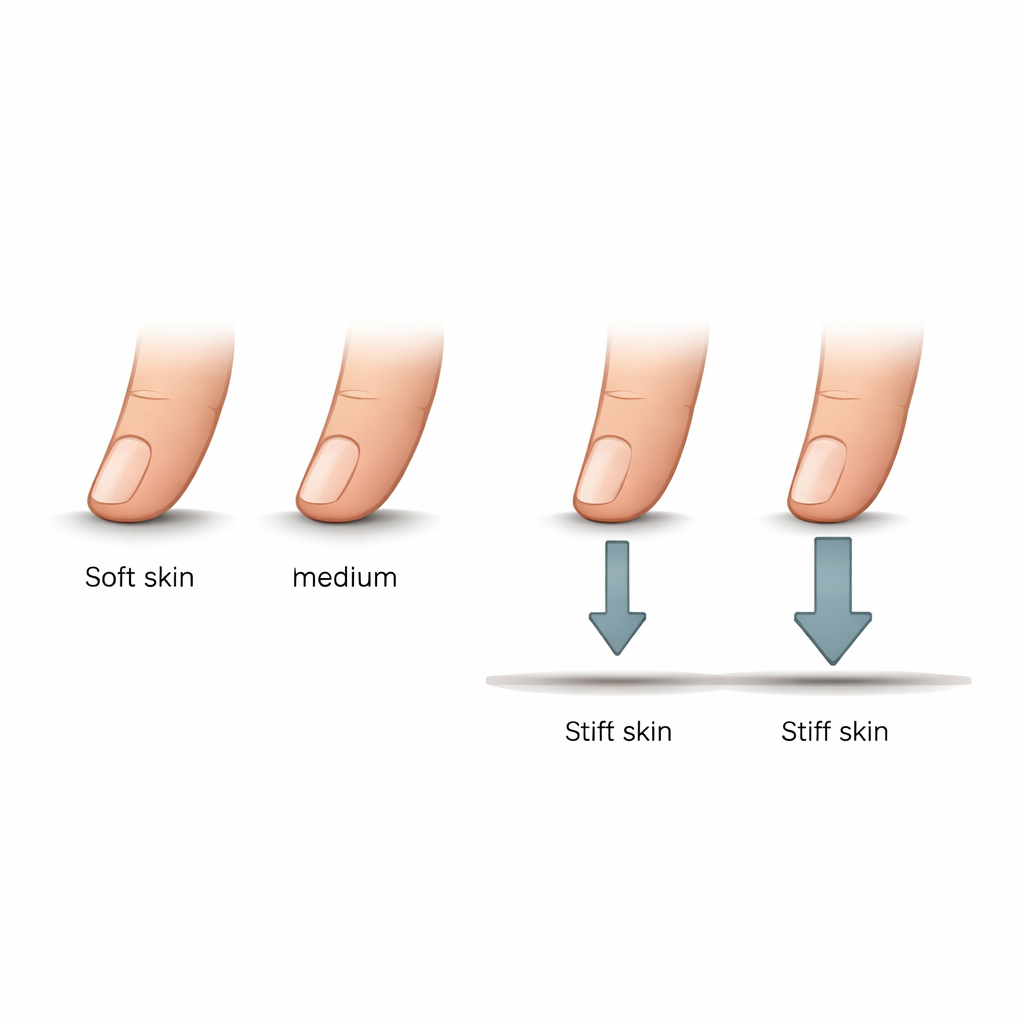
Different fingers, different natural touch
The researchers focused on what they call “natural touch” – the way people spontaneously stroke a smooth surface without being told to identify or compare anything. Past work has shown that people change their touch depending on what they are trying to feel, such as roughness or softness, and on surface features like friction. But here the team wanted to understand the built‑in, baseline differences between people: if you and a friend simply rub the same flat plate, why might you use very different forces even when you think you are “just touching normally”?
Measuring how soft or stiff a fingertip is
To probe this, they invited thirty young adults into the lab. Each person used their index finger to gently rub a smooth acrylic plate at a comfortable speed and angle, while a sensitive force sensor measured how hard they pressed straight down (the normal force) and sideways (related to friction). At the same time, a camera system, mirror, and side lighting captured the oval patch where finger and plate actually touched. In separate trials, participants pressed with several specified force levels so the team could see how the contact area grew with force. Using a standard contact‑mechanics model, they turned those measurements into an estimate of each person’s fingertip “stiffness,” expressed as an effective Young’s modulus – a way of saying how easily the skin deforms when pushed.
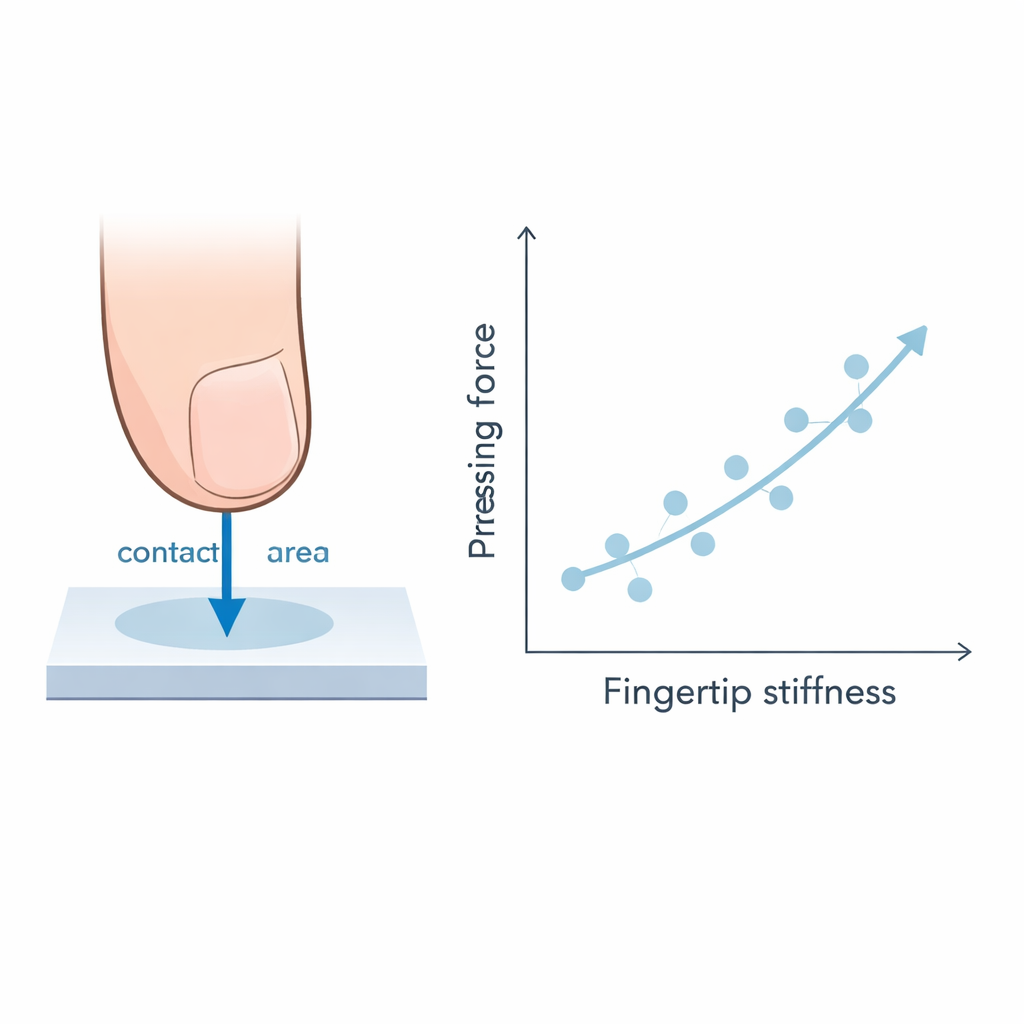
Stiffer skin, stronger push
The central finding was striking: people with stiffer fingertip skin consistently pressed harder during natural touch. Across participants, fingertip stiffness varied widely, much more than simple finger size did. When the researchers compared stiffness with the normal force used during casual stroking, they found a strong positive correlation. Softer fingertips tended to use smaller forces; stiffer fingertips tended to use larger ones. In contrast, the overall size or radius of the finger had no meaningful relationship with how hard people pressed. This points to the mechanical properties of the skin itself, rather than just geometry, as a key driver of individual touch style.
Contact area, friction, and what we might be sensing
The size of the contact patch between finger and surface also mattered. Participants who naturally used larger pressing forces showed larger absolute and relative contact areas, even though contact area did not simply track stiffness or finger size. This suggests that people may be using how “big” their touch feels against the surface as informal feedback to regulate force. When the team looked at friction – how much the finger resisted sliding – most people clustered around similar friction values, but a few outliers either had unusually high friction with low forces or the opposite. Importantly, gender did not explain the differences: men and women in this age range showed similar stiffness, forces, and friction in this setup.
What this means for everyday touch and future tech
In plain terms, the study shows that how hard you naturally press on smooth surfaces is closely tied to how stiff or soft your fingertip skin is, not to how big your finger is. This matters because the strength of touch shapes the tiny vibrations, deformations, and friction cues that your brain uses to judge texture and other properties. Designers of haptic devices, prosthetics, and touch‑based interfaces can use this insight to better tailor experiences to different users, for example by estimating or compensating for fingertip stiffness. And in basic science and medicine, fingertip stiffness may be an important hidden factor behind why some people seem more “sensitive” to touch than others, even when they appear to be touching in the same way.
Citation: Kurimoto, K., Fitch, E., Kappers, A.M.L. et al. Normal force in natural active touch correlates with fingertip stiffness. Sci Rep 16, 6333 (2026). https://doi.org/10.1038/s41598-026-37174-x
Keywords: tactile perception, fingertip stiffness, touch force, skin mechanics, haptics