Clear Sky Science · en
Physics-guided GNN-transformer model for multi-scale fatigue life prediction of concrete track slabs in high-speed railways
Why train tracks can get tired
High-speed trains glide smoothly over concrete slabs that quietly endure millions of passing wheels. Over years of service, this constant pounding can slowly weaken the concrete, just as repeated bending can break a paper clip. If engineers misjudge how long these slabs will last, the result could be costly over-maintenance—or, worse, safety risks. This study presents a new way to predict when those slabs might “get tired” and fail, using advanced artificial intelligence that is guided by real physics rather than being a mysterious black box.
Looking inside the concrete and under the trains
Concrete may look solid, but under a microscope it is full of pores, tiny cracks, and grains. These microscopic features control how damage starts and spreads when trains pass overhead. At the same time, trains do not load the track in a simple, regular way: speed changes, track irregularities, and other factors create a highly random pattern of forces. Traditional prediction methods either ignore the fine details of the concrete or oversimplify the loading history, which makes them less reliable for modern high-speed rail lines. The authors argue that an accurate and trustworthy model must consider both the internal “weak spots” of the material and the messy, real-world loading it experiences.
Turning pictures and vibrations into numbers
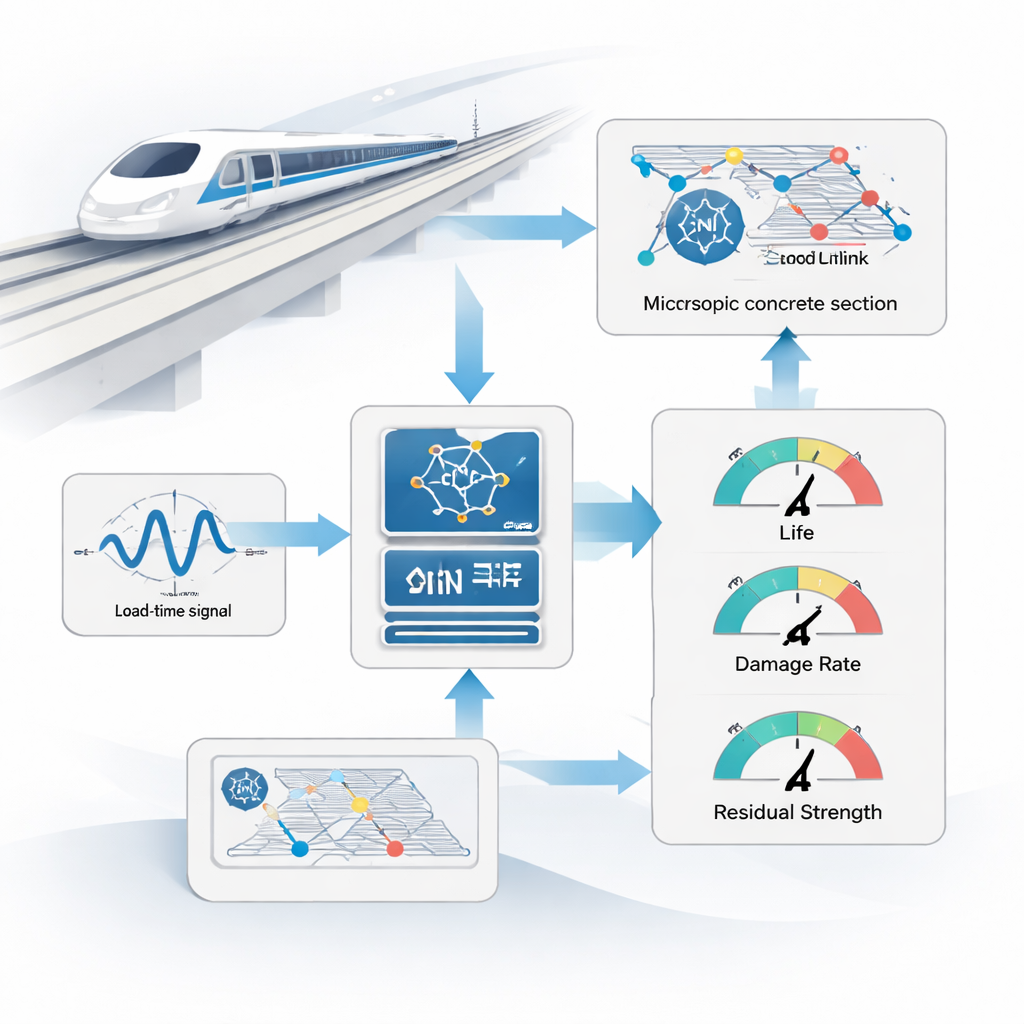
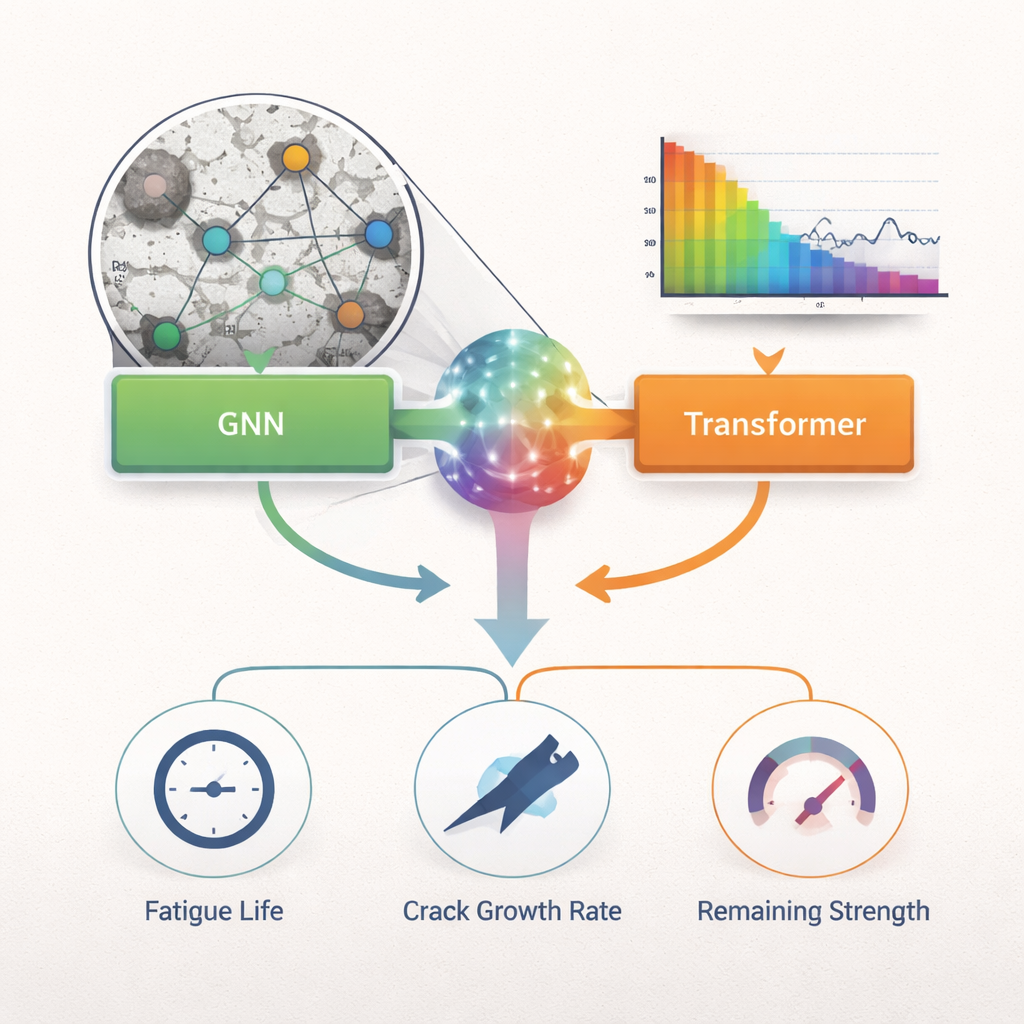
To capture the internal structure of the concrete, the researchers start from high-quality microscopic images of concrete samples at different stages of fatigue damage. They automatically segment these images, identify key features such as pores and grain boundaries, and turn them into a network, or graph, in which each pore or defect is a “node” and nearby features are connected by “edges.” A type of neural network designed for such graphs then learns how this web of weak points is arranged and how it might guide crack growth. In parallel, the team uses a detailed computer model of train–track interaction to generate realistic stress histories—essentially the push-and-pull forces over time as trains run at typical speeds. These complex, irregular signals are cleaned, standardized, and fed into a second neural network that specializes in recognizing patterns in time series.
Blending two views into one fatigue forecast
The heart of the approach is to fuse these two streams of information: the micro-level map of the concrete and the macro-level record of train loading. The graph-based network distills the internal structure into a compact numerical fingerprint, while the time-series network extracts the most important patterns from the random loading history. These fingerprints are then combined and passed through a shared core model that feeds three output branches. Instead of predicting just a single number, the system estimates the total fatigue life (how many load cycles until failure), the rate at which damage grows, and the remaining strength of the concrete at a given stage. This multi-output design reflects what engineers actually care about: not only “when will it break?” but also “how fast is it degrading?” and “how much strength is left now?”
Testing performance and speed
The authors rigorously train and test their model on standardized datasets, using common measures of accuracy. Their physics-guided system consistently beats several advanced comparison models that use only time-series or only structural information, or that do not combine tasks. The new model fits the data well and keeps prediction errors relatively low, indicating it can explain most of the variation in fatigue behavior. Just as importantly for real-world monitoring systems, it makes each prediction in under a second on modern hardware while using less than half of the available graphics-processor capacity. This balance of accuracy and efficiency suggests that the model can be integrated into online health-monitoring platforms for rail infrastructure.
What this means for safer railways
In everyday terms, the study shows that it is possible to build an AI “early warning” tool for concrete track slabs that does not just guess from past data but is grounded in how cracks really form and grow. By combining what happens inside the concrete with what the trains are actually doing on top, the model can give more trustworthy estimates of service life and remaining strength. That, in turn, can help rail operators schedule maintenance before damage becomes critical, avoid unnecessary replacements, and manage large networks more safely and economically. Although further testing with field data is still needed, this physics-guided approach points toward smarter, more transparent digital twins for key pieces of infrastructure.
Citation: Su, X., Lou, P. & Zha, Z. Physics-guided GNN-transformer model for multi-scale fatigue life prediction of concrete track slabs in high-speed railways. Sci Rep 16, 6755 (2026). https://doi.org/10.1038/s41598-026-37173-y
Keywords: high-speed railway, concrete fatigue, structural health monitoring, graph neural networks, predictive maintenance