Clear Sky Science · en
Distance-amplified power-law distributions better characterize human long-distance travel
Why How We Travel Far Matters
When people take long trips—by train, car, or plane—they help connect cities, economies, and families. But those same journeys can also carry viruses across a country in just days. This study asks a deceptively simple question: how long are our long trips, really, and do they follow the patterns scientists have long assumed? The answer turns out to be no, and that has big consequences for how we forecast disease spread and plan transport systems. 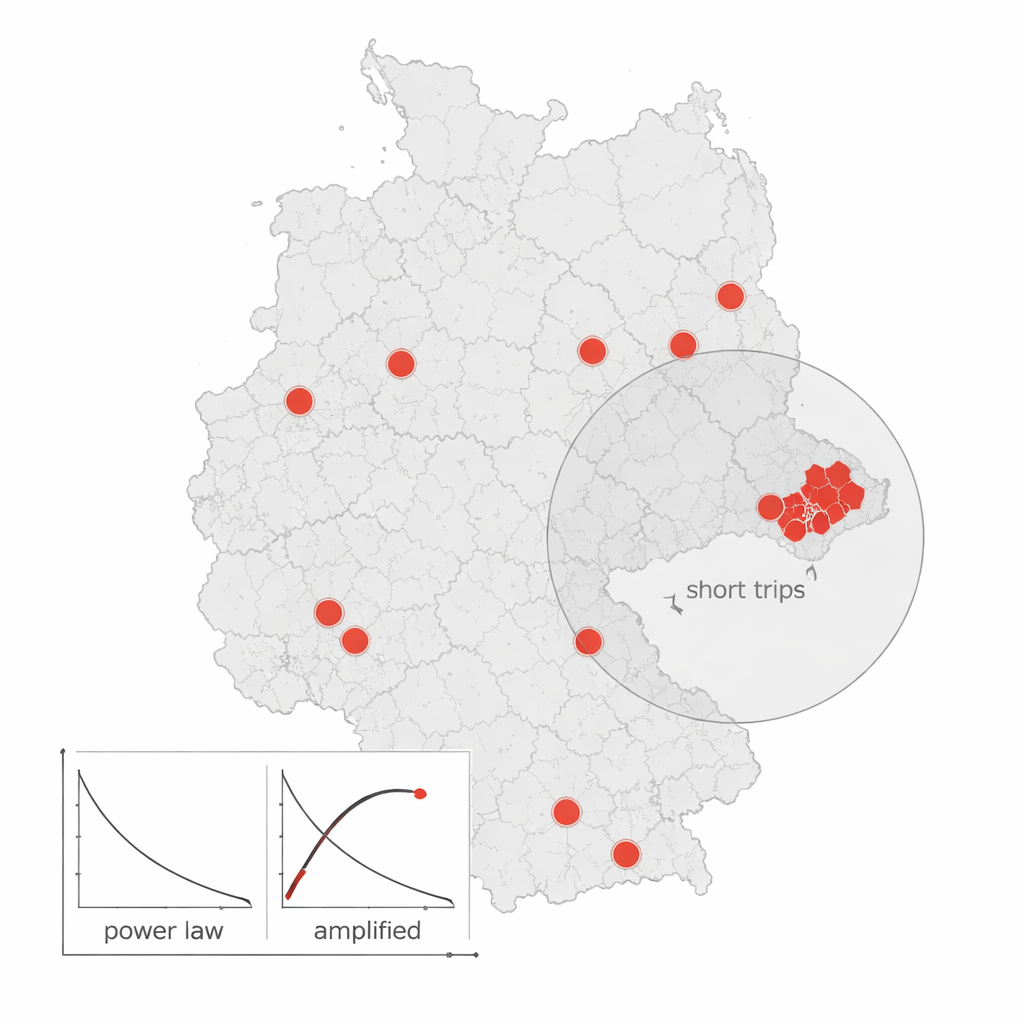
Old Rules For Movement Fall Short
For years, researchers have used a simple mathematical rule, called a power law, to describe how far people move. In this picture, short trips are very common and very long trips are rare, but they follow a smooth pattern on a log–log graph. That rule works reasonably well for everyday travel such as walking, biking, or taking a local bus. Using huge national surveys from Germany and the United States, the authors confirm that short and medium-length trips really do line up with this classic picture. But when they turn to journeys of hundreds of kilometers—the kind most likely to move a virus between regions—the mathematical pattern suddenly bends away from what the power law predicts.
Evidence From Millions Of Real Trips
The team combines three large data sources: detailed travel diaries from nearly two million reported trips in Germany and the U.S., plus over one million journeys inferred from mobile phone connections in the U.K. For each country, they focus on trips of at least 100 kilometers (or 300 kilometers in the larger U.S.). When they plot these long-distance trips, the straight-line signature of a power law disappears. Instead, there are more far-flung journeys than expected, and the curve changes shape at certain distances, such as around 200–300 kilometers in the U.K. data. This is not just a statistical quirk: similar “too-long” jumps show up when the authors look at how COVID-19 spread across German counties in mid-2021. New hotspots appear suddenly in distant regions, rather than radiating smoothly outward from earlier outbreak areas, contradicting what the traditional model would suggest.
A New Way To Think About Long Trips
To explain this behavior, the authors propose a new model they call a distance-amplified power-law distribution. The idea is intuitive: once someone commits to traveling a substantial distance—say, to reach a major train station or airport—they are more likely to keep going much farther. Mathematically, the model starts with a standard power-law distance, then repeatedly “amplifies” it by a fixed factor with some probability, like multiplying the distance by C, then by C again, and so on. This process naturally produces clusters of trips around certain distance bands and a heavier tail, meaning extra-long journeys are more common than classic theory suggests. The authors also add a realistic cap for each trip based on country size, mimicking the fact that most journeys begin and end within national borders. 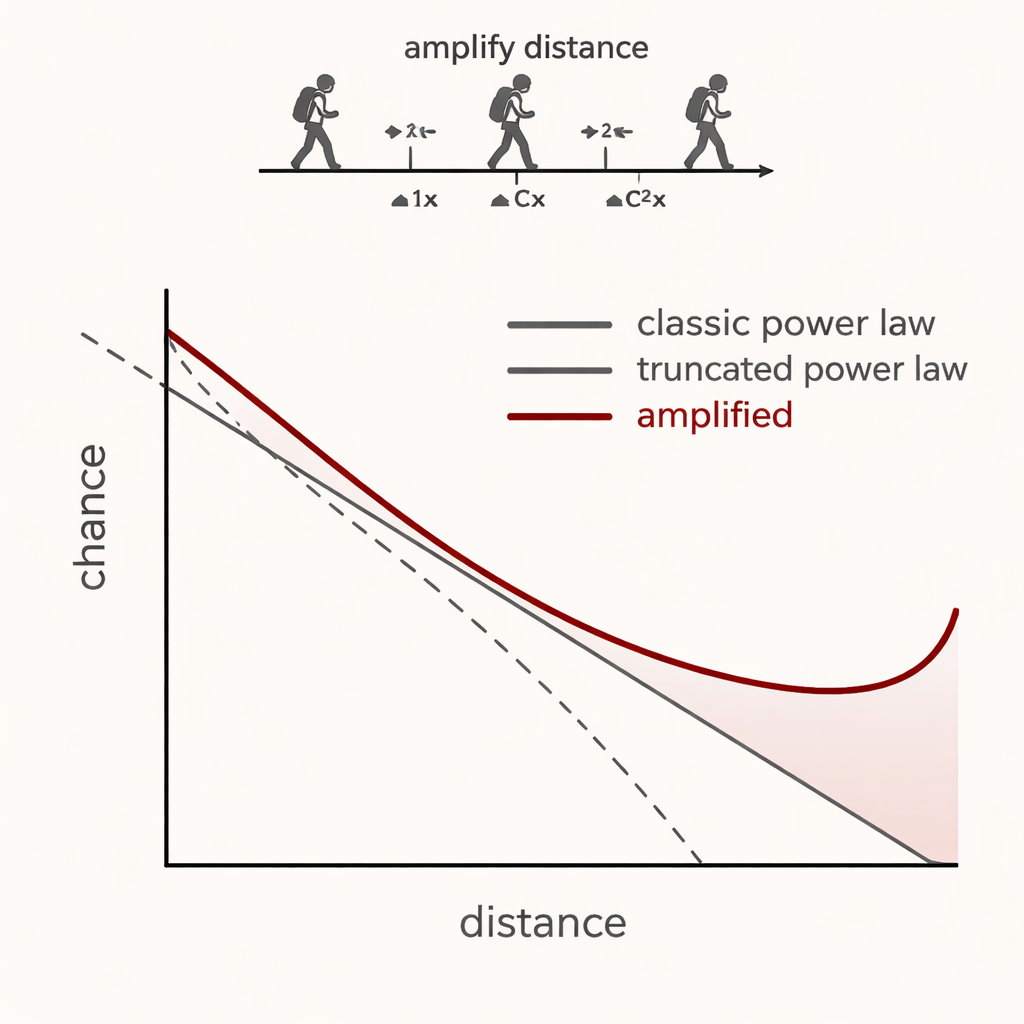
Putting The New Model To The Test
The researchers compare three approaches: a power law with a simple exponential cutoff, a power law with their new border-aware truncation, and the full distance-amplified model. They simulate tens of thousands of trips from each model and measure how closely the resulting distributions match real data across hundreds of distance points. Although both improved power-law variants do better than the basic model, they still miss key features, especially the extra density of trips at particular long distances. The distance-amplified model consistently fits best for all three countries, cutting the error well below that of competing models. Alternative, non–power-law families such as gamma, exponential, log-normal, and beta distributions were also tested but failed to capture the heavy tails and characteristic bends in the data.
What This Means For Everyday Life
In plain terms, this work shows that people take truly long trips more often—and in more structured ways—than our old formulas recognized. That matters because long journeys are exactly the ones that can leapfrog infections, redistribute pollution, and reshape regional economies. By providing a simple yet more accurate mathematical description of such travel, the distance-amplified model can improve how we simulate future epidemics, plan rail and air networks, and estimate emissions from mobility. Rather than treating all movement as scaled-up versions of local errands, this study argues that long-distance travel is a different beast, driven by decisions and constraints that call for their own dedicated model.
Citation: Bankhamer, G., Liu, H., Park, S. et al. Distance-amplified power-law distributions better characterize human long-distance travel. Sci Rep 16, 4331 (2026). https://doi.org/10.1038/s41598-026-37165-y
Keywords: human mobility, long-distance travel, epidemic spread, mobility modeling, COVID-19