Clear Sky Science · en
Dirac bound states in the continuum in honeycomb photonic crystal slabs
Light Trapped in Plain Sight
Most of the time, light that can freely propagate simply escapes a structure, just as sound leaks out of an open window. This paper explores a striking exception: specially designed patterns of tiny holes in a thin plastic film that can trap light even though, by all accounts, it should be able to leave. Understanding and controlling this "hidden" light could lead to sharper sensors, more efficient lasers, and compact optical components for future communication and computing technologies.
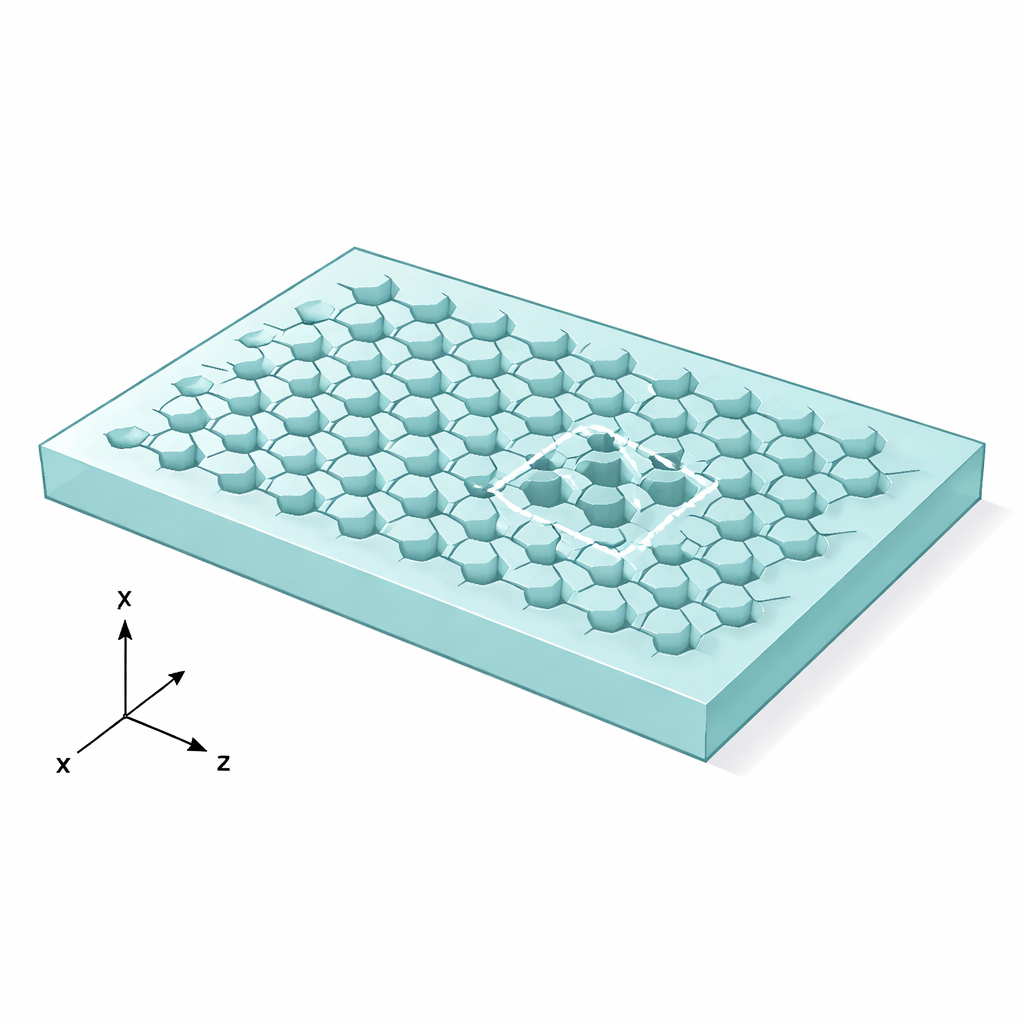
A Flat Crystal Made of Tiny Triangles
The researchers study a flat photonic crystal slab—essentially a transparent sheet of poly(methyl methacrylate), a common plastic, perforated with a very regular pattern of equilateral triangular holes. These holes are grouped in hexagonal clusters arranged on a honeycomb grid, giving the structure a high degree of rotational and mirror symmetry. When the distance from the center of each cluster to the triangular holes is exactly one third of the overall lattice spacing, the pattern can be viewed in two equivalent ways: as a honeycomb lattice or as a triangular lattice. This special, self-dual geometry turns out to be the key that forces unusual light-trapping behavior to appear.
Where Bands Meet: Double Cones of Light
In periodic structures like this slab, light does not travel in arbitrary ways; instead, it occupies allowed bands, somewhat like electrons in a solid. The team calculates how these bands depend on the direction and wavelength of light. At the special geometric setting where the cluster radius equals one third of the lattice spacing, they find that four of the lowest bands meet at a single point at the center of the crystal’s momentum space. Around that point the bands form two cones that touch tip to tip, known as a double Dirac cone. Because of the crystal symmetries, these cones are not easily disturbed: small changes in thickness or hole size keep the basic shape while slightly shifting the overall frequency.
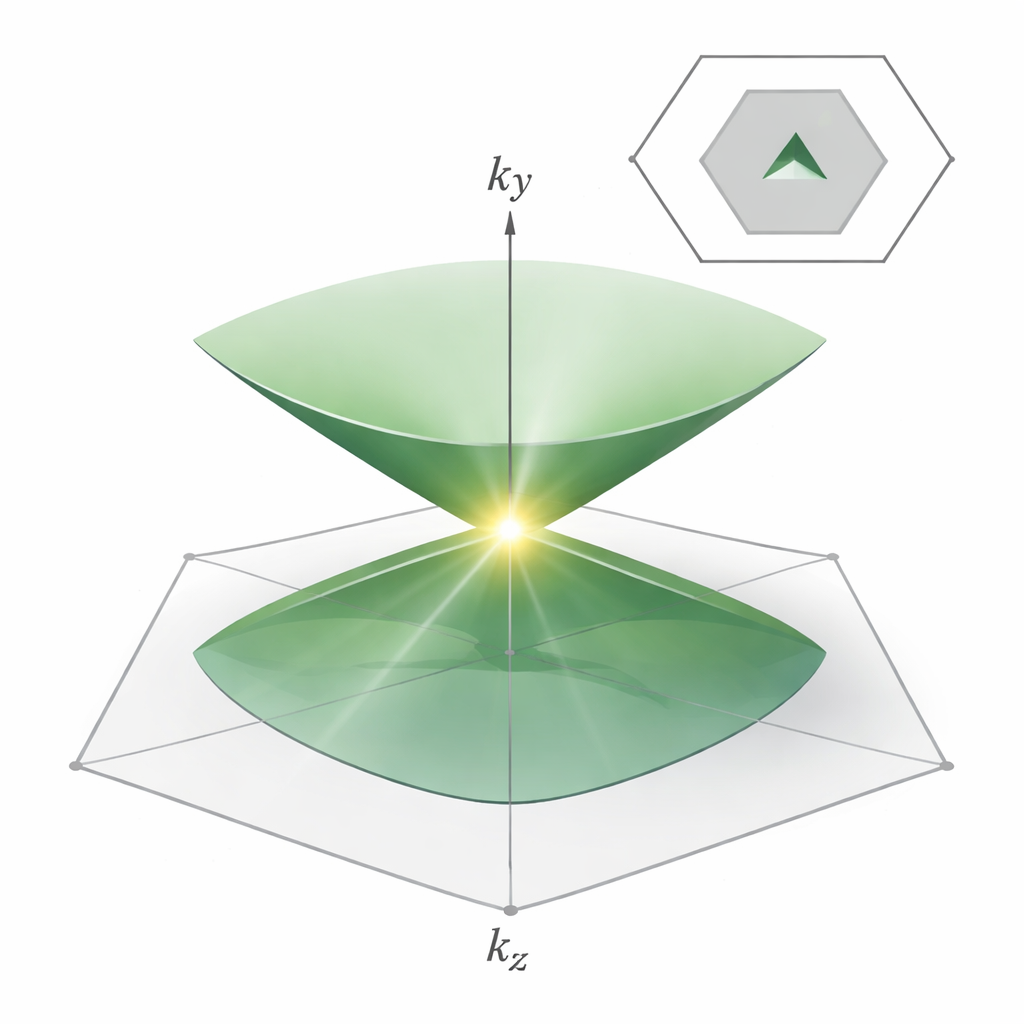
Bound States Hiding in the Continuum
Normally, modes that sit in the same frequency range as freely propagating light can radiate out and lose energy. Here, the authors identify two special modes exactly at the double Dirac point that do not radiate at all, despite existing in this "continuum" of available escape routes. These are bound states in the continuum (BICs). Their field patterns look like four-lobed whirlpools in the electric field, which prevents efficient coupling to simple outgoing waves. As a result, their quality factors—measures of how long they store energy—are predicted to exceed ten billion. The BICs are also topological objects: as one moves around the special point in momentum space, the polarization of the outgoing light (if it existed) would rotate twice around, giving each mode an integer winding number that helps protect it against disturbances.
Dialing the Geometry to Move and Transform the Traps
The authors then explore what happens when they gently tune the pattern away from the ideal setting. Changing the relative position of the triangles breaks the exact four-fold meeting of bands and opens a small gap between them. The double Dirac cones disappear, but new symmetry-protected BICs appear either on the upper pair of bands or the lower pair, depending on the direction of the change, and still exhibit extremely high quality factors. By deliberately shrinking three of the six triangles in each cluster, they further break the symmetry of the pattern. This converts the original high-order vortex-like traps into lower-order ones and simultaneously creates six nearby points with circular polarization. Together, these new features preserve the overall topological "charge," illustrating how the trapped states can split and rearrange without vanishing outright.
Why These Exotic States Matter
To a non-specialist, the main message is that the authors show how a carefully engineered pattern of nanoscale holes in a thin plastic film can host light that is both extremely confined and extremely long-lived, right inside the range where it should easily radiate away. By linking this behavior to clear geometric and symmetry conditions, and to robust topological properties, the work provides a practical recipe for creating ultra-narrow optical resonances. Such resonances are promising ingredients for low-threshold lasers, high-sensitivity detectors, and compact devices that manipulate light with great precision on a chip.
Citation: Chern, RL., Kao, YC. & Hwang, R.R. Dirac bound states in the continuum in honeycomb photonic crystal slabs. Sci Rep 16, 6401 (2026). https://doi.org/10.1038/s41598-026-37156-z
Keywords: photonic crystal slabs, bound states in the continuum, Dirac cones, topological photonics, nanophotonics