Clear Sky Science · en
Effective control and probe of Néel order in polycrystalline NiO films: a combined approach to study antiferromagnets
Why invisible magnets matter
From high‑speed computers to energy‑efficient memory, tomorrow’s electronics increasingly rely on the spin of electrons rather than their charge alone. Antiferromagnets – materials whose internal magnetism cancels out – are especially attractive because they can switch extremely fast and do not interfere with neighboring devices. But precisely because their magnetism is hidden, they are notoriously hard to control and even harder to detect. This study shows a practical way to both “set” and “read” the magnetic state of common antiferromagnetic thin films, clearing a major hurdle for real‑world spintronic technologies.
Hidden order in calm‑looking materials
In everyday magnets, tiny atomic magnets (spins) line up in the same direction, giving a net magnetic field that compasses and sensors can see. In antiferromagnets like nickel oxide (NiO), neighboring spins point in opposite directions, so the overall field cancels out. The pattern of these opposing spins – called the Néel order – still stores information, but ordinary magnetometers barely notice it. Many advanced schemes to control Néel order rely on carefully grown single crystals or complex stacks of materials, which are hard to scale up for manufacturing. Polycrystalline films, made of many tiny randomly oriented grains, are much easier and cheaper to produce, but their disordered internal structure has made their spin patterns difficult to steer in a reproducible way.
Using electrical resistance as a spin detector
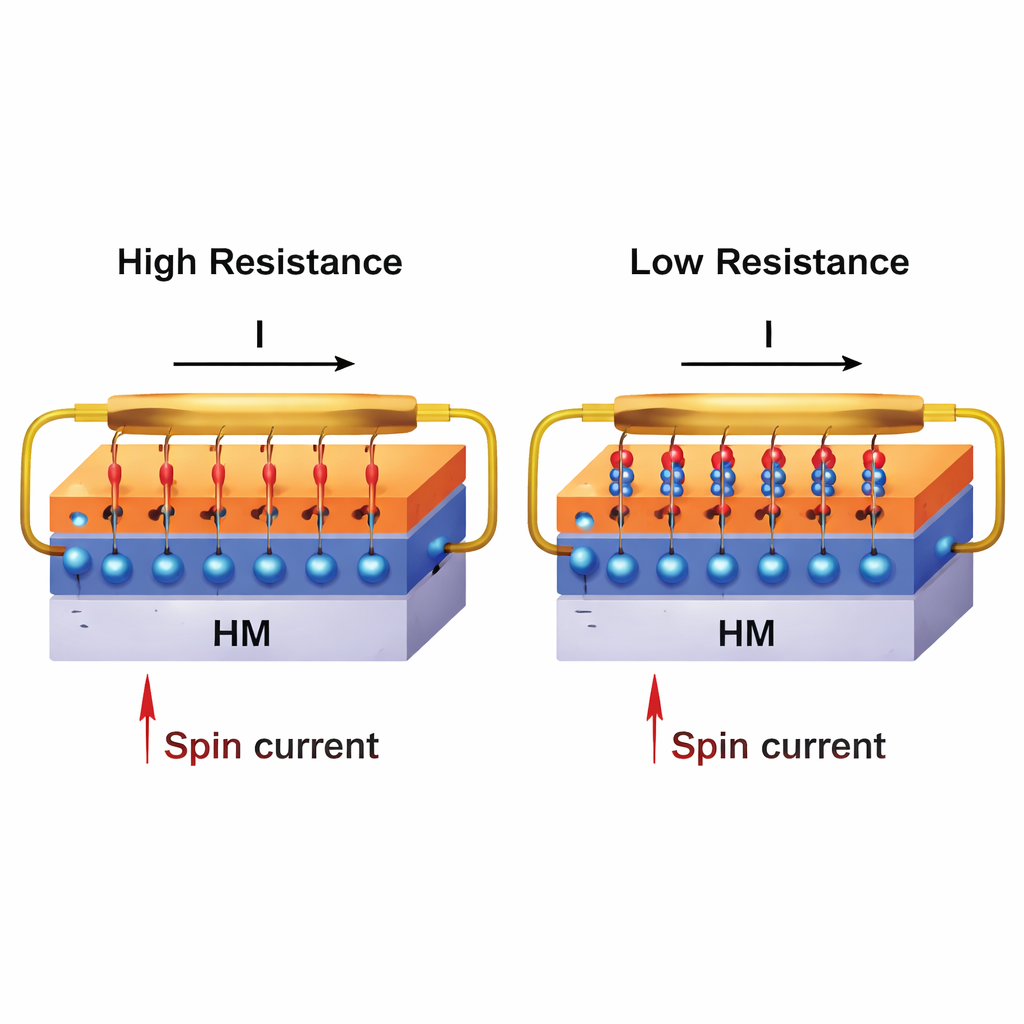
The authors exploit a subtle effect known as spin Hall magnetoresistance (SHMR) to turn ordinary electrical measurements into a sensitive probe of antiferromagnetic order. They place a thin heavy metal such as platinum (Pt) under an antiferromagnetic film. When an electric current runs through Pt, it generates a flow of spins that interacts with the spins in the adjacent layer. Depending on how the Néel order is oriented relative to the current, more or fewer of these spins are absorbed, slightly changing the resistance of the Pt. By measuring resistance with a magnetic field applied either along or across the current path, the team can deduce how the hidden spins are arranged. Tests on a well‑known ferromagnetic system first confirm the expected behavior, then the same method is applied to NiO/Pt and LaNiO₃/Pt bilayers to reveal their antiferromagnetic signatures.
Shaping spin order while cooling
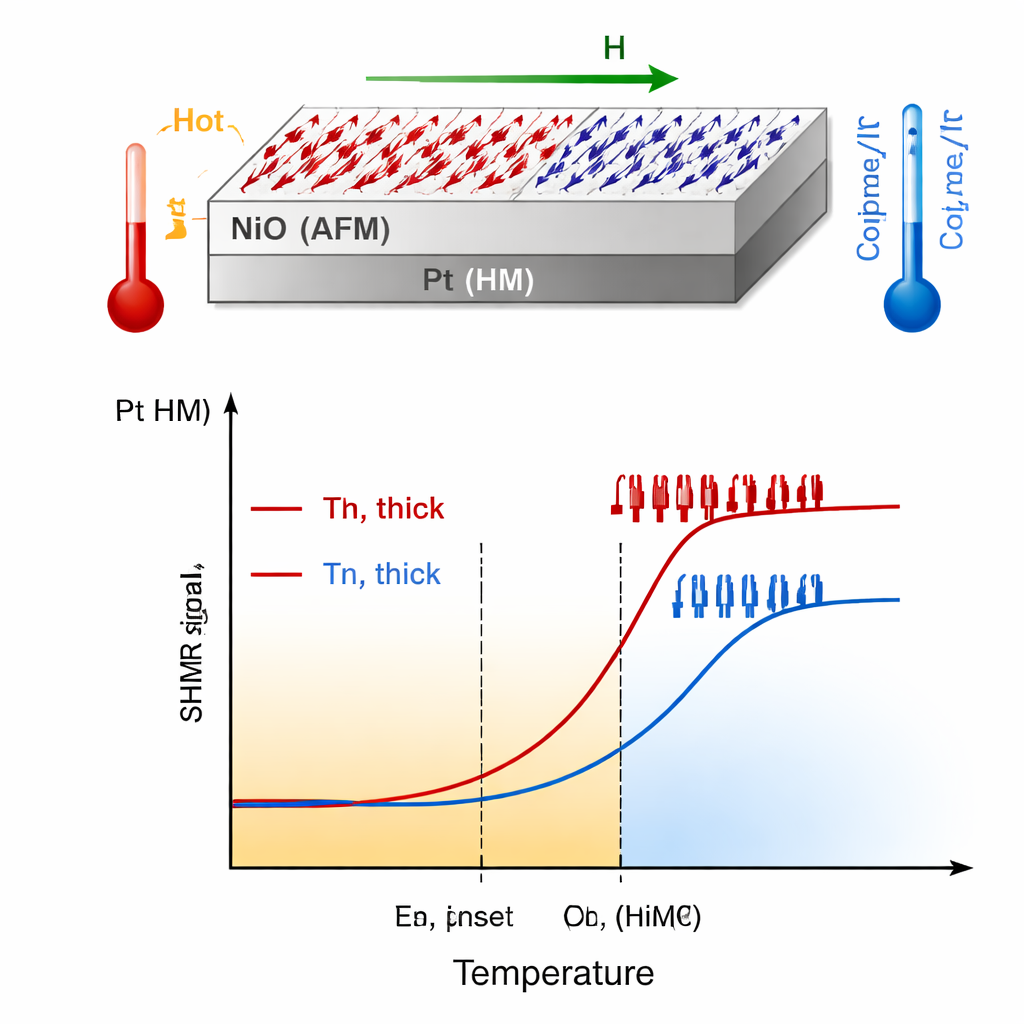
The key innovation is to combine this electrical readout with a simple “field‑cooling” step. The researchers heat the sample above the temperature where magnetic order disappears, then cool it down while applying a steady magnetic field. In NiO, this process encourages spins in different grains to adopt a common orientation that lies perpendicular to the field – a phenomenon related to the so‑called spin‑flop effect. As the sample cools, a clear SHMR signal appears, whose strength depends on both NiO thickness and field strength. Ultra‑thin NiO layers show a sharp onset of this signal at lower temperatures than thicker films, directly revealing how the ordering temperature drops as the film gets thinner. Importantly, once set in this way, the aligned Néel order remains stable even after the field is removed, providing a non‑volatile form of magnetic memory without continuous power or currents.
Revealing subtle magnetism in a “non‑magnetic” metal
To test how broadly this approach can be used, the team turns to LaNiO₃, a metallic oxide often considered magnetically inactive in bulk form. In ultrathin films grown under strain, however, hints of weak antiferromagnetic behavior have been reported but remain difficult to confirm with standard techniques. By applying the same SHMR plus field‑cooling protocol to LaNiO₃/Pt devices, the authors detect a small but distinct change in resistance emerging below about 100 kelvin, with a pattern matching that of an antiferromagnet. This shows that the method is sensitive enough to pick up even tiny volumes of ordered spins that escape more traditional probes, and that it can be extended beyond classic insulators like NiO to more complex metallic oxides.
What this means for future spin electronics
In plain terms, the study introduces a practical recipe for both programming and reading the magnetic state of antiferromagnetic films made with industry‑friendly methods. By cooling under a magnetic field, engineers can imprint a preferred spin pattern into polycrystalline NiO that persists at room temperature, and they can verify that pattern using straightforward resistance measurements. Because this control does not require special spin‑current‑generating layers or intricate stacks, it promises simpler, more scalable designs for antiferromagnetic memory, logic, and sensing devices. The work establishes field‑cooling plus SHMR as a versatile toolbox for exploring and exploiting “invisible” magnetism in a wide range of materials.
Citation: Hsu, CC., Lin, YC., Cheng, IY. et al. Effective control and probe of Néel order in polycrystalline NiO films: a combined approach to study antiferromagnets. Sci Rep 16, 6079 (2026). https://doi.org/10.1038/s41598-026-37152-3
Keywords: antiferromagnetic spintronics, nickel oxide thin films, spin Hall magnetoresistance, field cooling control, Néel order